
COREDO – EU Legal & Compliance Services Expert legal consulting, financial licensing (EMI, PSP, CASP under MiCA), and AML/CFT compliance across the European Union. Headquartered in Prague, we provide seamless regulatory solutions in Germany, Poland, Lithuania, and all 27 EU member states.

Pavel Kos
15.03.2026 | 6 min read
Updated: 15.03.2026
I have been leading COREDO since 2016 and have seen how quickly the environment around crypto assets, payments and cross-border structures is changing. Entrepreneurs come to me with the same questions: how to work safely and legally with private transactions, how to obtain financial licenses, how to build an AML program that will withstand regulator scrutiny and a bank audit, without destroying the economics of the business. The COREDO team has implemented dozens of projects in the EU, the UK, Singapore and Dubai, helped clients register legal entities, obtain licensing and establish sustainable compliance. In this article I will gather practices that actually work and honestly point out the pitfalls.
Privacy and AML in Crypto Business

The crypto market is maturing, and with it the regulators’ expectations and banks. Mixing risks in cryptocurrencies, migration of funds through cross-chain bridges, the use of DEXs — all of this increases the likelihood of account freezes, investigations, and refusals of banking services. Businesses lose weeks explaining the origin of funds and handling SAR/STR follow-ups, and sometimes months restoring accounts because of a single transaction flagged as mixing.
I see clients seeking privacy: protection of trade secrets, reducing the risk of client deanonymization, protection from competitive intelligence. But privacy tools and AML often conflict. My task as a consultant is to resolve this contradiction and turn privacy into a manageable risk with a clear compliance position on mixing that is understandable to the compliance policies of banks and regulators. The solution developed at COREDO is based on a risk-oriented approach, transparent documentation, and technological traceability of transactions where needed.
Financial Action Task Force, 5th and 6th Anti‑Money Laundering Directives, Markets in Crypto‑Assets, European Banking Authority, General Data Protection Regulation, Electronic Identification, Authentication and Trust Services Regulation
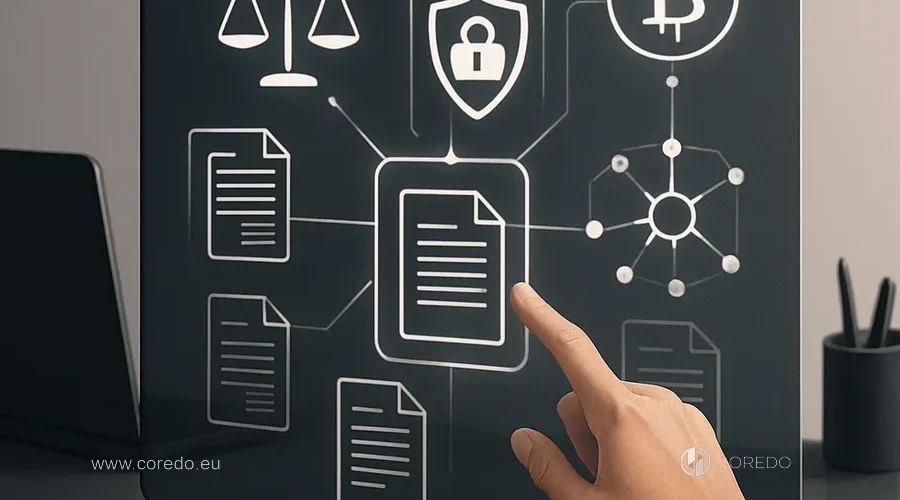
Effective functioning of digital asset markets and their participants relies on agreed standards and regulations such as FATF, AMLD5/AMLD6, MiCA, EBA, GDPR and eIDAS. In the following sections we will examine in more detail the key recommendations and requirements, starting with the FATF guidance on virtual assets and VASPs and their impact on compliance and market participants’ practices.
FATF on VASPs and virtual assets
FATF set basic principles for VASPs: customer identification, transaction monitoring, and the travel rule for data transmission between providers. FATF recommendations on virtual assets explicitly point to an increased risk from mixing and privacy tools, require KYT — know your transaction — and enhanced Due Diligence for high-risk clients. COREDO’s practice confirms: if you document your position on mixing and can explain how you control chain hops and timing delays in transactions, banks and regulators will perceive you as a predictable partner.
AMLD5/6 and UBO registries for crypto exchange operators
AMLD5/AMLD6 in the EU enshrined the registration of exchange providers and custodial wallets, expanded the list of predicate offenses and added liability for facilitating money laundering. For clients, this means mandatory KYC procedures/KYB, beneficial ownership and disclosure in the UBO registry, as well as sanctions for non-compliance. The COREDO team implements EDD methodologies for complex structures involving SPVs in Cyprus, licensed companies in Estonia, or payment providers in Slovakia, and brings documentation to a standard that withstands regulatory audits.
Practical MiCA changes for the EU
MiCA clarifies requirements for token issuers and service providers, strengthening requirements on risk management, capital and consumer protection. I advise clients planning to register a legal entity in the EU for crypto to budget and schedule the preparation of market policies, disclosures and technological reporting in advance. Our team builds process architecture so that KYT, suspicious transaction reporting and chain analysis are integrated into business flows rather than hindering them.
GDPR, DPIA: AML and privacy
GDPR does not cancel AML, but requires a legal basis, data minimization and controlled cross-border transfers. I always initiate a data protection impact assessment (DPIA) for AML processes and check GDPR and AML compatibility regarding privacy: where we store logs, how we anonymize samples for analytics, and how we set up SLAs with analytics providers. In COREDO projects we have configured selective disclosure and verifiable credentials to provide banks and partners only the necessary KYC attributes without excessive sharing of personal data.
Mixing and privacy tools

The use of Mixing and other privacy tools poses a challenge for businesses and regulators to balance the right to privacy with the need to prevent financial crimes. Below we will examine the compliance position regarding mixers and tumblers, their legal classification and the key regulatory approaches in the EU.
Qualification of mixers and tumblers in the EU
Mixers and tumblers are not prohibited per se in most EU jurisdictions, but regulators classify them as high-risk activities. Regulation of mixing in the EU is shifting from abstract bans to an assessment of intent and economic substance. I form a compliance position on mixing as follows: I describe categories of mixers (custodial/non-custodial), set thresholds for blocking, controls over the movement of funds through tumblers, and document the actions of the financial monitoring officer. Such a document has saved our clients in the Czech Republic and Estonia during inspections.
CoinJoin and CoinSwap: control of funds
CoinJoin and CoinSwap complicate transaction chain analysis, but do not make it impossible. Blockchain analytics tools for compliance use address clustering and heuristics based on timing, structure and wallet fingerprinting. I configure rules: if the KYT model sees participation in a CoinJoin, we freeze activity until confirmation of the source of funds; if we see repeated chain hops, fragmentation (transaction structuring and smurfing), we enable EDD and an expanded justification of economic rationale.
Monero and Zcash – legal risks and KYC
Privacy coins Monero and Zcash affect compliance differently. Zcash allows transparent addresses and selective disclosure via viewing keys; Monero is private by default. Our experience at COREDO has shown: if a business objectively needs privacy coins, we introduce separate acceptance thresholds, require confirmation of the source of funds from off-chain sources, and pre-agree this with the bank.
The legal risks of using privacy coins are manageable if you document the context and implement reporting and documentation for regulators.
Risks of Tor/VPN, DEX, cross-chain bridges
The risks of using Tor and VPN in business concern not only anonymity but also geo-sanctions. I recommend documenting an IP and geolocation policy to reduce the likelihood of breaching sanctions regimes. DEXs and the risk of circumventing AML controls manifest in the absence of a counterparty VASP and the travel rule; migration of funds via cross-chain bridges carries the risk of data leakage, bridge attacks and the inability to unambiguously trace chains. In COREDO projects we flag KYT on cross-chain events, check protocol risks and manually validate large cross-network transfers.
Compliance in private transactions

For reliable compliance when using private transactions you need a clear risk assessment methodology that takes into account both the technical specifics of protocols and behavioral and legal factors. In the next section we will examine the practical implementation, a risk-oriented model and a score-based rating that allow ranking clients and operations by priority of control measures.
Risk-oriented model and scoring
I build a score-based risk rating model that considers: asset type, use of privacy tools, client jurisdiction, address behavior, frequency of chain hops, as well as links to sanction lists SDN/OFAC and EU sanctions registers. The model assigns scores to transactions and entities, triggers EDD levels and determines when a SAR/STR is required. This approach provides proportionality of measures for SMEs and corporations and helps explain the control logic to banks.
KYT and chain analysis: clustering
KYT is the basis of operational control. The COREDO team applies chain transaction analysis (chain tracing), address clustering and input/output heuristics, time window analysis and UTXO behavior. Wallet fingerprinting methods help distinguish a client’s own wallets from third-party addresses and record cluster connectivity. I always complement on-chain signals with off-chain data: user behavior, authorization logs, payment metadata, to reduce false positives and speed up investigations.
Monitoring mixing and anomalies: rule + ML
ML for detecting anomalies in transactions strengthens the rules. I build a hybrid: static rules for mixing and privacy tools plus models that capture atypical volumes, delays, and chains with multiple hops. We set up a feedback loop from analysts to the models, optimize thresholds and reduce false positives without losing sensitivity. Scaling compliance as transactions grow requires sharding of streams, event queues and stress-testing of alert emitters.
KYC/KYB/SoF/SoW/PEP/sanctions screening
I build KYC/KYB on the principle “minimum to start, maximum as risk increases”. For clients using private transactions I request in advance source of funds and source of wealth with verification via bank statements, contracts, tax documents and beneficial ownership checks. PEP screening and sanctions screening rely on global lists, including OFAC SDN and EU sanctions registers. Enhanced due diligence for high-risk clients includes interviews, confirmation of wallet addresses and checks of affiliated parties.
AML Architecture and privacy-by-design

The architecture of an AML program should incorporate privacy-by-design principles when organizing wallet storage and audit so that data remains protected while still accessible for checks. This approach increases forensic readiness and speeds up response to suspicious transactions without compromising privacy.
Wallet storage and auditing
A secure wallet storage and audit policy is as important as monitoring. I require segregation of hot/warm/cold, multisig or MPC, access logs and regular independent audits. Forensic readiness includes retaining logs, analytics checkpoints, wallet snapshots and procedures for re-running chain analysis so you can respond to a regulator’s requests a year later. Such readiness reduces response time to SAR/STR and lowers operational losses.
Suspicious Activity Report/Suspicious Transaction Report: banks, regulators, Mutual Legal Assistance Treaty
SAR and suspicious transaction reporting is a process with deadlines and clear roles. I record triggers, escalation timelines and the narrative format. I set up interaction with banks on privacy issues in advance: a common glossary, a whitepaper on mixing policy, and contact points. In cross-border cases law enforcement and MLAT requests often get involved; I prepare an early legal position and a data-disclosure matrix to protect client confidentiality within the law.
Privacy-enhancing technologies: zero-knowledge succinct non-interactive arguments of knowledge (zk-SNARKs), multi-party computation (MPC), self-sovereign identity / verifiable credentials (SSI/VC)
Privacy-enhancing technologies (PETs) already help compliance. Zk-SNARKs provide selective disclosure of facts without revealing underlying data; MPC supports distributed signing and verification without a single point of failure; homomorphic encryption allows analysis of aggregates without decryption. Differential privacy reduces the risk of deanonymization in reports. I have implemented SSI (self-sovereign identity) and verifiable credentials with eIDAS-compatible identifiers so clients share verified attributes rather than raw documents.
GDPR and data sharing in AML processes
GDPR requires discipline: document the legal basis for AML, limit retention, conduct a DPIA, and put in place DPA/SCC for cross-border transfers. Data localization in certain countries is paired with centralized monitoring via anonymization and pseudonymization. I seek a compromise between analytics speed and privacy-by-design so that the regulator does not deem measures excessive and the business does not lose manageability.
Risk management and scaling
Managing operational risks when scaling requires revisiting processes and balancing growth velocity with operational stability. A key decision will be choosing between automation and manual review and applying a proportional approach for SMEs and corporations, from simple checklists to complex automated systems.
Proportionality for SMEs and corporations
I do not automate everything indiscriminately. Manual review of cases with a high risk of transaction mixing provides accuracy and trains the model. SMEs receive lightweight playbooks and ready-made rulesets, corporations – a pipeline with prioritization and SLA. This division of resources focuses officers’ attention where the cost of error is highest.
Scalability of monitoring and BCP
I achieve scalability of transaction monitoring through streaming architecture, independent alert queues, and degradation control. A business continuity plan (BCP) for compliance covers failure of the analytics platform, loss of the KYT provider, and spikes of alerts during market events. I run exercises at least once a year and record MTTR for recovery.
Outsourcing AML: SLA and third-party risks
Outsourcing AML and corporate responsibility go hand in hand. I put in place SLA with metrics for TAT, investigation quality, and data protection, and I also manage vendor risk (third-party risk): due diligence of privacy and analytics providers, backup channels, independent audits. Such a framework reduces concentration risk and increases infrastructure resilience.
Legal protection of banking relationships
In today’s environment, banking relationships require not only financial transparency but also carefully designed legal protection for clients and services. Below we consider interaction with banks on privacy issues, the risks of de-anonymization through off-chain data, and practical measures to reduce legal threats.
Banks: de-anonymization via off-chain
Banks increasingly use off-chain data: customer behavior, correlation of IPs and devices, and the collection of payment metadata. I coordinate data-sharing policies in advance and explain to banks best practices in compliance and privacy: why you apply privacy-by-design and how you reduce the risk of client de-anonymization. In several cases the COREDO team secured the restoration of correspondent relationships by demonstrating control over mixing and clear KYT reports.
Action plan for SAR/STR
Court cases alleging the use of mixers teach us three things: record the context, document decisions, and preserve evidence. I maintain an action plan for the appearance of SAR/STR: freeze, collection of artifacts, legal assessment, communication with the regulator. Legal protection when accused of money laundering relies on the transparency of your AML program and the reproducibility of investigations: without this it is difficult to defend your position.
Registration of an international structure
Licensing and registration issues determine how quickly and lawfully a crypto business can enter the European market, and the choice of an international structure directly affects tax burden, compliance and partners’ trust. Below we consider practical options for registering a legal entity in the Czech Republic, Estonia, Cyprus and Slovakia, taking into account local requirements for obtaining licenses and optimizing the structure.
Registration of a legal entity in the EU for crypto
Choice of jurisdiction is an element of a compliance strategy. Czech Republic and Slovakia provide predictable regulation for virtual asset providers; Estonia: strict but clear requirements for capital and officers; Cyprus — a convenient structure for international settlements and UBO disclosure. The COREDO team selects a configuration tailored to your business model and prepares the documentation so that registration proceeds without delays.
Licenses: payments, forex, crypto, EMI, banks in the EU, the UK, Singapore and Dubai
obtaining financial licenses – it’s not just a set of papers, but a demonstration of mature processes. We have launched clients on payment licenses and EMIs in the EU and the United Kingdom, prepared VASP registrations and crypto licenses in Estonia and Dubai, and structured forex activities in Singapore. I will help assess readiness for AML/KYC/KYT, staffing, IT controls and governance so that the regulator sees a resilient system.
DEX/OTC and smart contracts: UBO control
OTC deals and KYC/AML issues arise from weak counterparty identification. I implement counterparty checks, address validation and on-chain confirmations of wallet ownership. Smart contracts and the possibility of bypassing monitoring require procedural controls: lists of approved protocols, limits, and a ban on interacting with sanctioned addresses. I record UBO management in the registry and in update procedures — without this the bank and the regulator will ask too many questions.
COREDO Case Studies
COREDO’s practical cases show how even minor errors in transaction handling can lead to critical issues in accounting and security. In this section we will review approaches to assessing the risks of transaction mixing and practical steps to set up monitoring to detect and address such situations at early stages.
Assessing the Risks of Transaction Mixing
A client from the EU came with an exchange block due to their addresses’ participation in CoinJoin. I conducted an assessment of transaction mixing risks: reconstructed the chain, identified the economic purpose of the operations, and prepared a report. We implemented controls over fund movements through tumblers, set thresholds and auto-freeze for suspicious transactions. The exchange lifted the restrictions, and the bank accepted our report as part of EDD.
KYT: Reducing False Positives
A fintech from the UK suffered from 35% false positives. The COREDO team integrated a new KYT provider, trained an ML model on historical cases, and added heuristics for time delays and chain hops. We reduced false positives to 11% in two months and sped up TAT for investigations by 40%. The client achieved measurable impact and a stable scoring model.
Restoring EDD for High-Risk
A provider from Dubai lost correspondent accounts due to transactions involving a privacy coin. We developed a position on privacy tools and AML, formalized a KYC policy for private transactions, and presented the bank with transparent SoF packages. The bank restored the limit on the condition of quarterly reviews; the COREDO team supported three cycles, stabilized the metrics, and closed the audit plan.
TCO, ROI and the Cost-Benefit of AML Implementation
I often hear the question about payback. For a client in Singapore we calculated the TCO and ROI of compliance projects: KYT licenses, log storage, alert outsourcing, and employee training. After automation and rule review the number of manual cases dropped by 52%, time to list new tokens decreased by 30%, and the cost of incidents was halved. The ROI assessment of AML tool implementation becomes a strong argument at the board of directors.
Leader’s roadmap
This roadmap helps leaders quickly set priorities and focus on key changes in the first 90 days. Below are quick 90-day steps to systematically assess the situation, lock in decisions and launch initial improvements.
90-day steps
- Set a compliance position on mixing and privacy tools; describe triggers and thresholds.
- Conduct a GAP analysis against FATF, AMLD and MiCA; update KYC/KYB/EDD, PEP and sanctions screening.
- Deploy basic KYT and rules for CoinJoin/CoinSwap, cross-chain bridges and DEXs.
- Start a DPIA for AML processes, put DPA/SCC in place with providers, and configure SAR/STR reporting.
- Train the team and build a compliance culture: regular case reviews and knowledge sharing.
Scaling: 12-month plan
- Move to score-based risk rating and ML anomaly detection; optimize false positives.
- Implement PETs: selective disclosure, SSI/VC, and MPC for wallets and multisig.
- Build a BCP for compliance, ensure redundancy of KYT providers, and achieve forensic readiness.
- Fine-tune engagement with banks and regulators, including an MLAT response protocol.
- Conduct a cost-benefit analysis and set compliance KPIs at the board level.
Conclusions
Compliance and privacy in crypto are not opposing forces but an engineering problem. If you measure the risks of mixing and privacy tools, document your stance, and build processes based on KYT, EDD, and transparent reporting, you turn potential chaos into a manageable system. The COREDO team has repeatedly demonstrated: a well-thought-out AML program architecture, integration of PETs, and respect for GDPR make it possible to obtain licenses, maintain banking relationships, and scale a business in the EU, the UK, Singapore, and Dubai. I invite you to think strategically: build privacy-by-design and compliance that withstand regulatory scrutiny and create added value. Such an approach strengthens trust, reduces TCO, and opens doors to long-term partnerships with banks and regulators — where your business belongs.