
COREDO – EU Legal & Compliance Services Expert legal consulting, financial licensing (EMI, PSP, CASP under MiCA), and AML/CFT compliance across the European Union. Headquartered in Prague, we provide seamless regulatory solutions in Germany, Poland, Lithuania, and all 27 EU member states.

Nikita Veremeev
17.01.2026 | 6 min read
Updated: 17.01.2026
When I launched COREDO in 2016, the main task was not simply to register companies abroad, but to build stable structures for clients that could withstand any tightening of regulation, updates to the FATF lists and revisions of banking policies. Over the years it has become clear: the FATF grey list is not an abstract "country risk", but a factor that directly affects business bank accounts abroad, access to financing and even strategy for entering new markets.
In this article I want to explain how the grey list of the FATF affects corporate banking services, show common mistakes and share COREDO's practice: what really works when working with AML high‑risk jurisdictions and how to structure a business to reduce the risk of blocking corporate bank accounts.
FATF grey list: what it is and what it means for businesses

FATF (Financial Action Task Force): the global standard in AML/CTF (anti‑money laundering and counter‑terrorist financing). For business, two key categories:
- high‑risk jurisdictions subject to a call for action, a de facto FATF black list (maximum restrictions, effective financial isolation);
- jurisdictions under increased monitoring, FATF grey list — countries under increased monitoring that formally cooperate with the FATF but have not yet brought their AML/CTF regime up to the required level.
When a country enters the FATF grey list, it is not a ban on business, but:
- banks and financial institutions strengthen their risk‑based approach to clients connected with that jurisdiction;
- the likelihood of de‑risking increases: a targeted refusal to serve higher‑risk clients;
- greater scrutiny of correspondent accounts, which affects cross‑border payments and transaction times.
Our experience at COREDO shows: many entrepreneurs underestimate the impact of country risk on banking services for companies abroad until the first case of delayed payments, mass KYC requests, or a bank notice of account closure.
How FATF grey list status affects corporate accounts

How FATF grey list status hits corporate accounts: primarily by changing the perception of a jurisdiction as more risky and "toxic" for international banking partners. Enhanced FATF supervision leads to stricter customer due diligence procedures, which directly affects corporate accounts: from openings and renewals to daily operations and interbank payments.
Changes to banks' compliance requirements
When the country of the client, beneficiary or a key counterparty is on the FATF grey list, banks:
- increase the company's risk profile;
- move servicing to the enhanced Due Diligence (EDD) category;
- increase the frequency of file reviews (rechecking beneficiaries, sources of funds, structure).
In practice this leads to:
- opening a company's account in a high-risk country takes longer, requires more documentation and often separate approval by the compliance committee;
- servicing non-residents in EU banks becomes noticeably more difficult - especially if the structure includes companies from jurisdictions under increased FATF monitoring;
- a properly functioning account can be temporarily blocked until additional evidence of the economic rationale of the transactions is provided.
The COREDO team regularly assists clients for whom a country's inclusion in the FATF grey list unexpectedly changes their banking reality: yesterday the bank requested a standard KYC package, today - a breakdown of the entire funding chain and proof of the beneficiary's source of wealth.
Blocking and closure of bank accounts
Main scenarios I encounter in practice:
- targeted blocking of transactions, the bank requests explanations for a specific payment related to a counterparty from a high-risk AML country;
- temporary blocking of the account until completion of an internal investigation or EDD;
- planned de-risking, the bank notifies of the closure of the corporate account due to an update in its policy on dealing with clients from «grey» jurisdictions or connected to them.
The solution developed at COREDO for such cases is always comprehensive: from preparing justifications for the origin of funds and beneficiary transparency to restructuring the corporate structure and choosing banking partners in safer jurisdictions.
FATF grey list and black list: risks for businesses

For strategic planning, it is important to understand:
| Status | Business implications | Typical consequences |
|---|---|---|
| Grey list | Country under monitoring, taking measures to strengthen AML/CTF | Stricter compliance, EDD, higher fees, selective de‑risking |
| Black list | Country designated as high-risk and non-cooperative | Restrictions on correspondent accounts, financial isolation, mass account closures |
For companies in grey jurisdictions, FATF's main risk is not a ban but unpredictability: banks constantly reassess their risk appetite, and what is acceptable this quarter may become unacceptable in the next quarter.
COREDO's practice confirms: relying on «the country will soon come off the grey list and everything will sort itself out» is a weak strategy. It's far more effective to account for the FATF grey list and business risks in advance when choosing a jurisdiction and group structure.
Registration of companies in the EU and Asia
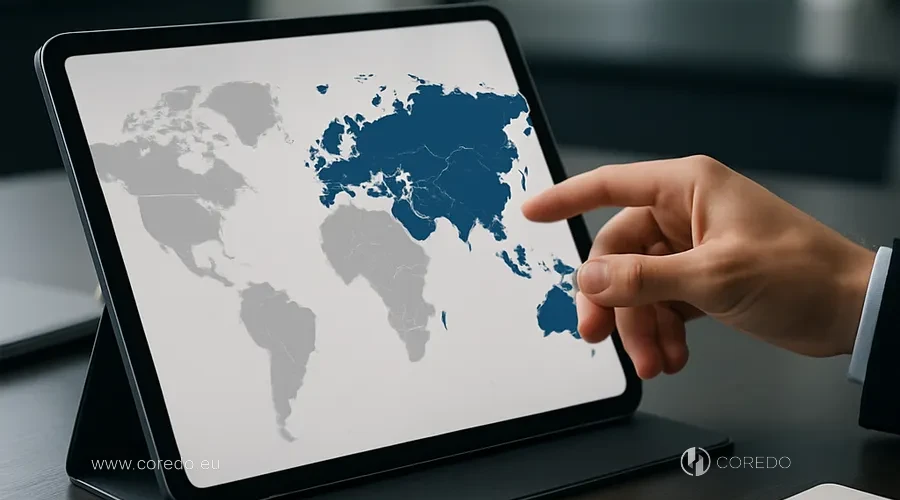
How this affects company registration in the EU, Asia and other regions: no longer a theoretical question but a practical factor that directly influences the choice of jurisdiction, ownership structure and access to banking services. The tightening of sanctions and AML controls is changing the rules: requirements for beneficiary transparency, source of funds and genuine business activity are becoming key when registering companies in the EU, Asia and other regions.
Company registration in the EU and banking risks
When we assist clients with registering legal entities in the EU — in the Czech Republic, Slovakia, Cyprus, Estonia, the United Kingdom and other countries — one of the first topics discussed is the jurisdictional risk of beneficiaries and key counterparties.
- a bank in the EU may be relatively lenient toward a local company, but significantly stricter toward a group if the holding or part of the assets are located in a FATF grey list country;
- corporate accounts in countries on the FATF grey list often face difficulties with cross‑border payments to the EU due to correspondent‑bank level restrictions;
- company registration in Europe without a sound banking strategy is almost pointless: an account may open, but ongoing service will be unstable.
The COREDO team in such projects does not limit itself to registration alone: we immediately model how a specific structure will look from the perspective of a European bank, where KYC‑triggers will arise, and where additional substance and transparency are needed.
Asia and Africa: high-risk AML jurisdictions
When registering companies in Asia (including Singapore and other centers) we always look at the surrounding map of AML high‑risk jurisdictions: which countries are already on the grey list, which could potentially join it, and how this will affect:
- access to local banks;
- the ability to open accounts in the EU;
- the structure of cross‑border financing.
A separate area of COREDO's work is analysing prospects for entering African markets: here, country risk assessment (country risk) that takes FATF lists into account is critical already at the business‑plan stage. In some cases we explicitly recommended that a client avoid registering an operating company in a jurisdiction with heightened AML risk and instead use a structure with an SPV in a more stable country, while establishing local presence via a representative office or a contractual network.
Consequences for banks of being placed on the FATF grey list

What happens to banking services when a country is placed on the FATF grey list? For businesses and private clients, it means that any transaction involving such a jurisdiction is automatically treated by banks as higher risk, even if it is completely legal. Banking services become more complicated: compliance control intensifies, requirements for documents and verification times increase - and these are exactly the immediate consequences we examine below.
Immediate consequences for the organism
From the point of view of corporate accounts, inclusion in the FATF grey list leads to several typical effects:
- review of limits and fees on existing accounts, increase in commissions, especially for international payments;
- increase in transaction processing times, especially to/from high‑risk AML countries;
- additional KYC/KYB requests for already serviced clients, document updates, confirmation of structure, disclosure of beneficiaries.
I often see companies underestimate these «details»: payment delays of several days, regular requests for every large transfer — all this becomes direct costs and hits operational efficiency.
Medium-term consequences of de-risking and financial isolation
If the trend continues, banks gradually:
- reduce limits, restrict types of operations (for example, trade finance, complex cross‑border deals);
- refuse new clients linked to «grey» jurisdictions;
- initiate correspondent de‑risking: closing or restricting correspondent accounts with banks from those countries.
This already affects not only individual companies but also the ability of an entire business segment to conduct international payments normally. In such conditions COREDO's task is to help clients avoid financial isolation by building a reasonable balance between jurisdictions of presence, banking partners and alternative payment solutions.
KYC and EDD for clients from grey jurisdictions
How banks strengthen KYC/EDD for clients from grey jurisdictions is primarily about moving to a stricter risk‑based approach: such clients are automatically assigned an elevated risk profile, and disclosure requirements become deeper and more detailed. As a result, the standard set of documents is no longer sufficient: banks expand the list of requests, enhance transaction monitoring and expect much greater transparency from clients regarding structure, beneficiaries and sources of funds.
What is most often required
When I see a client's structure linked to FATF grey list countries, I immediately plan for an enhanced KYC package. At a minimum, banks request:
- a detailed ownership structure listing all beneficial owners and controlling persons;
- confirmation of the source of funds and origin of capital (source of funds / source of wealth);
- documents for key counterparties, especially if they are from AML high‑risk jurisdictions;
- explanations of the business model and the economic rationale of transactions.
For enhanced due diligence (EDD), they may additionally request:
- board resolutions, corporate agreements, trust declarations;
- a legal opinion (legal opinion) on the AML risks of the structure;
- the company's internal AML policies and procedures, including the appointment of an MLRO.
The COREDO team regularly prepares structured document packages and legal opinion on AML risks for clients so that banks' compliance officers can quickly assess the company's risk profile and make an informed decision.
Requirements for beneficial ownership transparency
FATF is consistently strengthening requirements for beneficial ownership transparency: beneficial owner registers, access for regulators, information sharing. For clients with a presence in grey jurisdictions, this means:
- banks' near‑total rejection of complex, opaque structures lacking an obvious business purpose;
- a stricter approach to trusts, funds, and multi‑level SPV chains;
- attention to links with politically exposed persons (PEP).
In COREDO's practice this often leads to restructuring: we remove unnecessary levels, simplify ownership, and relocate key elements to jurisdictions with low AML risk and clear regulatory practices.
Strategy for companies in countries on the FATF grey list
A strategy for groups with companies in countries on the FATF grey list requires more than one‑off measures "after the fact" — it needs a thoughtful approach to managing risks, reputation and access to international settlements. To avoid living in a constant "firefighting" mode, such groups need a systemic compliance strategy instead of a spontaneous reaction to ever‑new requests from banks and regulators.
Compliance strategy instead of reaction
A fundamental mistake I observe: companies react to changes in the FATF list in a piecemeal way, "only when it's already on fire." It's far more effective to build a centralized monitoring and response system:
- tracking updates to the FATF grey list and national lists of high‑risk countries;
- regular assessment of country and jurisdictional risk taking into account the group's exposure;
- scenario analysis: what happens to banking relationships and financing if a specific client's country/subsidiary is placed on the grey list.
At COREDO we use this approach when working with international groups: we develop a country risk map, identify critical points (banks, correspondent accounts, payment providers) and prepare an action plan in advance in case the status changes.
When it makes sense to change jurisdiction
A question I'm asked regularly: is it worth relocating a holding or an operating company from a FATF grey list jurisdiction?
The answer is always individual, but the general approach is:
- if the cost of maintaining the entity (bank fees, compliance burden, transaction restrictions) grows faster than the economic rationale for staying in the current jurisdiction, relocation may have a positive ROI;
- if access to international financing and investors is critical (funds, SPV structures, investment projects), presence in grey jurisdictions seriously weakens the negotiating position;
- if the group targets EU banks and developed financial centres, maintaining a beneficial ownership link with a high‑risk country will continuously reduce banks' risk appetite.
The COREDO team helps model such a move: from assessing the ROI of relocation to the actual re‑registration of companies in the EU, Asia or other stable jurisdictions while preserving business continuity.
How to reduce the impact of the FATF grey list on business
I will gather in one place the practices that actually work for our clients.
Business structure and choice of jurisdictions
- Avoid concentrating key companies in FATF grey list countries, especially if you plan to work with EU banks or international financial institutions.
- Use holding companies and SPVs in low-AML-risk jurisdictions, keeping presence in 'grey' countries at the operational level and minimizing their role in the funding chain.
- When entering new markets (including Africa and parts of Asia), incorporate country risk into your model and include scenarios for changes in FATF status.
Internal AML/CTF system
- Implement formalized AML policies, KYC procedures/KYB and transaction monitoring: banks appreciate when a business "speaks the same language" as them.
- Appoint an AML/CTF officer (MLRO) and set up a regular training cycle for employees involved in international payments.
- Digitize processes - automated collection and updating of KYC documents, a log of counterparty checks, and sanctions risk monitoring.
The COREDO team often starts projects with AML consulting and only then moves to licensing and account openings: a well-established internal system significantly increases trust from banks and regulators.
How to work with banks and payment providers
- Don't rely on a single banking partner: diversifying accounts across jurisdictions and types of institutions reduces the risk of sudden financial isolation.
- When choosing a bank, openly discuss the country and jurisdictional risk of your group; this will immediately reveal their appetite for clients with a presence on the FATF grey list.
- Consider alternative payment solutions, licensed fintech providers and payment institutions where correspondent banking is significantly limited.
In several cases the COREDO team helped clients build a combination: a classic bank account in a low-risk jurisdiction + a payment institution for some cross-border payments, which reduced costs and increased resilience to de-risking by individual banks.
How COREDO helps navigate high AML risk
Over years of work COREDO has developed several stable areas of expertise that are particularly important in the context of the FATF grey list and corporate banking services:
- Registration of legal entities in the EU, Asia and the CIS taking into account AML risks and banks' requirements, from choice of legal form to ownership structure.
- Obtaining financial licenses (crypto, forex, payment, other licenses in EU countries, the UK, Singapore, etc.) with a focus on AML compliance/CTF standards.
- AML consulting: development of an internal AML system/CTF, preparation for audits, support in interactions with banks and regulators.
- Comprehensive business support: Legal outsourcing, transaction support, preparation of Legal Opinion, structuring of holding and investment schemes.
For many clients we become a long-term partner: we register the company, help open and stabilize banking services, obtain licenses, set up an AML system and stay by your side when FATF lists, sanction regimes or banks' policies change.
If you see that:
- the country of registration of your company or a beneficiary is at risk of being placed on the FATF grey list;
- a bank has increased KYC/EDD requests or has notified of a review of the relationship;
- you are planning to register a company in the EU, Asia or another jurisdiction and want to take AML risks for international business into account already at the structuring stage,
at this stage it makes sense not to limit yourself to one-off measures, but to build a systemic approach. At COREDO we do exactly that: we turn complex regulatory changes into clear managerial solutions - with a focus on business resilience and predictability of banking services.