
COREDO – EU Legal & Compliance Services Expert legal consulting, financial licensing (EMI, PSP, CASP under MiCA), and AML/CFT compliance across the European Union. Headquartered in Prague, we provide seamless regulatory solutions in Germany, Poland, Lithuania, and all 27 EU member states.

Alena Sharykava
16.02.2026 | 6 min read
Updated: 16.02.2026
I have been running COREDO across the markets of Europe, Asia and the CIS since 2016 and have seen how **whistleblowing** in fintech has turned from a formality into a pillar for sustainable growth. When early signals from inside reach a competent team, the business wins across the board: compliance quality improves, regulatory risks decrease, and investors see the maturity of corporate governance. COREDO’s practice confirms: a properly configured complaints system in a fintech company speeds up the detection of breaches, improves AML controls and saves remediation budgets.
I regard **whistleblowing** as a business process with a clear architecture, SLA and measurable ROI. It is not only compliance with the EU’s **whistleblowing** requirements, but also an operational protection of informants in financial services, embedded into a compliance framework for fintechs, crypto firms, payment providers and neo-banks. In this article I will compile the strategy, operational practices and lessons from COREDO cases: from channel architecture to performance metrics and scaling across international markets.
Directive (EU) 2019/1937 and standards
The European Directive on the protection of whistleblowers (Whistleblower Directive), Directive (EU) 2019/1937, sets minimum standards for companies, including the financial sector. National implementation of the directive in the EU and the risks of non-compliance vary by country, but the direction is clear: reliable internal channels, protection from retaliation, confidentiality and timely feedback to the whistleblower. In financial services there are also industry frameworks: EBA recommendations and guidance on internal channels and risk management, as well as ESMA expectations for the capital markets and fintech companies working with securities and derivatives.
GDPR underpins any processing of complaints. **Confidentiality and GDPR** in complaints mean clear legal bases, data minimisation, pseudonymisation and clear retention periods. In practice this translates into a DPIA for the complaint system, the assignment of roles and responsibilities to the whistleblower officer, and the regulation of interaction with the DPO: the DPO’s job description and cooperation with the DPO should directly take the whistleblowing processing workflow into account.
Channels and deadlines under the EU directive
The directive requires mandatory channels of communication: an internal reporting channel for whistleblowers and the option of an external reporting channel to the regulator (national contact points and competent authorities). Internal reporting rules provide for acknowledgement of receipt of a complaint within seven days and feedback on the results within three months (with a possible extension up to six months in justified circumstances). Such regulated response times under the directive discipline the process and set SLA standards for compliance teams.
National implementation and sanctions
National implementation of the directive in the EU and the risks of non-compliance include regulatory fines and legal risks for breaching the directive. In EU case law there are examples of sanctions for the absence of internal channels, breaches of whistleblower confidentiality or missed deadlines. The financial consequences of non-compliance (fines, reputational risk) often exceed the costs of implementation. In some jurisdictions administrative and criminal consequences are added for ignoring a complaint, especially where possible economic crimes or money laundering are involved.
privacy by design in the GDPR
The impact of the GDPR on the processing of reports is reflected in details: conditions for anonymity and two-way anonymous communication, pseudonymisation and storage of complaint data, encryption and secure storage of records, cross-border transfer of complaint data and the legal bases for this. **Privacy by design** for reporting systems: not a slogan, but concrete measures: end-to-end encryption for **whistleblowing**, multi-factor authentication for reporting portals, protection of the communication channel from DDoS and leaks, as well as evaluating platform providers against SOC/ISO standards and checking their audit trail. At COREDO we usually build a DPIA for the complaint system at the start of a project; this reduces the likelihood of regulatory ‘surprises’.
Architecture of the complaints system in fintech
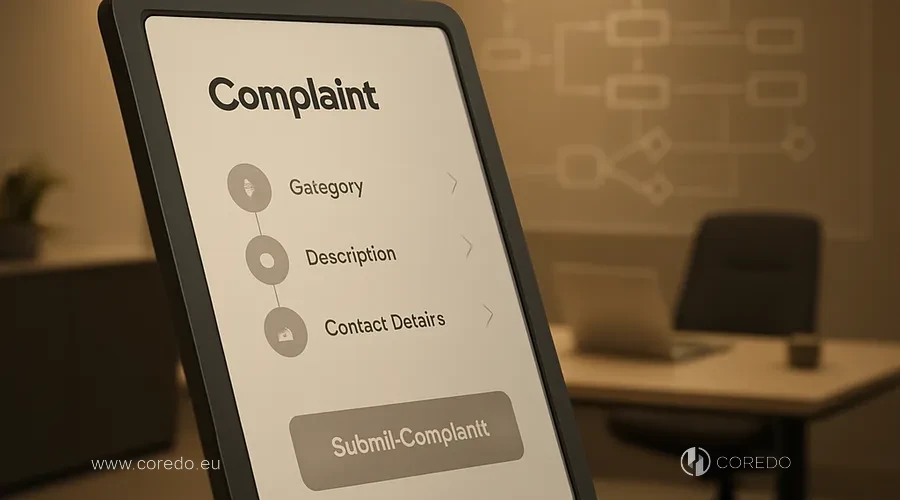
The complaints system in a fintech company is not just a ‘mailbox’. It is a set of processes and technologies: whistleblower channels (in-house software vs outsourcing), a secure reporting platform, triage and prioritization procedures, integration with case management systems and interaction with AML/SAR processes. I recommend viewing the architecture as a target operating model with clear interfaces and responsibilities.
Platform selection and security
Choosing a platform for secure reporting determines the resilience of the entire program. At the technology level I require end-to-end encryption for **whistleblowing**, multi-factor authentication, certified crypto libraries, segmented storage and strict access roles. I also look specifically at protection of the communication channel from DDoS and leaks, integrity logs and continuous monitoring. When evaluating platform vendors against SOC/ISO standards I am interested in independent audits (for example, ISO 27001, SOC 2 Type II), the presence of an audit trail, two-way anonymous communication features and GDPR compatibility.
Integration with case management systems, automation of investigations and workflows, as well as incident visualization tools for the board of directors simplify management of the complaint lifecycle. Compatibility of the complaints system with transaction monitoring systems helps speed up verification of signals related to AML, fraud and conflicts of interest.
Scaling for international fintech
Scaling a complaints system for international fintech relies on international jurisdiction and cross-border complaints. Scaling challenges during international expansion are usually related to local data storage and retention requirements, language localization and cultural specifics. Regional particularities in the EU, Asia and the CIS during implementation may require distributed hosting, mechanisms to restrict cross-border transfer of complaint data and local escalation procedures to national competent authorities.
The crypto sector adds nuances: regulation regarding cryptocurrencies and complaints is actively evolving, so compliance and **whistleblowing** in crypto firms must take into account the Travel Rule, risks of KYC circumvention and interaction with exchanges and custodial providers. The link between **whistleblowing** and AML/SAR is particularly strong here.
Integration of the compliance framework
I recommend tying **whistleblowing** to AML processes, KYC/CDD, IT security and HR. SAR vs internal report, the difference and interaction should be clear to every line of defense: an internal report triggers a corporate investigation, while a SAR to the FIU is a regulatory report of suspicious activity. I consider compatibility with transaction monitoring systems and a unified case management ecosystem mandatory: it reduces the time to gather evidence and improves the quality of legal assessment of reports.
Processes from report to resolution

The heart of the program: investigation management after a report and a well-thought-out triage methodology. The solution developed at COREDO combines risk scoring, automatic checks against registers of breaches and the involvement of subject-matter experts. Signal analysis: how to reduce false positives is not only a matter of algorithms, but also of data-source settings, category clarity, and staff training.
Best practices for triage and prioritization
Transparent rules govern triage: triage methods — scoring and prioritization of reports by harm, likelihood, regulatory criticality and management involvement. Machine learning for clustering complaints and NLP for automatic categorization of reports help ease the team’s workload and improve response times. I add KRIs for corporate ethics risk and KPIs and metrics for the complaints program’s effectiveness — for example, the share of valid reports, average time to remediation, repeat incidents and the quality of feedback to the whistleblower.
Investigation management
legal assessment of reports and evidence collection require discipline: documenting investigations and preserving the chain of custody, legal standards for evaluating evidence, version control of artifacts and independent verification. Integration with case management systems and an audit trail ensures consistency and readiness for external review. Outsourcing investigations to an independent provider may be necessary in conflicts of interest or in complex cases where specialized expertise is required.
Escalation and engagement with external authorities
Internal/external escalation procedures set thresholds: when an internal resolution is sufficient and when an external reporting channel to the regulator is required. Interaction with the FIU and national supervisory authorities, as well as transferring data to the FIU and liaising with law enforcement, should follow pre-approved scenarios. The COREDO team helps clients prepare notification templates for regulators and evidence packages for different cases to meet regulated response times and the level of detail expected by competent authorities.
Roles, responsibility and culture

The compliance manager and the board of directors’ responsibility – key to maturity. I expect the board to approve a whistleblower policy, establish safeguards against retaliation and receive regular reports on the program’s status. The roles and responsibilities of the whistleblower officer include receiving reports, communicating with the whistleblower, initiating triage, and monitoring deadlines and anonymity.
Policies and instructions
A whistleblower policy for payment providers, compliance and **whistleblowing** in crypto firms, and implementing a **whistleblowing** program in a neo-bank require nuance. For payment organizations the policy should take into account PSD2/EMI risks; for crypto — risks of AML and sanctions circumvention; for neo-banks: a complex third-party matrix and open banking. I typically propose a whistleblower policy template with an annex: directive requirements on communication channels, internal reporting rules, safeguards against retaliation, escalation procedures, confidentiality and GDPR, data storage and retention periods.
Training and change management
Staff training and change management are the key to trust in the system. Training line managers and leadership helps reduce “noise” and improve the quality of the initial assessment. Change management and communication with staff include open Q&A, anonymized case studies, regular reminders about channels and encouragement to report. Building an ethical culture and encouraging reporting increase the number of useful signals, and the impact of corporate culture on report volumes becomes a measurable KPI.
Protection against retaliation and anonymous communication
Safeguards against retaliation include a ban on disciplinary measures against bona fide whistleblowers, oversight of HR decisions, confidential consultations with HR and an independent appeals channel. Whistleblower anonymity and two-way communication are supported through platforms with pseudonyms, one-way disclosure and metadata control. In some jurisdictions anonymous rewards and incentives for whistleblowers are possible, and I will align such practices in advance with local law and regulators’ expectations.
How to calculate ROI

risk assessment when implementing a complaint system and the ROI of implementing a **whistleblowing**-system interest financiers no less than lawyers. I consider the basic ROI metrics: cost per case (cost per case), time to remediation (time to remediation), reduction in operational losses through early detection of violations and the share of prevented external investigations. Costs and benefits of internal reporting consist of platform licenses, training, investigations and savings on fines, downtime and reputational losses.
Maturity indicators: KPI and KRI
I use a three-level system of indicators:
- KPI: time to confirmation, time to triage, time to resolution, share of substantiated cases, reporters’ satisfaction with the quality of feedback.
- KRI for corporate ethics risk: increase in the number of reports in risk areas (without decline in quality), share of severe cases, incident recurrence.
- Maturity indicators of the whistleblower program: presence of a DPIA, integration with AML/SAR, independence of the appointed officer, regular reports to the board, benchmarking of **whistleblowing** programs by industry.
Economic efficiency model
The program’s economic efficiency calculation model takes into account return on investment (ROI) scenarios: prevention of regulatory fines, reduction of IT process downtime during abuse incidents, and reduction of fraud losses. Scenarios are built on probabilities: baseline (compliance only), advanced (early detection), strategic (systemic integration with transaction monitoring and HR). In COREDO’s experience, the strategic scenario pays off faster, especially for companies with intensive payment flows and international expansion.
Implementation: plan and COREDO cases
The COREDO team has implemented dozens of deployments, from startups to large groups. Implementing **whistleblowing** in a startup vs a large company differs in process depth and governance frameworks, but the stages are similar.
Project implementation plan
- Diagnosis and design: maturity assessment, DPIA for the complaints system, compliance gap vs Directive (EU) 2019/1937, EBA/ESMA expectations.
- Solution selection: reporting channels: software vs outsourcing, choosing a platform for secure messages, assessment by SOC/ISO, privacy by design.
- Integration: case management system and audit trail, compatibility with transaction monitoring systems, integration with HR processes and disciplinary procedures, linkage with conflict of interest policy.
- Policies and training: whistleblower policy template, escalation procedures, staff training and change management, communication with personnel.
- Testing and launch: testing the complaints channel (penetration tests), DDoS protection checks, incident response and trust recovery plan.
- Operations and measurements: KPIs/KRIs, reporting tools for management and the board, audit of the effectiveness of the whistleblower program.
COREDO cases
- Neo-bank in the EU: implementing a **whistleblowing** program at a neo-bank took 12 weeks. Integration with AML/SAR and transaction monitoring reduced time to triage by 38% and false positives by 22%. National contact points received two external reports with correct notification templates – the regulator accepted the responses without additional requests.
- Payment provider in Central Europe: a whistleblower policy for payment providers and two-channel escalation helped uncover a scheme to bypass limits. Documenting investigations and preserving the chain of evidence ensured successful cooperation with law enforcement and the FIU. The company avoided a fine, receiving only an order to improve third-party controls.
- Crypto firm with a hub in Asia: compliance and **whistleblowing** in crypto firms were integrated into Travel Rule processes. Machine learning for complaint clustering and NLP for automatic categorization of messages reduced the compliance line’s workload by 30%. A regulatory review confirmed compliance with the directive and local data protection rules, and the board approved additional budget to scale in the CIS.
Risks of non-compliance during inspections
Preparation for inspections by supervisory authorities is part of the regular operational cycle. Engagement with banking sector regulators, ESMA observers and financial ombudsmen requires clear dossiers, transparent logs and readiness for interviews. corporate governance and **whistleblowing** go hand in hand: stakeholders – boards of directors, investors, the auditor – expect regular and clear reporting.
Audit and reporting on complaints
Audit and reporting on complaints for the regulator are built on standardized datasets: complaint categories, response times, investigation status, and remedial and preventive measures. Reporting tools for management and the board provide a dashboard with trends, risk heatmaps and KPI/KRI details. Data retention policies and timeframes are aligned with GDPR and local regulations; encryption and secure storage of records are verified by an independent audit.
Preparation for inspections: stress tests
I recommend regular stress tests: testing the complaints channel (penetration tests), checking DDoS controls, simulating a mass influx of reports and an analytical review of bottlenecks. Preparation for investigating complex economic crimes includes forensic playbooks, role assignments, access to external experts and readiness for public communications. We work through the ethical and reputational aspects of public investigations in advance so the company can confidently maintain its stance when interacting with the media and investors.
How COREDO Helps
Our experience at COREDO has shown: there is no single “box”, context matters: licenses, jurisdictions, group structure, digital maturity. The COREDO team designs a compliance framework for fintech taking into account Directive (EU) 2019/1937, GDPR and industry guidance, selects and implements platforms, configures two-way anonymous communication, integrates AML/SAR and case management, trains staff and establishes metrics. We treat culture with care: without trust in the channels and protection against reprisals, the system will not work.
COREDO helps conduct a DPIA, build escalation procedures, organize external reporting of violations in the financial sector, prepare notification templates, and, if necessary, outsource investigations to an independent provider. For groups with an international presence we configure cross-border transfer of complaint data in line with local rules, and manage the vendor chain for complaint platforms. As a result, the company gains not just compliance, but a working mechanism for the early detection and remediation of risks.
Conclusions
**Whistleblowing** – is not a ‘regulatory burden’, but a reliable tool for managing risks and reputation. When a fintech has internal and external channel architecture, privacy by GDPR standard, well-designed triage and investigations, as well as board support and effective communication, the program begins to deliver measurable benefits. You will see clear KPIs, a clear KRI profile, a comprehensible ROI and a real reduction in operational losses.
If you are preparing to launch or upgrade a program, start with a diagnosis: assess channels, roles, integrations and metrics. The COREDO team will gladly share methodologies, case studies and templates, and will also help adapt the solution for the EU, Asia and the CIS. With correct implementation, **whistleblowing** strengthens corporate ethics, accelerates the AML framework and increases business resilience; it is precisely the foundation on which international growth is built.