
COREDO – EU Legal & Compliance Services Expert legal consulting, financial licensing (EMI, PSP, CASP under MiCA), and AML/CFT compliance across the European Union. Headquartered in Prague, we provide seamless regulatory solutions in Germany, Poland, Lithuania, and all 27 EU member states.

Nikita Veremeev
18.03.2026 | 6 min read
Updated: 18.03.2026
I have been running COREDO since 2016 and see every day that the fate of international payments is rarely decided at the level of “your bank”. The key lies in correspondent relationships between banks, where every link in the chain can speed up or stop a settlement. When entrepreneurs say “my bank is reliable,” I ask: what about the correspondent bank, its risk appetite and de-risking terms? It is there that limits, sanctions filters, KYC/KYB and EDD procedures, as well as rules for pass-through transactions are formed. This is where the real consulting work begins: methodically, demonstrably, taking into account FATF, Basel III, OFAC/EU/UN and the requirements of the specific jurisdiction.
Correspondent relationships and payments

Correspondent relationships between banks are agreements under which one bank holds an account with another to service international settlements. For the client this means access to payment corridors and currencies not available directly. Often it is the correspondent that determines whether a payment will be executed, how long it will take, and which compliance profile the sender must confirm.
Nostro/Vostro account is two views of the same balance. Nostro: “our account with you” reflects an asset of the sending bank at the correspondent. Vostro: “your account with us” reflects a liability of the correspondent bank with respect to the respondent bank. Managing Nostro/Vostro liquidity is critical: incorrect cut‑off times, insufficient pre‑funding position and weak reconciliation lead to delays and excessive costs. At COREDO this topic is part of regular reviews of clients’ treasury processes.
The role of SWIFT in correspondent payments is standardization and routing. SWIFT BIC identifiers provide mutual recognition of banks, and SWIFT gpi gives transparency on the status, timing and fees of each link in the chain. In one project the COREDO team implemented gpi tracking into the ERP of a payment provider from Estonia via API, and the SLA for client notifications was reduced from hours to minutes. This affects not only the client experience but also the risk assessment by correspondents: predictability — a factor of trust.
Why the correspondent bank matters more
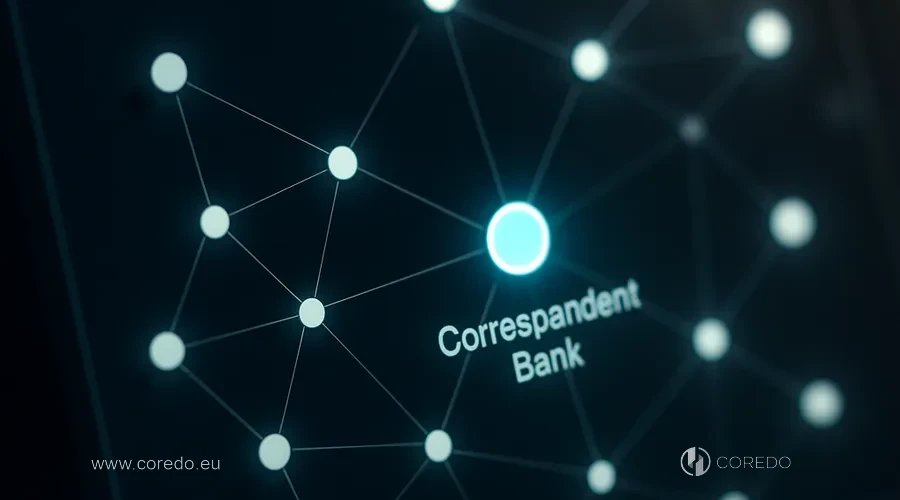
Your bank may be financially stable and technologically advanced, but without a correspondent payment network it will not be able to move funds to the required jurisdiction. A correspondent bank is more important than your bank in terms of international settlements because it applies its own sanctions filters, country and counterparty limits, as well as a pass‑through transaction policy. If the correspondent deems the risk unacceptable, the transfer will be stopped regardless of your relationship history with your bank.
The risk of correspondent-bank refusal has increased due to global de‑risking. Tightening Basel III raises capital requirements and the cost of compliance, so banks optimize their counterparty networks and close high-risk payment corridors. Decisions are also influenced by sanctions and negative media flags, rising fines for AML/CTF violations, and regulatory trends in Europe and Asia regarding reporting on cross-border payments. COREDO’s practice confirms: those who proactively manage these factors preserve corridors and reduce transaction costs.
Correspondent bank requirements: KYC/KYB, UBO, sanctions, geography

A correspondent evaluates not the “questionnaire” but the controlled system. It looks at KYC and KYB processes, AML/CTF policy, transaction monitoring and the three‑level compliance control model. CDD and enhanced Due Diligence procedures for international settlements are important, as is documenting sources of funds and wealth. When we at COREDO build such processes, we strive for demonstrability: action logs, reporting, compliance performance KPIs and an audit trail.
Beneficial owner (UBO) verification procedure includes checking against beneficiary registers and public databases, assessing ownership structure, corporate fitness (fit and proper) and confirmation of control. Sanctions screening should cover OFAC, the EU and the UN, taking into account phased updates and fuzzy name matching to reduce both false positives and misses. The correspondent considers geographic risk, industry, types of transactions, presence of PEP statuses among management and shareholders, and the results of adverse media monitoring.
Technologically, LEI (Legal Entity Identifier), KYB automation and API integrations are important. The faster and more accurately a bank can verify a counterparty and the transaction profile, the higher the chance of a positive decision on the account and on individual transfers. COREDO’s experience has shown that a structured client dossier — with a business model, a map of payment corridors, limits, policies and an evidentiary base — reduces the CDD/EDD cycle severalfold.
How to prepare a KYC package and pass AML

I recommend approaching KYC so that the correspondent sees the full picture. AML policies/CTF, KYC and KYB should reflect real processes: roles and areas of responsibility, levels of verification, sanctions screening, thresholds and rules of transaction monitoring, STR/CTR procedures and escalations, as well as storage and protection of client data. At COREDO we draft documents as working tools, not just “tick-box” paperwork.
The required document package for a correspondent account usually includes founding documents, licenses and permits, corporate governance and internal audit minutes, financial statements with notes and audit, a description of the business model, tariffs and payment flows, confirmations of sources of funds, profiles of key clients and suppliers, risk maps and reports on their mitigation. Additionally, we prepare certifications and evidence of compliance for banks to remove questions at the EDD stage.
Preparing KYC for a correspondent bank is not only about files, but also about a live demonstration of processes. I insist on system tests: real-time sanctions screening, fraud detection and behavioral payment analysis, “combinatorial” monitoring rules (scenarios + ML), as well as change and access logs. When we show the correspondent the tools working on real cases, the decision speeds up and the “heavy” EDD is simplified.
Correspondent Account in the EU and Asia
How to open a correspondent account in the EU: a matter of procedure and positioning. I start by mapping payment corridors, assessing sanctions and geographic risks, analysing licensing requirements and regulatory supervision in the EU, and then compile a list of banks with a compatible risk‑appetite. We agree on timelines and SLAs for opening the correspondent account already during pre‑onboarding and record them in the CBRA (correspondent banking relationship agreement).
The conditions for opening a correspondent account for companies from Asia and the CIS usually include an increased focus on the source of funds, group structure and transparency of the tax model. Regulatory trends in Singapore and the UAE have raised expectations around transaction monitoring and reporting, and European banks pay more attention to restrictions on pass‑through payments and wrapped payments. The COREDO team provides legal support: CBRA, interbank agreements, payment endorsement and dispute resolution mechanisms.
The technical part is connecting to SWIFT, reconciliation of nostro/vostro and integration with ERP/treasury. We set up the daily reconciliation procedure, cut‑off timing and the liquidity plan in advance. This approach minimizes operational risks at launch and reduces the cost of ensuring payment liquidity.
Managing correspondent banking risks
I operate according to the “networks and data” principle. Diversifying correspondent banks reduces concentration risk and strengthens the negotiating position. We set limits for each payment corridor, manage exposure, and test the business continuity plan in case of losing a correspondent. If necessary, we arrange a transition to new correspondent providers without interrupting operations, including migration of SWIFT routes and notarized transfer of contracts.
Technology has become a mandatory element. Real-time sanctions monitoring tools with OFAC/EU/UN updates, SWIFT gpi for payment tracking, behavioral analytics and ML models for fraud, as well as API integrations for KYB improve CDD quality and reduce false positives. We assess third-party risk of compliance service providers and document KYC outsourcing with legal accountability and SLA/KPI.
Operational discipline keeps costs in check. Optimization of the CTR/STR process, correct classification of transactions, management of limits and thresholds, monitoring of sanction changes and adverse media: all of this reduces the likelihood of suspicious transactions (STR) and increases correspondent confidence. COREDO’s practice shows: transparent reporting and relevant compliance KPIs deliver measurable ROI from preserving correspondent relationships and reducing downtime.
Reasons for refusal and the likelihood of opening an account
Typical reasons for a correspondent bank’s refusal consist of three blocks. First: risk profile: a complex corporate structure without verifiable UBOs, high‑risk geography without compensating controls and negative media‑flags. Second, processes: formal AML/KYC policies without demonstrable enforcement, weak transaction monitoring and absence of a three‑level control model. Third: economics: low expected turnover, high cost of custom checks and unclear ROI for the bank.
I set out how to reduce the risk of refusal by a correspondent bank in three steps. First we raise data quality: LEI, UBO‑dossier, sources of funds, IFRS financial statements and reconciliation with public registers. Then we document and demonstrate compliance: sanctions screening with fuzzy name matching, PEP‑screening and risk assessments, EDD procedures for international payments and logs of transaction monitoring. Finally, we arrange the commercial part: payment corridors, volumes, SLAs and service KPIs so that the bank sees the economics of the relationship.
Preparing a response to sanctions inquiries from a correspondent bank requires speed and completeness. I include a delisting template and justification for each flag, the history of transactions and counterparties, as well as legal guarantees and contracts with the correspondent. Such a package often lifts blocks faster than formal correspondence and preserves the corridor.
Protection of clients’ payment corridors
Case 1: a payment institution in Estonia with a license for payment services faced de‑risking on the USD corridor. The COREDO team repackaged the AML/CTF compliance program, implemented SWIFT gpi and behavioral fraud detection, and then diversified correspondent accounts in the EU and the UK. As a result, payment processing times decreased by 37% and transaction costs by 18%, while the correspondent bank removed limit restrictions after a quarterly review.
Case 2: a forex broker in Cyprus received a request for EDD due to structural changes in the group. Our solution included a source-of-funds audit, updating the UBO file and restructuring corporate controls taking fit and proper into account. We added escalation procedures and communications with the regulator and agreed new SLAs with the correspondent. The account was retained, and the bank increased limits after strengthening internal audit.
Case 3: a trading company from Dubai was opening a euro corridor through a bank in Slovakia for deliveries to Central Europe. At COREDO we prepared a KYB package, set up transaction classification, defined rules for pass-through transactions and wrapped payments, and integrated the client’s ERP with the bank’s system via API for daily nostro/vostro reconciliation. The payment corridor launched as planned, and the SLA for credits meets T+0/T+1.
Case 4: a fintech from Singapore was looking for a correspondent account in the EU for B2B payments. We drafted interbank agreements, performed proof-of-controls for OFAC/EU/UN sanctions, and trained the client’s team in international KYC standards and certification. After the pilot period the correspondent confirmed long-term cooperation, and the ROI metrics from compliance were reflected in savings on rejections and a stable client inflow.
Regulatory trends in Europe and Asia
FATF is increasing its focus on the effectiveness of AML measures, not just the formal existence of policies. European initiatives to regulate cross-border payments require greater transparency of fees and statuses, which enhances the value of SWIFT gpi and data standardization. In Asia, supervision of third parties and compliance service providers is intensifying, making the assessment of their risks a mandatory part of on-site and off-site inspections.
The impact of Basel III on correspondent services is reflected in higher capital buffers and increased compliance costs, causing banks to reduce “thin” corridors and focus on large, transparent clients. Reporting and audit requirements for correspondents are expanding, and legal risks of transfer pricing in payment chains require coordinated interbank agreements and transparent pricing. COREDO’s experience helps clients proactively adapt policies and contract structures.
Checklists: verification and relationship lifecycle
- Verification checklist. Create a client dossier to verify data verifiability and include LEI, UBO structure, sources of funds and reporting. Add AML/CTF, KYC/KYB, EDD policies and evidence of their enforcement, as well as a record of the three-line control model.
- Sanctions framework. Set up OFAC/EU/UN sanctions screening with phased updates and fuzzy name matching, and include PEP screening. Document the delisting process and response handling, as well as adverse media monitoring and escalation procedures.
- Monitoring and reporting. Define threshold rules, CTR/STR, transaction classification and transaction-monitoring algorithms. Record compliance performance KPIs and SLA/KPIs in correspondent relationships.
- Technologies and integrations. Include tools for real-time sanctions monitoring, ML-based fraud detection and API integrations for KYB. Provide ERP/treasury integration and daily nostro/vostro reconciliation with liquidity management.
- Risk management and BCP. Assess concentration risk and prepare strategies for account diversification and migration to new providers without disrupting operations. Maintain a business continuity plan for the loss of a correspondent and controls for limits and exposures.
Each item is important for two reasons. First, it increases the chance of opening an account with a correspondent bank and reduces the risk of subsequent account freezes. Second, it creates a measurable ROI from compliance: less downtime, fewer rejections, lower reputational costs and less unpredictability in cash flows.
COREDO for finance and compliance teams
I view correspondent relationships as a multi-layered project. The solution developed at COREDO covers the analysis of payment corridors, legal support for CBRA, preparation of a KYC/KYB package, configuration of an AML/CTF compliance program, PEP and sanctions screening, as well as the implementation of monitoring technologies and SWIFT gpi. We take on communications with banks and regulators, prepare responses to sanctions inquiries and build an evidentiary base for audit.
The COREDO team has executed projects in the EU, the United Kingdom, the Czech Republic, Slovakia, Cyprus and Estonia, as well as in Singapore and Dubai. We take into account regional payment standards, adapt transaction classification and configure wrapped payments with consideration for intermediary liability. For corporate groups we prepare procedures for structural changes so as not to disrupt EDD and lose corridors.
Our specialists help establish SLAs and KPIs for correspondent interactions, assess commercial and reputational risks and define ROI metrics from maintaining correspondent services. When necessary we engage external providers, but we document third-party risk and legal liability in contracts. This approach reduces uncertainty and protects operational metrics.
Strategic capital – correspondent banking relationships
Correspondent payment corridors: part of a company’s strategic capital. You can’t buy them ‘all at once’; they must be built: with a transparent structure, tech-enabled compliance, liquidity discipline and a sound legal framework. COREDO’s experience shows: when an entrepreneur treats a correspondent bank as a partner, not a ‘pipe’, the business gains speed, predictability and a reduction in the total cost of transactions.
If you plan to expand into the EU, Singapore, the UK or Dubai, build correspondent engagement into your roadmap at an early stage. I am ready to show how to turn KYC/KYB, AML and sanctions requirements from obstacles into a competitive advantage, and the network of correspondents: into a resilient foundation for international settlements.