
COREDO – EU Legal & Compliance Services Expert legal consulting, financial licensing (EMI, PSP, CASP under MiCA), and AML/CFT compliance across the European Union. Headquartered in Prague, we provide seamless regulatory solutions in Germany, Poland, Lithuania, and all 27 EU member states.

Alena Sharykava
04.03.2026 | 6 min read
Updated: 04.03.2026
Since 2016 I have been building COREDO as a platform where legal precision meets technological practice. During that time the COREDO team has implemented dozens of projects in the EU, the United Kingdom, Singapore, Dubai, the Czech Republic, Slovakia, Cyprus and Estonia: from company formation and obtaining financial licenses to AML consulting and implementing smart contracts into a client’s operating model. In this article I present a systematic view: when and how smart contracts operate as a legally meaningful infrastructure, how to reduce risks and achieve measurable ROI.
Our experience at COREDO has shown that “smart contracts for business” is not about fashion, but about managed automation of obligations in accordance with contract law and regulatory frameworks. I will examine legal statuses in key jurisdictions, issues of recognition in courts, the connection with AML/KYC and data protection, and provide guidance on designing “self-executing contracts” and the economics of implementation (TCO, CAPEX, OPEX and ROI metrics).
Smart contracts: legal reality
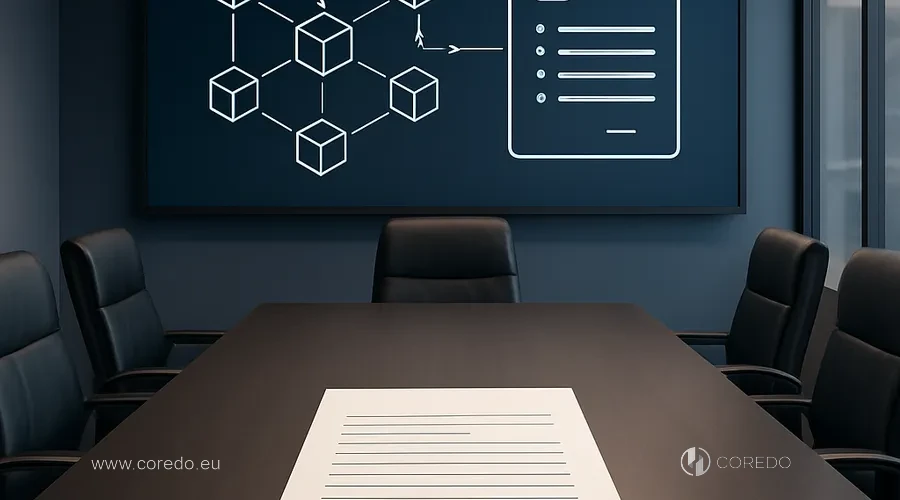
Smart contracts are code that automatically executes pre-defined terms of a transaction on a distributed ledger (DLT). In business practice I prefer the formulation “smart contract as a legal agreement,” because the legal force of smart contracts arises not from the code but from the parties’ mutual will and compliance with the applicable law, with the code serving as the execution infrastructure.
The core of the debate “code as law vs code and law” is that lex cryptographica, cryptographic law, does not repeal contract law but coexists with it. Blockchain and distributed ledgers are important in law as mechanisms for recording facts and ensuring performance, but the legal framework is set by rules: offer, acceptance, consideration, legal capacity and the permissibility of terms.
COREDO’s practice confirms: DLT and the legal force of records strengthen the evidentiary basis if the transaction architecture is subject to the chosen law and properly documented off-chain.
Smart contract vs traditional contract
A traditional contract relies on subsequent performance and, in dispute, on judicial enforcement. A smart contract, as an alternative mechanism for performance of obligations, is built into the mechanism: performance occurs automatically, and penalties can be embedded in the code logic (withholding, escrow, fines). At the same time legal risks of smart contracts include faulty code, incorrect oracle data and non-compliance with mandatory rules.
The solution developed at COREDO is to combine on-chain and off-chain legal mechanisms, where the code executes only those terms that are suitable for automation, and the rest remain in the contractual documentation.
International framework: EU, Asia, CIS

The international framework covers the EU, Asia and the CIS countries, where approaches to regulating smart contracts differ significantly in terms of recognition, evidentiary value and liability. Below we will examine the key legal features and practical implications for each region, starting with the legal status of smart contracts in the EU.
Legal status of smart contracts in the EU
In the EU we rely on eIDAS and the electronic signature: a qualified electronic signature (QES) is equated with a handwritten signature. If parties need unconditional recognition of a signature for an off‑chain document, we recommend a QES — and anchoring the document’s hash on a blockchain to record transactions as evidence. MiCA and EU digital asset regulation shape the framework for tokens and service providers, affecting KYC/AML and disclosures.
DLT and the legal effect of records in the EU are supported by national acts (for example, pilot regimes for DLT market infrastructures). To recognize a smart contract as part of a transaction, we include in the master agreement provisions on the applicable law, arbitration and on‑chain addresses as identifiers of the parties. This reduces disputes about the ‘formality threshold’ and facilitates the admissibility of electronic evidence in court.
Legal status of smart contracts in Asia
Singapore, Hong Kong and the UAE (Dubai) promote a technology-neutral approach. In Singapore, MAS regulatory sandboxes accelerate testing of DLT solutions while complying with AML. In the DIFC/ADGM in the UAE, flexible regimes for digital assets operate, and courts recognize a wide range of electronic evidence.
In these jurisdictions, smart contracts and electronic signatures rely on general principles of contract law: the intention to be bound, certainty of terms, and the parties’ capacity to enter into transactions.
International regulation: UNCITRAL
UNCITRAL and model laws on digital contracts set the basis for equal legal force of electronic communications and traditional documents. In cross‑border projects I insist on conflict-of-law clauses and choice of applicable law, as well as a description of the procedure for international enforcement of decisions and recognition of blockchain operations.
This approach ensures predictability when working in supply chains and trade finance.
Legal force and recognition in court

Understanding the legal force of electronic documents is important for minimizing risks and ensuring their applicability in legal practice. Below we will examine mechanisms of court recognition, enforcement of decisions, features of electronic evidence, and rules for secure storage that determine when digital data become fully admissible evidence.
Recognition of electronic evidence
Issues of recognition and enforcement of smart contracts in courts boil down to three things: validity of the agreement, coherence of code and text, and admissibility of evidence. To ensure “how to ensure proof of smart contract execution in court,” the COREDO team builds an evidence preservation framework and a data storage chain: notarized timestamps, call logging, version hashing, and storage of execution logs.
This increases the admissibility of electronic evidence in court and reduces the risk of losing digital traces.
On-chain and off-chain: mechanisms and arbitration
On-chain and off-chain legal mechanisms complement each other: the code executes payments, escrow, and time-locks, while the off-chain agreement covers force majeure in automated contracts, liability, and fault tolerance.
Smart contracts and arbitration: including arbitration clauses is critical — part of the dispute logic can be delegated to on-chain arbitration and dispute-resolution logic (for example, via multisig arbitrators), but the final decision is often better entrusted to institutional arbitration (LCIA, SIAC) to preserve the possibility of an enforceable award.
AML/KYC: data protection

AML/KYC processes, a key tool in identifying and managing risks, require strict adherence to international standards and compliance procedures. Reliable data protection ensures the traceability of operations and reduces the likelihood of leaks, which will form the basis for the discussion of risks, recommendations of FATF and traceability issues.
AML/KYC risks and FATF recommendations
Smart contracts and AML/KYC must be designed together with the provider’s policies. FATF recommendations on virtual assets and AML require counterparty identification and transaction monitoring. We integrate KYC solutions for smart contracts through identification providers and address whitelists.
We also use transaction traceability and forensic blockchain analysis to identify links to sanctioned entities or risk pools.
Regulation of digital assets and its impact on smart contracts is manifested in the licensing of VASP/PSP and the travel rule. COREDO’s practice confirms: early alignment of AML processes with contract logic saves months in licensing in the EU, the UK and Singapore.
GDPR data protection
Smart contracts and GDPR require caution with hard-to-delete data on the ledger. We apply privacy-by-design and compliance-by-design: personal data is stored off-chain with access control, and only pseudonymized hashes are written on-chain.
personal data protection in blockchain systems is achieved through access tokens, encryption and data minimization policies. Smart contracts and personal data protection are not a ban, but an engineering discipline.
Asset licensing and tokenization

Licensing in asset tokenization is a key factor determining the legality and commercial sustainability of projects in the digital rights market. In the following section we will examine in detail which licenses are required and how the MiCA framework shapes requirements for the issuance and circulation of tokens.
MiCA licenses
Financial licenses (crypto, banking, forex, payment services) determine how and which smart contracts can be used for the issuance, exchange and custody of tokens. MiCA and cryptocurrency regulation and their impact on smart contracts introduce requirements for the whitepaper, asset management and stablecoin reserves.
The COREDO team guides clients through a pre-licensing audit so that code and business processes comply with regulatory expectations.
Tokenization standards
Smart contracts and asset tokenization use standards ERC-20, ERC-721 and legal characteristics of tokens: transferability, property rights, corporate and consumer restrictions. Legal support for asset tokenization includes analysis of token classification (payment, utility, security), marketing regimes and cross-border offerings.
DAO Corporate Governance
Smart contracts and corporate governance enhance transparency: from the treasury to the enforcement of limits. DAO as a form of corporate structure and the legal challenges boil down to personal liability, taxes and recognition of legal personality.
In some jurisdictions legal models for DAOs and automated governance are recognized, but more often we create a “governing shell” (LLC/基金/Foundation) and register on-chain governance rules as internal regulations.
Multisignature (multisig) and distributed accountability allow managing the risks of unilateral control. For large treasuries we implement the fulfillment of obligations through multisig and escrow, and standardize roles and approval procedures.
Legally compliant smart contracts
Designing requires attention to detail: smart contracts must be legally compliant and drafted so that their execution conforms to legal norms. In the following sections we will review practical steps for drafting and bringing them in line with contract law requirements to minimize the risk of disputes and ensure the enforceability of the terms.
Formalize the contract under contract law
How to legally formalize a smart contract — rely on a master agreement where:
- the parties are defined (legal entities and their on-chain addresses);
- the smart contract is described as a legal agreement, its functions and limitations;
- the role of standard clauses in smart contracts is established: governing law, forum, arbitration, notices, force majeure;
- penalties and sanctions for breach of smart contracts and off-ramp procedures are provided;
- escrow via smart contracts and conditional transfers, time-lock and conditions for deferred performance are described.
To address “how to ensure a smart contract complies with contract law”, we agree the offer/acceptance and consideration in an off-chain document, and make the code an annex with the hash and address.
Smart contracts in international trade require Incoterms clauses, payment currency, taxes and prohibitions on sanctioned supplies.
A template of a legal smart contract for commercial transactions in our practice is a package:
– Master Agreement with governing law and arbitration;
– Technical specification (description of the state machine, events, roles);
– Oracle and data source policy;
– Emergency shutdown and migration plan (upgrade path);
– Appendix with the hash of the source code and the deployment address.
– Master Agreement with governing law and arbitration;
– Technical specification (description of the state machine, events, roles);
– Oracle and data source policy;
– Emergency shutdown and migration plan (upgrade path);
– Appendix with the hash of the source code and the deployment address.
Electronic signature: eIDAS and QES
Smart contracts and electronic signatures must interlock so as to express the parties’ intent. In the EU we anchor the signature of the contract text with a qualified electronic signature (QES), and in the smart contract itself we refer to identifiers of the signed document.
This reduces the risk of disputes about the validity of arbitrary addresses and strengthens the evidentiary value.
The role and liability of oracles
The role of oracles in legally significant smart contracts is critical because they translate the external world into an on-chain state. Oracle reliability and legal liability require: source audits, provider SLAs and insurance coverage.
Legal requirements for oracles and data providers include compliance with licensing (where applicable), transparency of methodologies and incident response procedures.
Reliability and security of technologies
The reliability of the technological platform and ensuring its security are not abstract tasks but mandatory conditions for the stable operation of systems and the preservation of users’ trust. This is achieved through formal verification, independent audits, and a clear allocation of responsibility among the participants in the process.
Formal verification and audit
Formal verification (formal verification) of smart contracts and formal verification methods reduce the likelihood of logical vulnerabilities. security audit of smart contracts and legal liability should be stipulated in the contract: scope of the audit, exceptions, responsibility of the developer and the client.
Secure development practices (secure coding) and code audit and compliance include static and dynamic analysis, threat modeling, and mandatory testing of emergency scenarios.
Smart contract vulnerabilities and legal consequences concern restitution, reputation, and possible regulatory liability.
The COREDO team recommends reserve funds and cyber risk insurance policies for critical protocols.
Upgradeability, versions and SLA
Upgradeable contracts and the legal consequences require special provisions: who and how initiates an upgrade, how the parties’ rights are preserved, which contract upgrade mechanisms (upgradeability patterns) are applied (proxy, beacons), and how the user is notified.
Version control and change management in smart contracts are recorded via release hashes and an approvals log.
SLA for decentralized applications formalizes availability, RPO/RTO, and the incident management procedure. Security policies and access management, as well as monitoring tools and incident response in DLT (on-chain monitoring, anomaly alerts, key management), are part of the mandatory operational procedures.
Integration and operational model
Integration of key systems: ERP/CRM and CLM is a prerequisite for building a transparent and manageable operational model where data and processes are aligned across departments. In the following points we will examine which standards and architectural solutions provide such synchronization and how this is reflected in daily operations.
ERP/CRM and CLM standards
How to integrate smart contracts with ERP and CLM — via data buses and events (webhooks) with guaranteed delivery and status mapping.
Integration with ERP/CRM and CLM automation allow linking contract law and the automated execution of terms to the deal lifecycle.
Contract lifecycle management (CLM) for smart contracts is complemented by “smart metadata”: versions, addresses, signing rights, deadlines. Smart contracts and document management standards rely on smart-contract interoperability standards (EIP/ERC), and in the corporate environment on APIs corresponding to ISO 20022/EDI where payments and logistics are involved.
This reduces friction between the legal and technical domains.
Operational limits and scalability
The scalability of blockchain solutions and business risks depend on throughput, TPS and the network’s operational constraints. Gas fees and their impact on the commercial model should be defined in the economics of the deal: who pays the fee, at what level of network load execution is permitted, and how transaction queues operate.
The COREDO team models worst-case scenarios to prevent execution from “sticking” due to infrastructure faults.
Economics of implementation
The economic aspects of implementation determine how viable and cost-effective the project will be in the long term. In this section we will examine key metrics, ROI and TCO, and discuss risk insurance mechanisms that help protect investments and reduce uncertainty.
ROI and TCO in risk insurance
The benefits and ROI from implementing smart contracts in a company appear in reduced operational errors, accelerated DSO/working capital turnover, and lower dispute costs. ROI metrics for smart contracts: cycle time from order to payment, frequency of claims, share of automated payments, savings on manual checks.
TCO and the economic model for implementing smart contracts account for TCO, CAPEX and OPEX when deploying DLT: development, audit, licensing, node hosting, monitoring, legal support, insurance. The risk assessment model and cyber risk insurance are included in the financial model taking business criticality into account.
Smart contracts and tax implications for companies require early involvement of tax advisors: classification of income, VAT/GST on tokenized services, taxation of token issuance and burning, transfer pricing in cross-jurisdictional flows.
COREDO case studies and best practices
In the supply chain, one European manufacturer implemented smart contracts in international trade for letters of credit with conditional transfer. We drafted arbitration provisions, implemented plausibility oracles for delivery statuses and multisig escrow for the supplier and the bank, which reduced collection time by 37%.
Practical cases: disputes, arbitration, enforcement, have shown that on-chain recording and pre-agreed SLAs speed up dispute resolution.
In an asset tokenization project in Estonia, the COREDO team developed an oracle policy, included upgradeability with upgrade locks during a dispute, and conducted a code audit and compliance according to the requirements of the virtual asset service provider license.
In Singapore we guided a client through the MAS regulatory sandbox, combining KYC solutions for smart contracts with forensic blockchain analysis for counterparty risk monitoring.
In corporate governance (Dubai) we designed a treasury DAO model for a legal wrapper in ADGM: multisig, distributed responsibility, version control and change management, as well as security policies and access management.
COREDO’s practice confirms: best practices for implementing smart contracts in corporations: it’s always cross-functional teams: lawyers, developers, risk management and finance at the same table.
Preparing a company for smart contracts
The first stage is process diagnostics: where automation of performance delivers the greatest benefit without violating the law. Next, standardization of model clauses for automated contracts: arbitration, force majeure, upgrades, sanctions, taxes.
Documenting requirements and SLA for smart contracts helps teams align and protects the budget.
I recommend a phased implementation plan:
- legal map: applicable law, licenses, AML/KYC, GDPR;
- architecture: on-chain/off-chain separation, oracles, evidence storage;
- security: secure coding, audit, formal verification on critical components;
- operations: monitoring, incidents, SLA, reserves and insurance;
- integration: ERP/CRM, CLM, document management standards and interoperability.
Regulatory and judicial practice
Case law on matters involving smart contracts in the EU and Asia shows a growing willingness of courts to recognize electronic evidence and smart logic as part of a transaction. International guidelines on digital contracts from UNCITRAL support the equal legal force of electronic communications, which is important for cross-border enforcement.
On-chain arbitration is useful as an operational filter for disputes, but for international enforcement of decisions we provide for traditional arbitration with a clear exequatur procedure. With a sound architecture — recording transactions as evidence, evidence preservation, and a chain of custody for data — courts accept on-chain records as part of the evidentiary base.
COREDO turns technology into results
Smart contracts are not an end in themselves or a risky experiment. They are a way to make contract law and the automation of contract execution part of your processes with manageable risks and measurable economics.
The COREDO team has implemented integrations in the EU, the UK, Singapore, Dubai, the Czech Republic, Slovakia, Cyprus and Estonia, and our experience at COREDO has shown: sustainable results are achieved where legal engineering, security and licensing go hand in hand.
If it’s important to reduce TCO, increase ROI and gain predictability in international trade, tokenization or payments, use the approach: law first, architecture up front, security continuously.
My colleagues and I at COREDO are ready to handle legal entity registration, obtaining the required financial licenses, AML consulting, building on-chain/off-chain mechanics and supporting implementation through to operational resilience.