
COREDO – EU Legal & Compliance Services Expert legal consulting, financial licensing (EMI, PSP, CASP under MiCA), and AML/CFT compliance across the European Union. Headquartered in Prague, we provide seamless regulatory solutions in Germany, Poland, Lithuania, and all 27 EU member states.

Grigorii Lutcenko
02.02.2026 | 6 min read
Updated: 02.02.2026
Since 2016 I have been leading COREDO through a shifting regulatory landscape, helping entrepreneurs from Europe, Asia and the CIS launch and scale fintech businesses. Over that time regulators have learned to speak the language of technology, and technology — the language of regulators. I see how the fintech director has evolved from a visionary product specialist into an architect of corporate governance for fintech, a proponent of the risk-based approach and a leader of change. And every time the COREDO team takes on a project, I start with a simple question: how to turn regulatory expectations of fintech directors into a competitive advantage?
In this article I have gathered practical approaches, hands-on tools and proven frameworks that at COREDO consistently lead to licenses, a sustainable operating model and flawless inspections. I deliberately use plain language but employ precise terminology — this way our clients build a shared vocabulary with regulators and increase trust at every stage.
Company registration and jurisdiction selection

jurisdiction selection – not about the speed of opening an account and not about “where it’s cheaper to register an LTD”. This decision is about regulatory risk appetite, market access, compliance costs and reporting requirements. COREDO’s practice confirms: early calibration of objectives (payments, e‑money, crypto, brokerage, lending, neobank) saves months and tens of thousands on restructuring.
We most often compare the EU (Lithuania, Cyprus, Estonia), the United Kingdom, Singapore and Dubai. In Europe the PSD2 linkage and open banking matter, in the United Kingdom: FCA expectations for senior managers (SM&CR) and mature financial crime practice, in Singapore – MAS sandbox and an approach to risk‑based licensing, in Dubai: a focus on virtual assets and structuring client funds. The COREDO team carefully assesses local specifics: regulatory supervision for neobanks, requirements for e‑money providers, safeguarding and escrow options.
License vs local registration
In conversations with clients I rarely recommend a “one‑size‑fits‑all license” without a clear go‑to‑market model. An international license opens doors, but only where it is recognized. Local registration for a pilot market sometimes provides a faster product‑market fit and manageable compliance. The solution developed at COREDO typically includes a map of passporting opportunities, post‑Brexit constraints, requirements for agents/distributors and a plan for subsequent harmonization in the EU or Asia.
EU passporting after Brexit
Service passporting is a real advantage for payment institutions and EMIs, but only with a robust model of three lines of defense (three lines of defense) and readiness for cross‑border supervision. After Brexit a UK license does not provide automatic access to the EU, and “reverse” passporting is impossible. Our experience at COREDO has shown: a hybrid architecture with EU‑EMI and UK‑AEMI can cover both zones with a reasonable compliance TCO.
Beneficial owner (BO) checks
In the EU and in several Asian jurisdictions the beneficial owners register (BO) is part of basic hygiene. We build in advance the evidentiary base of source of funds, the ownership structure and the chain of control to withstand enhanced Due Diligence. This sharply reduces friction when opening accounts and speeds up onboarding with partner banks.
PSD2, crypto and brokerage licenses

When it comes to licensing, the main thing is not the list of documents but the alignment of the operating model with the regulator’s intent. I think in terms of governance, risk, compliance and reporting. This helps design processes so the regulator sees risk control embedded in the fabric of the business, not in detached policies.
Licensing of payment institutions
A payment institution in the EU requires evidence of control over operational and financial risks. We rely on EBA guidance on managing payment risks: risk segmentation, incident management, outsourcing, IT and security. For PSD2 compliance we prepare:
- a map of products and data flows, including eIDAS and electronic signing schemes;
- regulatory reporting for fintech: formats, deadlines, SLAs, process owner roles;
- GDPR and fintech requirements: privacy by design, DPIA and data pseudonymization;
- procedures for client money rules, safeguarding and reconciliation.
Requirements for e-money providers
For EMI we always model capital adequacy requirements taking into account growth rate, seasonality and stress scenarios. Safeguarding client funds is the core of trust: segregated accounts, escrow structures and daily reconciliations. At COREDO we implement checkpoints for custody vs safeguarding so that no custodial storage function is disguised as protection of client money.
Regulation: AMLD5/AMLD6 and the Travel Rule
We divide crypto regulation for companies into three layers: Licensing of VASPs, AML/CFT and data requirements. Directives AMLD5 and AMLD6 and VASP requirements demand a risk‑based approach, EDD for PEPs, and KYC/KYB processes adapted to on‑chain risks. The Travel Rule sets standards for data transfer in inter-exchange transfers of crypto assets; here we design secure channels and data-sharing agreements. At the same time we take into account sanctions compliance for fintech (OFAC/UN/EU) and restriction registers.
Neobank and regulatory sandboxes
Regulatory sandboxes: a tool, not a goal. I design a sandbox procedure for fintech as a managed experiment with clear hypotheses, metrics and a sandbox exit strategy. In the UK we focus on FCA SM&CR and the role of senior managers; in Singapore – MAS sandbox and Singapore’s requirements on risk disclosure; in Hong Kong, regulatory practice of the HKMA and SFC. We agree in advance on regulatory forbearance, checkpoint mechanisms and a commercialization plan after exit.
Corporate governance of fintech

The right architecture of governance determines the “health” of a license for years to come. The fintech director today: an integrator of product, risk and compliance, owner of culture and performance benchmarks.
Regulatory expectations for fintech directors
Regulatory expectations for fintech directors include transparency of decisions, a managed risk appetite, demonstrable competencies and process resilience. The fintech leader’s responsibility extends to strategy, product economics, fintech compliance and supplier‑chain resilience. The role of the fintech director in the corporate governance system is to ensure a balance between growth and control, to define tolerance statements and to monitor their operationalization.
Compliance director KPIs
What do regulators expect from the compliance director? Clear board reporting, independence of the second line of defense and measurability of controls. We implement KPIs and KRIs: false positive rate and triage speed, SAR rate, detection rate for key scenarios, the closure rate of audit findings and the maturity of continuous monitoring. We complement this with reverse stress testing and scenario analysis so the board can see the boundaries of resilience.
Product cybersecurity: the leader’s role
How does the fintech director ensure product cybersecurity? Through the cloud shared responsibility model, contractual guarantees and regular checks. I build in penetration testing and red team exercises, API vulnerability controls, SIEM/SOAR processes and incident response with pre‑defined communication to the regulator. This reduces operational risk and readies the evidentiary base for inspection.
AML for fintech: detections
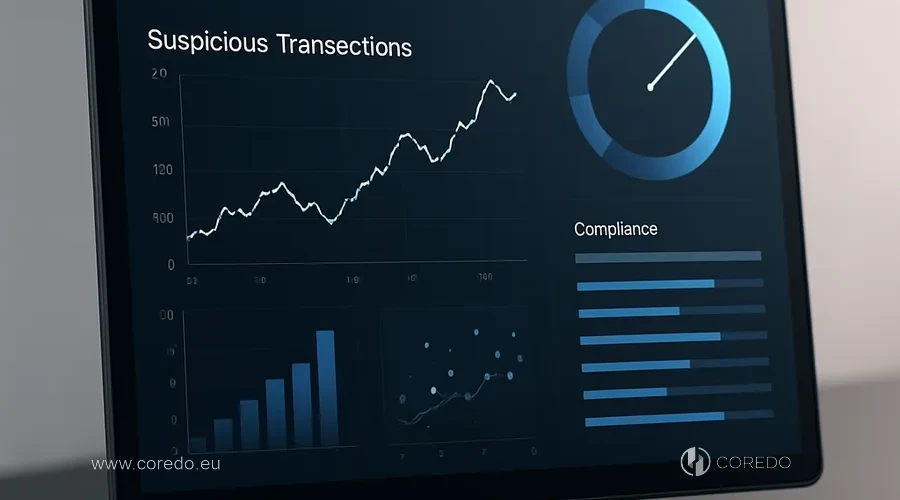
Compliance does not live in documents but in data and case‑level decisions. We configure processes so they are fast for the customer and persuasive for the regulator.
How to build an AML program in a neobank
The roadmap always starts with RBA: segmentation of customers, products, channels and geographies. Next — KYC/KYB, identity verification (IDV) and biometric verification with KYC orchestration to reduce friction and increase conversion. We incorporate PEP screening, Enhanced Due Diligence for high‑risk profiles, counter‑terrorism financing controls (CFT) and anti‑money laundering reporting requirements for payment services.
Transaction monitoring and algorithmic risk
Transaction monitoring systems require careful tuning of scenarios. We combine expert rules and machine learning for fraud detection with explainable AI to ensure algorithmic transparency. Model risk management is a mandatory layer: model governance, model backtesting, drift monitoring, model risk management in scoring and anti‑fraud systems. For complex schemes we use graph analytics and network analysis to improve signal quality.
Sanctions compliance
The sanctions program begins with a risk taxonomy and covers sanctions screening, OFAC/UN/EU lists and local registries. I recommend taking into account the impact of sanctions on supply chains and payments, supplementing vendor due diligence and continuous vendor monitoring. For complex jurisdictions we build a “dual‑track” counterparty screening and near‑real‑time monitoring of sanctions updates.
Regulatory reporting/SAR/audit trail
Suspicious Activity Report (SAR) and interaction with the FIU or FinCEN: an area where speed, completeness and security matter. We prepare regulatory reporting with clear SLAs, requirements for log retention and auditing (audit trail) and continuous monitoring procedures. This ensures reliability and readiness for sudden supervisory requests.
GDPR and data governance
Data is the lifeblood of fintech, and GDPR is the anatomy. I always start with a map of data flows, legal bases, and transfer boundaries.
Schrems II: SCC/BCR and privacy by design
GDPR: the legal aspects of transferring customer data require consideration of Schrems II and international data transfer mechanisms — SCC and BCR. At the same time, we implement privacy by design, DPIA and requirements for pseudonymization and protection of customer data. eIDAS facilitates cross-border payments and identification, but does not eliminate the need for thoughtful cryptography and access controls.
Outsourcing and third-party risks
Outsourcing is not a way to “shift responsibility”, but an area of increased regulatory scrutiny. I design controlled boundaries with clear metrics and accountable parties.
Outsourcing governance: evidence
We establish outsourcing governance, SLAs with suppliers, contractual frameworks and compliance warranties. In inspections regulators often ask: how to demonstrate risk management of suppliers and integrators? I use a package: vendor due diligence, continuous vendor monitoring, change control, failover tests and a plan to replace a critical provider.
Shared responsibility and cyber risks
Approaches to risk management when outsourcing cloud providers include the shared responsibility model, encryption, segmentation, least privilege and monitoring. Contractual guarantees are complemented by technical measures: logging, anomaly detection, periodic red team exercises and independent audit.
Cross-border supervision and coordination
Interagency coordination and cross-border supervision mean that queries may come from several regulators at once. I proactively arrange communication channels, mapping of regulatory requirements and allocation of roles within the team to ensure a coordinated position.
Regulatory transformations, automation
Regtech today is not a fashionable option, but a way to keep pace with change. I evaluate not only functionality, but also TCO (total cost of ownership) and ROI from investments in AML and regulatory automation.
AML roadmap and change management
The roadmap for implementing an AML project at COREDO consists of discovery, design, build, validate, run. We create regulatory intelligence and mapping of regulatory requirements, configure continuous controls monitoring and prepare the team through targeted training. Change management mitigates the risks of service disruption and loss of knowledge.
Regtech platforms: performance metrics
We select regtech platforms for compliance automation, focusing on integration with core systems and scalability. Metrics: KPIs and KRIs include false positive rate, average investigation time, SAR quality, share of detected cases by key patterns, as well as case management system metrics. These metrics feed into board reporting and show how compliance supports growth.
Regulatory inspections: preparation
Inspections are part of a license’s lifecycle. The more transparent the processes, the smoother the inspection.
Checklist for AML inspection readiness
The regulatory checklist for launching a payment product includes confirmation of capitalization, governance, IT and security, AML/CFT and data protection. How to prepare a company for an AML regulator inspection? We build an audit trail, pre-assign communication owners and compile an “evidence package”: policies, triage procedure, logs, case examples and SAR. internal audit helps to capture an objective picture before the inspectors arrive.
Reputational risk and dealing with findings
After an inspection, a constructive follow-up is important. I use a matrix of findings’ severity, owners and deadlines, and regular reports to the board. This strengthens regulator trust and reduces reputational risk during inspections.
COREDO case studies: what worked
Examples are the best way to show how approaches come to life in real projects. Below: several case studies where the COREDO team delivered on complex objectives on time.
EMI in Cyprus: capital, safeguarding
For a B2B‑fintech we launched an e‑money license in Cyprus. We developed a capital adequacy model with reverse stress testing, set up safeguarding and an escrow model, and established client money rules. For PSD2 compliance we connected open banking modules with eIDAS certificates and carried out a DPIA. The regulator accepted the operating model without additional rounds of questions, a sign of maturity in the documentation and processes.
VASP in Estonia: Travel Rule
A crypto service in Estonia required a VASP license and a full AML/CFT framework. We implemented KYC/KYB with biometrics, configured the Travel Rule, integrated sanctions screening against OFAC/UN/EU lists and network analysis to identify high‑risk wallets. The regulator noted strong explainability in the detection models and transparency of case management.
Neobank in the UK: SM&CR and sandbox exit
For a European startup we designed participation in the UK sandbox and built an SM&CR matrix for senior managers. We defined sandbox metrics, continuous monitoring and a commercialization plan. The sandbox exit strategy included scaling compliance and an international data architecture taking Schrems II and SCC into account.
EU institute: cross-border outsourcing
In a payment institution project in the EU we established outsourcing governance with the cloud provider, defined SLAs and control points, conducted vendor due diligence and continuous vendor monitoring. The regulator requested evidence of supplier risk management, and the prepared package demonstrated process maturity, including contractual guarantees and resilience tests.
Roadmap for the fintech leader
To translate regulatory requirements into growth, I propose a simple framework. It helps the fintech director maintain a balance between product and supervision across different regions.
Steps for scaling compliance
- Formulate the regulatory risk appetite and tolerance statements, align them with the board, and operationalize them into metrics.
- Build the three lines of defense, define critical KPIs for the fintech director on risk and compliance, and integrate them into the OKR cycle.
- Deploy regulatory intelligence, account for fintech regulation in Europe, MAS and HKMA/SFC in Asia, and evolving expectations in Africa.
- Plan compliance scaling when entering international markets: passporting where possible and localization where required.
- Prepare incident response and communication with the regulator, including inter-agency coordination and cross-border supervision.
Resilience – discipline, not an accident
Over the years I have learned: a reliable fintech company grows from discipline in the details, from choosing a jurisdiction to configuring transaction monitoring systems and board reporting. Yes, regulation changes and becomes more complex. But with a sound governance architecture, a clear RBA and thoughtful automation, regulatory requirements become an ecosystem where it is easier for a business to grow and earn trust.
The COREDO team has delivered dozens of projects in the EU, the UK, Singapore, Estonia, Cyprus and Dubai: and each time our approach has remained the same: transparency, measurability, risk manageability and respect for the logic of supervision. If you are building a payment service, an e-money provider, a crypto service or a neobank, I have a simple recommendation. Start with a requirements map and an honest assessment of operational maturity, then step by step build processes that will withstand inspection in any jurisdiction. This is how a business that is trusted by customers, banks and regulators is created, and how it scales steadily without unexpected regulatory “brakes”.