
COREDO – EU Legal & Compliance Services Expert legal consulting, financial licensing (EMI, PSP, CASP under MiCA), and AML/CFT compliance across the European Union. Headquartered in Prague, we provide seamless regulatory solutions in Germany, Poland, Lithuania, and all 27 EU member states.

Nikita Veremeev
23.01.2026 | 6 min read
Updated: 23.01.2026
As the CEO and founder of COREDO, I see every day how entrepreneurs from Europe, Asia and the CIS face a maze of AML regulations. Since 2016 our team has supported company registrations, obtaining financial licences and implementing compliance in key jurisdictions — from the Czech Republic and Cyprus to Singapore and Dubai. Today, as 6AMLD and the EU AML Regulation change the rules of the game and AMLA gains momentum, choosing the right approach determines success. In this article we analyze AML regulations in the EU, the UK and Switzerland, the key differences and the strategies the COREDO team applies for clients. You will receive practical tools to optimize CDD, reduce false positives and scale your business without risks. In recent years dozens of financial and investment structures have gone through COREDO projects: fintech startups, crypto providers, payment institutions, family offices and holding companies. We have supported clients during bank investigations, regulatory inspections, license interviews and AML remediation projects after fines. It is this hands-on experience that underpins the conclusions of this article.
AML during registration: why is it the main challenge?

As CEO of COREDO I personally take part in designing AML models, negotiating with banks and preparing clients for regulatory inspections. We build systems as if an audit by AMLA, the FCA or FINMA could start the next day.
Registering a legal entity abroad is not just a formality. COREDO's experience shows: banks and regulators require substance and transparency from day one. In the EU, 6AMLD strengthens directors' responsibility for beneficial ownership, in the UK post-Brexit AML focuses on SM&CR, and Switzerland through AMLO-FINMA and TLEA emphasizes a risk-based approach.
The COREDO team recently helped a fintech startup from Estonia obtain a crypto license in the EU: we integrated FATF recommendations into the structure, providing sanctions lists screening and transaction monitoring. Result: launch in 4 months without delays. The project started with high risks of rejection: the client had crypto operations, a cross-border structure and investors from multiple regions. We rebuilt the ownership model, AML frameworks and onboarding procedures even before submitting documents to the regulator. Such cases confirm: ignoring AML in the EU, the UK or Switzerland leads to account refusals and fines of up to millions of euros.
AML EU vs UK vs Switzerland
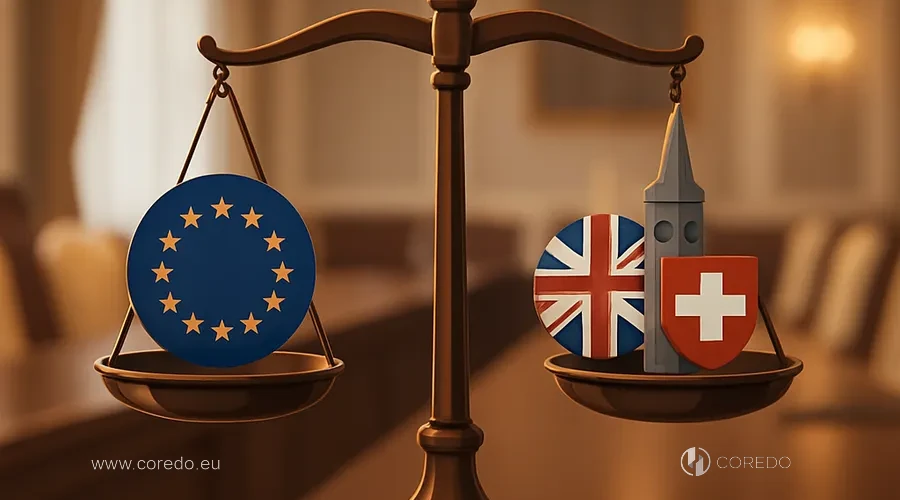
Let's break down the AML comparison by key parameters. The solution developed at COREDO always starts with a risk matrix that takes into account 6AMLD enforcement, Swiss AMLA and UK AML rules.
In our work we use a multi-level AML model:
- regulatory layer (supervisory areas, licenses, AMLA/FCA/FINMA),
- control layer (CDD/EDD, transaction monitoring, SAR, training),
- operational layer (onboarding, IT architecture, data, reporting).
It is at the intersection of these layers that systemic errors most often occur.
| Aspect | EU (6AMLD, AML Regulation, AMLA) | UK (post-Brexit AML) | Switzerland (AMLO-FINMA, TLEA) |
|---|---|---|---|
| CDD/EDD | Mandatory risk-based approach; EDD for PEPs and high-risk; eIDAS for digital ID. Harmonization through AMLA supervisory powers by 2026. | Strict CDD under FCA and PRA cooperation; focus on SM&CR for senior managers. | Enhanced Due Diligence under FINMA oversight; TLEA requires a register of beneficial owners with public access. |
| Transaction monitoring | Centralised AMLA supervision; AI-driven AML systems for false positives reduction. | Decentralised, but influenced by Annex IV reporting; RegTech is mandatory for P2P. | In-house controls under FINMA; Automated KYC with a focus on AML liquidity management. |
| Penalties | Up to 10% of turnover; 6AMLD strengthens criminal liability. | Up to £10 mln; Senior Managers Regime personalises risks. | Up to CHF 500k; AMLO-FINMA emphasises group-wide AML policies. |
| Implementation | Direct applicability Regulation; national transposition by 2027. | Self-regulation with the Bern Financial Services Agreement for equivalence. | Swiss AMLA with CDB 20 revision; FATF compliance through the Bern Agreement. |
AML Switzerland vs EU wins on flexibility for high-risk financial institutions, but the EU leads on unification. UK vs EU AML differs by decentralisation: in Britain there is more focus on internal controls, in the EU on centralised supervision by AMLA. COREDO's practice confirms: for multi-jurisdiction businesses the optimal solution is a single AML framework integrating EU AML 2026 with Swiss AMLA.
Implementation strategies: from registration to compliance
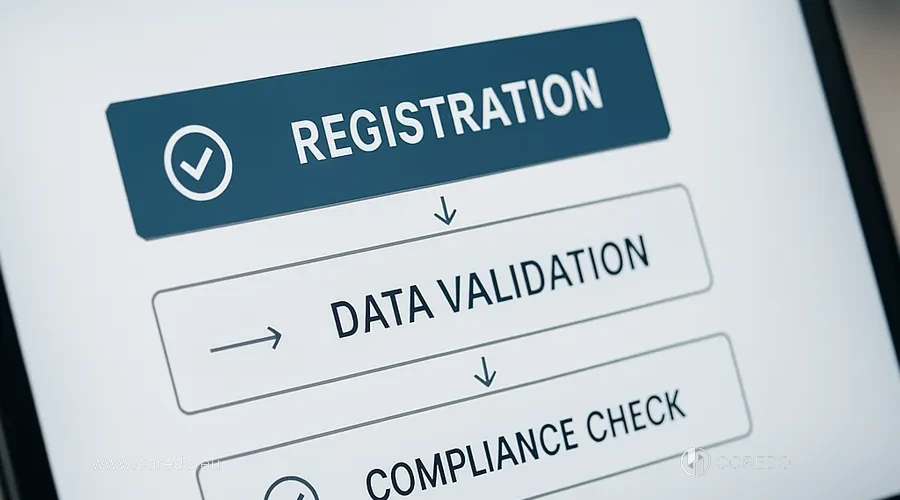
Implementation strategies: from registration to compliance is a comprehensive approach that enables businesses to consistently build a system for regulatory compliance while minimizing the risks of fines and reputational damage. Starting with registration with built-in AML, where correct configuration of onboarding checks plays a key role, companies avoid common mistakes and smoothly move to full compliance through risk assessment, policies and monitoring. Most AML failures occur not at the licensing stage but much earlier — during the design of the structure and the first banking contacts. Therefore, we always view registration as the first element of a compliance architecture, not as a separate legal service.
Registration with AML: common pitfalls
When registering in the EU (Cyprus, Estonia) or Asia (Singapore) our experience at COREDO emphasizes: start with pre-investment disclosures and a beneficial ownership register. For a client from the CIS we registered a holding in the Czech Republic under 6AMLD, providing unified ownership structures. Banks opened accounts within a week: the key is audit-ready transparency.
In Switzerland TLEA requires a detailed register of owners. The COREDO team prepared documents for a payment platform, integrating ongoing compliance monitoring; this saved 30% on audits.
licensing: crypto, forex, payments
Financial licensing in the EU (Poland NPI/SPI, Lithuania) now includes Crypto-asset service providers (CASPs) under AIFMD II. In the UK: via the FCA, in Switzerland - FINMA. COREDO implemented 15+ licenses: for a forex broker in Dubai we set up transaction monitoring, reducing false positives by 40% with RegTech solutions. These projects covered different risk profiles — from payment institutions to crypto-custody and brokerage models, which allowed us to develop universal AML frameworks for multi-jurisdictional business.
The differences between 6AMLD and the Swiss AMLA are critical: the EU focuses on Terrorist Financing (TF), Switzerland on operational risk mitigation. The choice depends on your focus: for the EU - harmonized EU rules, for Switzerland, mutual recognition/equivalence with the UK.
AML consulting: automation and scaling
The impact of AMLA on high-risk institutions in Europe, increasing requirements for group-wide AML training. ROI from automated AML systems in the EU and UK reaches 5x due to AI-driven reduction of false positives. For an Asian client we implemented intelligence-driven screening in Singapore, integrating eIDAS: operational costs fell by 25%.
For banks and regulators today, what matters is not so much policies as demonstrable effectiveness of systems: alert quality, speed of investigations, transparency of decisions. These are the parameters we build into AML architecture.
Scaling CDD in Switzerland vs the EU: Switzerland allows fragmented customer data with strong in-house controls, the EU requires centralised. Optimization of transaction monitoring for multi-jurisdiction: use RegTech for sanctions screening and PEPs, the COREDO team achieved 95% automation.
Penalty comparison: the EU leads (up to 10% of turnover), Switzerland is milder, but FINMA is strict with banks. The Bern Agreement simplifies AML compliance for UK-Swiss firms in the EU.
Long-term risks: how to minimize

Non-compliance risks with EU AML Regulation 2027 are reputational and financial. The long-term effects of AIFMD II amplify liquidity risks in the EU vs UK SM&CR. Preparing for TLEA in Switzerland: focus on beneficial owners disclosures.
COREDO offers internal AML department outsourcing: full support from registration to group-wide policies. Our approach is risk-based, with AI AML for false positives reduction and T+1 settlement impact. In all projects we operate on a regulator-first and bank-ready basis: each structure is designed to withstand inspection by the regulator, the bank and the auditor simultaneously.
Conclusion: AML as a competitive advantage

AML in 2026 is no longer about formal compliance with directives. It's about business architecture, resilience to regulatory risks, and the ability to scale without losing access to banks, investors, and markets.
The convergence of approaches in the EU, UK and Switzerland via AMLA, 6AMLD and FINMA means one thing: fragmentary solutions stop working. Companies that continue to build AML as a set of documents will face account freezes, protracted licensing processes and reputational losses. Those that build a single, risk-oriented and technologically supported AML framework gain a strategic advantage — they enter markets faster, attract partners more easily, and grow sustainably.
COREDO's practice shows: when AML is integrated into the business structure — from company registration to transaction architecture and investor onboarding — it stops being a drag and becomes growth infrastructure. It is precisely this approach that companies choose today when they are focused not on a short-term launch but on a long-term presence in regulated markets.
In an environment of increased supervision, the main question is no longer "how to pass an inspection" but "how ready is your model for continuous oversight". The answer to that question determines which businesses will survive the new wave of AML regulation and which will be forced out of the market.