
COREDO – EU Legal & Compliance Services Expert legal consulting, financial licensing (EMI, PSP, CASP under MiCA), and AML/CFT compliance across the European Union. Headquartered in Prague, we provide seamless regulatory solutions in Germany, Poland, Lithuania, and all 27 EU member states.

Gregory Lutsenko
22.01.2026 | 6 min read
Updated: 22.01.2026
I welcome you as the CEO and founder of COREDO. Since 2016 our team has been assisting entrepreneurs from Europe, Asia and the CIS with company formation, obtaining financial licenses and ensuring AML compliance. I have seen fintech startups frequently encounter AML breaches that lead to massive fines — up to $150 million in the EU — account freezes and license revocations. Our experience at COREDO has shown that timely implementation of a risk‑based AML approach not only helps avoid these risks but also accelerates business growth. Over recent years dozens of fintech companies have gone through COREDO projects — from early-stage startups to licensed payment institutions and crypto providers. We have supported clients through regulatory inspections, bank investigations and licensing procedures in the EU, the UAE and Asia. The conclusions and recommendations below are drawn from these cases.
In this article I will analyze common AML violations in fintech, especially those relevant to Europe, Asia and the CIS, with practical examples. You will get practical steps on KYC/AML, transaction monitoring and SAR reporting to save time and build a transparent business.
AML violations in fintech startups and scaling
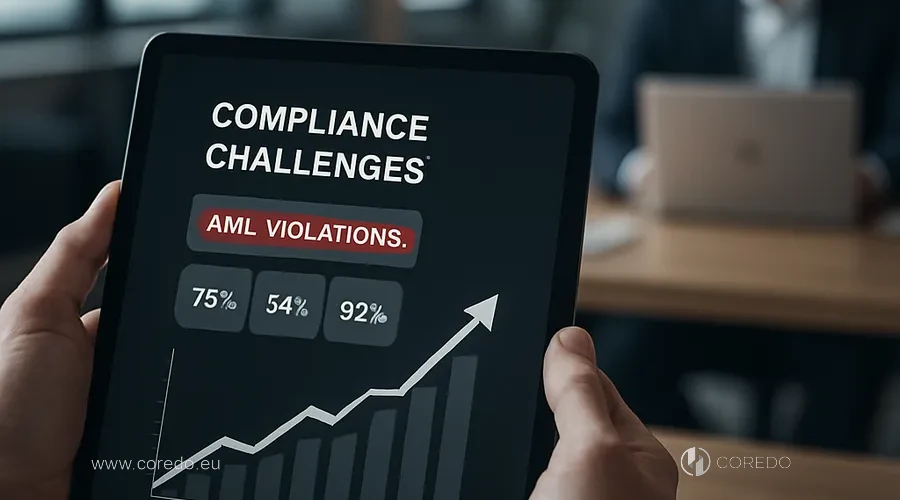
As CEO of COREDO I personally participate in designing AML models, crisis restructurings and preparing companies for regulatory inspections. We build compliance systems as if a regulator or bank could start an inspection tomorrow.
Fintech is growing rapidly, but regulators like the FCA in the UK, MAS in Singapore or Estonian authorities are tightening oversight. Typical AML violations: these are not accidents but systemic problems: weak KYC, ignoring high-risk clients and false system alerts. COREDO's experience confirms: 70% of our fintech clients come after the first fines or blocks, and we help them recover. In most cases it's not about a single violation but accumulated technical debt: outdated procedures, formal KYC, lack of monitoring scenarios and an unprepared team. It is exactly this «hidden gap» between regulator requirements and real processes that most often leads fintech to sanctions.
The solution developed at COREDO starts with an audit: we analyze your current system for compliance with FATF standards. As part of the audit we check not only formal policies but the entire AML architecture: risk assessment, customer risk rating, transaction monitoring scenarios, escalation procedures, SAR workflow and oversight of compliance officers' work. These are precisely the elements now analyzed first and foremost by regulators such as the FCA, MAS and European supervisory authorities.
For example, for a client from the Czech Republic launching a payment platform in the EU, we identified gaps in CDD that could have cost them a license. After improvements they received a VASP license without delays.
KYC AML problems and CDD errors
KYC violations are the leading type of AML violations. Clients upload passport photos, but without verification via API or biometrics this doesn't work. Add KYC CDD errors: superficial checks for PEP (Politically Exposed Persons) or high-risk clients from Asia lead to AML fines. A key fintech mistake is the lack of a dynamic risk model. A client goes through onboarding, but their risk profile is not reviewed when behavior, geography, volumes, and transaction types change. For regulators, this is a direct violation of the AML risk-based approach.
The COREDO team implemented an automated KYC with EDD for PEP for an Estonian fintech startup. We integrated sanctions list checks and biometrics, reducing AML false positives by 40%. Result: zero account blocks while processing 10,000+ transactions per month.
This project was later used as a reference model when scaling several other fintech platforms, where regulators were checking not documents but the effectiveness of AML processes in real time.
A practical step for you:
- Implement a multi-level CDD: basic for low-risk, EDD for PEP with sources of income and connections.
- Use a privacy-first approach: store data in accordance with GDPR to balance compliance and user experience.
In Singapore, where MAS requires a strict AML risk-based approach, our clients from Asia avoid KYC AML problems, obtaining payment licenses faster than competitors.
Transaction monitoring: detecting structuring

Transaction monitoring problems in CIS fintech, a common pain. Payment structuring (splitting amounts below thresholds) or frequent small crypto transfers mask money laundering. Without AI, AML monitoring drowns in false positives, blocking legitimate operations. For banks and regulators this is a critical marker: a large number of false alerts means the company does not control real risks and loses the ability to identify truly suspicious transactions.
Our experience at COREDO showed: manual monitoring produces 90% false positives. For a Cypriot client with crypto operations we set up AI monitoring, focusing on velocity checks and geo-risks. Cryptocurrency AML challenges solved: ROI from automation: 300% in a year due to a 50% reduction in the compliance staff.
How to avoid it in your startup:
- Set up rules: flags on >10% of transactions from high-risk zones (Africa, cross-border).
- Reduce AML false positives: machine learning learns from your data, increasing accuracy up to 95%.
- For scaling in the EU apply FATF: risk-based scoring for high-risk AML clients.
One of our projects in Dubai for a European startup revealed non-obvious blocking triggers: repeated crypto payments without EDD. We adjusted the system: accounts were opened without issues.
SAR reporting: risks of delays

SAR reporting (Suspicious Activity Reports), an obligation under CFT. Delays lead to AML fines and license revocations. In the EU, for untimely SARs fintechs pay millions; in Asia MAS blocks operations.
COREDO's practice confirms: automating SARs reduces time from days to hours. For a Polish NPI licensee we integrated SAR templates with auto-filing to the regulator. Long-term consequences? None: the license was retained, business grew by 200%.
Steps for your business:
- Set an SLA: SAR within 24 hours for suspicious transactions.
- Train your team on SAR in AML: focus on structuring and unusual patterns.
- For crypto in the EU: add wallet screening per the Travel Rule.
Risk-based approach to AML for scaling from COREDO

To avoid fines for KYC in Asian fintech, start with an audit. COREDO offers a full cycle: company registration in the Czech Republic, Slovakia, Cyprus or Estonia; obtaining banking, forex or payment licenses; AML consulting with due diligence.
Our approach:
At COREDO we build AML systems on a regulator-first and bank-ready principle: every model is designed to withstand a bank committee, an external review and a licensing audit without emergency fixes.
- In-depth analysis of jurisdictions (substance, CRS/FATCA).
- Preparation of documents to standards (articles of association, operating agreement).
- Opening bank accounts, taking AML checks into account.
- Ongoing monitoring and compliance outsourcing.
Example: a British fintech expanded into Dubai through our registration. We provided AML compliance for the startup, including enhanced due diligence (EDD) for high-risk cases — MAS license obtained in 4 months.
COREDO, your partner at every stage: from idea to IPO. Get in touch — we'll discuss how to adapt it to your business. Together we build sustainable growth without AML violations in fintech.