
COREDO – EU Legal & Compliance Services Expert legal consulting, financial licensing (EMI, PSP, CASP under MiCA), and AML/CFT compliance across the European Union. Headquartered in Prague, we provide seamless regulatory solutions in Germany, Poland, Lithuania, and all 27 EU member states.

Alena Sharykava
16.03.2026 | 6 min read
Updated: 16.03.2026
I founded COREDO in 2016, when entrepreneurs were increasingly entering international markets but ran into two systemic problems: complicated company registration abroad and growing compliance requirements. Over the years the COREDO team has implemented projects in the EU, the United Kingdom, the Czech Republic, Slovakia, Estonia, Cyprus, Singapore and Dubai, helping clients build a sustainable architecture for registration, licensing and AML. In this article I have compiled approaches and practical methods that deliver predictable results: from building a client risk profile to automating KYC and reducing the cost of compliance without sacrificing quality.
It’s important for me to speak concretely and without generalities. An entrepreneur needs a clear roadmap: where to open a company, which license to obtain, how to pass a bank’s KYC procedure and which elements of an AML compliance framework the regulator actually considers effective. COREDO’s practice confirms: the sooner you build a risk-oriented model and document decisions for audit, the faster the business grows and the easier it is to scale it across multiple jurisdictions.
Architecture of international presence

Geography affects everything: taxes, requirements for beneficiaries, bank onboarding timeframes and even the form of internal control. Our experience at COREDO has shown that for tech companies a convenient combination is Estonia or the Czech Republic for the operating company, Cyprus or Slovakia for the holding structure, and the United Kingdom or Singapore for client trust and payment infrastructure. For expansion into the Middle East, Dubai offers quick access to banking services and clear regulatory requirements with the right pre-risk assessment for the bank.
When choosing a jurisdiction we evaluate not only taxes and corporate law. We go through the bank’s client risk policy in the target market, availability of electronic identifiers (eID), biometric verification capabilities and requirements for beneficial ownership verification. Beneficial ownership registries in the EU have simplified owner verification, but for multi-jurisdictional structures it is useful to map out the ownership chain in advance and document its source of truth (data lineage).
Licenses: requirements and timelines
financial licenses set KYC/AML standards and determine the depth of CDD. In the EU payment institutions (PI) and electronic money institutions (EMI) require a mature KYC policy, an operational client risk-category matrix and transaction monitoring procedures. In Singapore, MAS focuses on a risk-based approach, enhanced due diligence (EDD) for high-risk segments and clear engagement with the FIU when filing SAR/STR.
For crypto business regulators expect a dual layer of controls: sanctions screening of clients and analysis of transaction chains on the blockchain, including DeFi scenarios. The solution developed at COREDO for crypto operators includes client risk scoring taking into account counterparties’ jurisdictions, PEP customer verification and rules for measures: rejection, restriction, monitoring. For forex and banking licenses the criteria become stricter: procedures for managing clients’ risk portfolios, regular reporting to management and demonstrable effectiveness of AML measures by metrics the regulator understands are important.
Bank policy and KYC onboarding
Opening an account today is not a “paper” story, but a full case of client risk assessment. The bank conducts a compliance assessment of the client, checks the client’s AML profile and compares it with the bank’s internal client risk policy. For successful KYC completion, consistency in the bank’s procedure is critical: incorporation documents, information about activities, verified sources of funds, assessment of beneficial owners (beneficial owner) and the existence of a clear risk narrative.
The COREDO team achieves predictability by preparing a risk dossier: creating the client’s risk profile, segmenting clients by risk and describing monitoring plans. Such a package eases interaction, reduces the number of bank requests and increases trust from compliance officers.
Risk-oriented AML framework
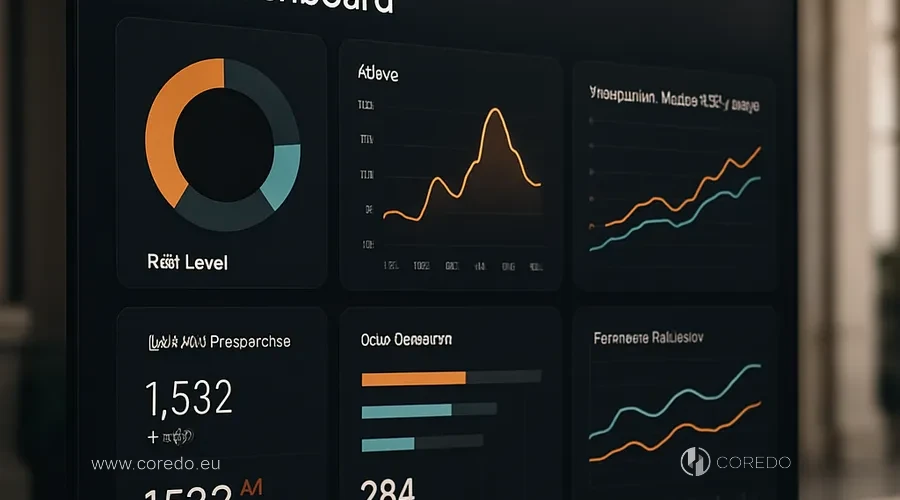
I view AML as a management system rather than a set of regulations. The structure we implement always starts with strategy and ends with measurable business outcomes: onboarding speed, reduction of the false positive rate, audit transparency and real risk reduction.
Risk profile and category matrix
The client risk assessment algorithm is based on factors: geography, product, channels, behavioral metrics, ownership structure and historical transactions. Client risk-classification methods are recorded in a client risk-category matrix with escalation thresholds. We apply client risk ratings as the basis for CDD depth and the frequency of periodic reviews.
In the case of complex owners we use beneficial owner verification with cross-checking through beneficiary ownership registries in the EU and external data enrichment sources. For high-risk groups we assign enhanced customer due diligence (EDD): beneficiary interviews, extended documentary verification of the origin of funds and independent references from partner data providers.
CDD/EDD, PEP and sanctions screening
Basic CDD covers identification, document verification and assessment of the business model. In EDD we add sanctions monitoring and watchlist screening (OFAC, EU, UN), PEP — politically exposed person identification and risks, and we clarify risk scenarios: money laundering and terrorist financing. For risk-critical clients we enable transaction monitoring with preconfigured rules and manual investigation through a case management system.
When suspicion arises, it is important to act quickly and correctly. I always insist on a clear SAR/STR procedure and a protocol for interaction with the Financial Intelligence Unit (FIU). This protects the business, reduces regulatory risks and demonstrates the maturity of internal control.
Portfolio management and reporting
The strategic level is the management of the clients’ risk portfolio. We build client risk reporting for management: segment heat maps, risk-category dynamics, KRIs for the Chief Compliance Officer and KPIs on onboarding speed. I separately present AML performance metrics: precision/recall for alerts, time to investigate (TTR), cost per alert and the share of automatic closure of low-risk cases.
Such a report makes compliance understandable for the board and the risk committee. Executives see the impact of political and economic conditions on the client risk profile, understand where to strengthen monitoring and how to optimize the budget without losing quality.
KYC Automation and Risk Monitoring
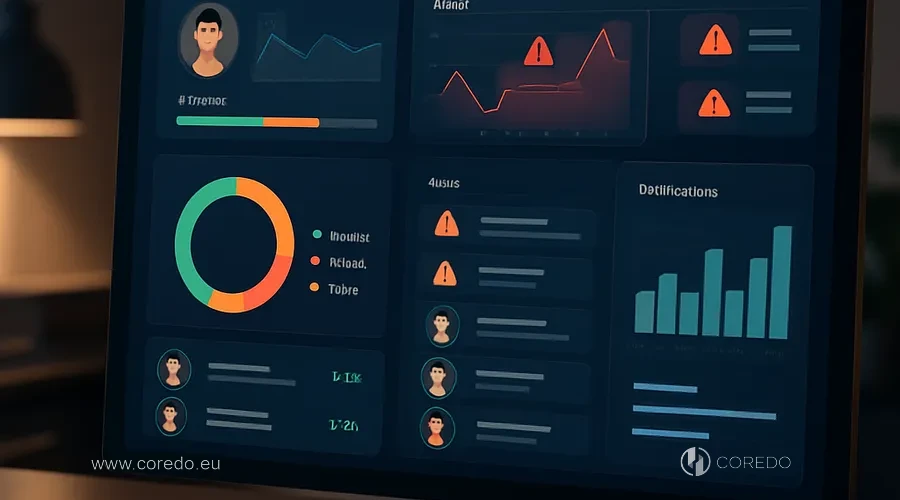
Manual review processes do not scale. At COREDO we build a hybrid approach: rules plus ML to achieve explainability of decisions and flexibility to adapt to changing customer behavior patterns.
Risk scoring algorithms
Customer risk scoring starts with a transparent algorithm: factor weight coefficients, escalation thresholds, and linkage to compliance actions. Then we add ML-based scoring models for AML, for example gradient boosting to aggregate weak signals and transaction clustering to detect anomalies. For new patterns we use unsupervised approaches, and for hypothesis testing — supervised ones.
Explainable AI (XAI) in customer risk assessment is mandatory. I require local feature explanations (SHAP/LIME) for every alert so that an analyst can make decisions quickly. This increases trust in the system, reduces staff training, and accelerates investigations.
Quality metrics and false positives
Optimization of metrics, continuous work. We monitor precision/recall, manage false positives, control methods to reduce false negatives without increasing false positives, and measure accuracy, speed, and cost. Transaction monitoring rule tuning is carried out through A/B testing of monitoring rules and scenario stress testing.
Managing false positives in monitoring delivers immediate savings. When alerts become smarter, TTR falls, analysts focus on truly risky cases, and the regulator sees an appropriate workload and a mature case management system.
How to integrate and manage models
Integrating AML with core banking, CRM, and ERP via API enables closing the full onboarding and monitoring cycle. I recommend integrating risk scoring into the bank’s CRM so that relationship managers have the customer’s up-to-date risk profile at the moment of interaction. Investigation workflows in case management platforms record RBAC, audit trails, and documentation of decisions for external audit and regulators.
For model resilience, DevOps/MLOps is required: validation, back-testing, documentation, and model governance. We monitor model drift and concept drift, set alerts for deviations, and pass retrained models through the model and compliance committee before release.
Data Privacy

Data, the fuel for KYC/AML. Data quality determines how accurately risk scoring works and how often the bank asks additional questions.
How to assess sources and quality
Assessment of data quality for KYC includes completeness, accuracy, timeliness, consistency and data lineage. We apply data enrichment and external data sources for KYC: data providers like Refinitiv World-Check, LexisNexis and Dow Jones cover sanctions and PEP screening, court registers and adverse media. For cross-border structures we use beneficial owner verification challenges for cross-border corporates relying on local registries, notarial records and independent reports.
Graph analysis and link analysis help reveal hidden connections between companies and beneficiaries. In cryptocurrency cases we apply transaction chain analysis and counterparty risk markers, which strengthens transaction monitoring and transaction-level risk assessment.
GDPR: personal data protection
Data privacy and GDPR in KYC are an absolute priority. We design privacy by design, apply RBAC, encryption, pseudonymization and manage cross-border transfers of personal data. Exchange between branches in different jurisdictions is documented via standard agreements and DPIA, and access to sensitive data is restricted by a role model and audit logs.
Regulators expect mature processes for access, consent and storage. This is not only about legal compliance but also about the trust of clients and partners.
Scaling the operating model

Compliance resilience shows up in everyday work. Business processes and team training are more important than any technology.
EDD in complex jurisdictions: reviews
Business processes for EDD in complex jurisdictions include document checklists, interviews with key persons, independent sources of verification and escalations to the risk committee. For clients with high risk ratings we implement continuous monitoring of client relationships and CDD, and for others we follow best practices for periodic reviews and KYC refresh cycles.
We separately record rules for correct risk classification for SME and corporate clients. Standards remove discrepancies and increase the replicability of decisions in international teams.
Outsourcing vs. in-house: costs
Outsourcing AML and vendor Due Diligence is a practical tool to speed up. We assess vendor risk, SLAs, data quality, process resilience and prepare responses to the questions regulators ask. At the same time, we keep key decisions on client risk in-house, and use the external perimeter for screening and initial processing.
Cost optimization for AML processes is based on reducing cost per alert, automatic closure of low-risk alerts and sensible segmentation. The return on investment in AML automation (AML ROI) becomes visible when we account not only for savings but also for faster onboarding and reduced client attrition from banks.
Scaling an international group
Scalability — how to scale KYC as the client base grows — is achieved by standardizing artifacts and exchanging data between branches in different jurisdictions. We create a single catalog of KYC attributes, integration APIs and local adapters for the regulatory requirements of Europe and Asia. This approach allows maintaining a unified client risk profile and managing a global risk matrix without losing local specificity.
COREDO Case Studies: strategy and results
Case studies are better than any slogans at showing what works and what doesn’t. Below: three projects where the COREDO approach produced a measurable impact.
Crypto payments in the EU and Singapore
The client was developing payment infrastructure and crypto services in the EU and Singapore. The solution developed at COREDO combined legal entity registrations in Estonia and Singapore, obtaining a license for payment services and crypto authorizations, as well as transaction-chain analysis for crypto clients and DeFi. We implemented hybrid monitoring: sanctions and PEP rules plus ML models with anomaly scenarios.
Result: the bank approved the risk assessment, KYC was completed within 15 business days, false positives decreased by 34%, TTR by 41%. The regulator received transparent SAR/STR, and the board received client risk reporting for management on a monthly cycle.
Forex or bank license: comparison
An international group was choosing between a Forex license in the UK and expanding a banking license in one of the EU countries. The COREDO team conducted a client risk assessment and a scenario matrix, took into account EBA guidance, EU AML Directives and expectations regarding capital adequacy. We modeled the bank’s client risk policy with different client portfolio options and carried out stress-testing of the client portfolio for AML risks.
The group chose the route of a Forex license with strengthened EDD practices for high-risk regions. This reduced capital strain, simplified interaction with the FIU and preserved flexibility in payment routing. The risk committee approved a roadmap for implementing risk scoring in the bank with phased control of KPI/KRI.
Scoring in Dubai to reduce TTR
A fintech from Dubai faced an increase in alerts and analyst overload. We integrated risk scoring into the CRM, added explainable AI (XAI) for compliance decision-making and restructured the investigation workflow in the case management system. Additionally, the COREDO team updated KYC policies and procedures, introduced identity proofing and biometric verification for high-touch segments.
After two months TTR decreased by 52%, cost per alert decreased by 27%, and the share of EDD investigations became more targeted due to correct client risk segmentation. The regulator noted improvements in audit trails and documentation of decisions.
Risk Management and Audit
The right governance structure provides stability and predictability. I always establish the “compliance as part of corporate governance” track, not “compliance as a function”.
The Board’s Role in the Risk Committee
The Risk Committee approves the risk-category matrix, escalation thresholds, and rules for taking action. The Board adopts the bank customer’s risk policy, monitors resource adequacy, and signs reports for regulators in Europe and Asia. Access control and management’s role in KYC are set out in the regulations, and decisions are recorded for subsequent external audit.
We pay attention to evaluating and documenting risk decisions for audit so that any external examiner can trace the logic and data sources. This approach strengthens trust and reduces the likelihood of regulatory sanctions and reputational risks in the event of KYC errors.
Compliance with International Standards
Adherence to the European AML Directives (AMLD5, AMLD6), FATF recommendations and EBA guidance is the foundation on which the framework is built. For sanctions, we manage OFAC and international sanctions risks with regular updates to the lists. SAR/STR standards and interaction with the FIU are formalized in instructions, and analyst training and change management during AML implementation are conducted according to a schedule agreed with the CCO.
This architecture does not overburden the business. It makes it resilient and ready for inspections at any time.
Compliance optimization and ROI
Compliance creates value when managed by metrics. I always ask to calculate the effect and communicate it to the board.
Business automation case
The business case for implementing an AML platform includes a baseline of costs, a load forecast, a reduction in cost per alert, time to investigation and the impact on onboarding conversion. AML ROI: the calculation of return on investment in automation takes into account not only savings but also a reduction in rejections by banks and regulators.
COREDO practice shows that automation of KYC and CDD with proper segmentation and XAI reduces labor by 25–40% without increasing risk. It is important to set the right KRI/KPI and conduct quarterly reviews to capture the benefit.
Quality tuning
Rule optimization is not a one-off project. We apply methods to reduce false negatives without increasing false positives, run A/B tests on a subset of clients and monitor concept drift. Based on the results we update thresholds, features and explanations for analysts.
The result: a sustainable balance between speed, quality and cost. The business grows, and compliance remains manageable.
How we launch projects at COREDO
Over the years at COREDO I have built a step-by-step approach that saves time and reduces uncertainty. It scales for companies from the EU, Asia and the CIS and adapts to the requirements of local regulators.
Target model diagnostics
We start with diagnostics: evaluation of the current AML compliance framework, policies and procedures, data quality assessment, IT architecture and current metrics. Then we form the target model: KYC/AML strategy, risk matrix, monitoring and reporting, integration with core banking/CRM via API.
At the same time we roll out quick wins: sanctions screening of clients, PEP checks of clients, setting up basic transaction monitoring rules and a response plan for identified client risks. This delivers a quick impact and builds trust within the team.
Change management and training
We base analyst training on real cases. We cover EDD practices, SAR/STR standards, case management workflow and explainable AI. Change management supports the transition: procedures, roles, RBAC, SLAs and communications with the front office.
For control — clear KPI/KRI: TTR, false positive rate, precision/recall, quality of documentation and onboarding speed. The team sees progress, management receives transparent reporting, and the regulator gets a mature system.
Conclusions
International growth is no longer separable from compliance. Strong KYC/AML is not a brake but an accelerator if approached as a management system with clear metrics, a technological base and accountability at the board level. COREDO’s experience confirms that properly forming a client risk profile, a well-thought-out client risk assessment and a transparent client risk policy of the bank simplify registration and Licensing, open doors to banks and reduce the total cost of ownership of compliance.
If you are preparing to enter new markets, planning licensing or want to strengthen a client’s AML profile, start with diagnostics and strategy. The COREDO team will help assemble the architecture: from registration in the EU, the United Kingdom, Singapore and Dubai to the automation of KYC and CDD, interaction with the FIU and building reporting for the board. This way you will gain a reliable long-term partner and turn AML from a set of requirements into a competitive advantage for your business.