
COREDO – EU Legal & Compliance Services Expert legal consulting, financial licensing (EMI, PSP, CASP under MiCA), and AML/CFT compliance across the European Union. Headquartered in Prague, we provide seamless regulatory solutions in Germany, Poland, Lithuania, and all 27 EU member states.

Nikita Veremeev
17.01.2026 | 6 min read
Updated: 17.01.2026
When an entrepreneur today hears from a bank or regulator “please provide source of funds and source of wealth“, it’s no longer a formal checklist but a real filter: will your business be accepted into the international financial system, will you be able to open an account in Europe or Asia, will you close an M&A deal or raise investment.
As the founder of COREDO I see this every day: strong or weak handling of SOF/SOW directly affects deal speed, the risk of account freezes and, overall, whether your international project will operate sustainably or constantly ‘burn’ on compliance.
In this article I’ll cover:
- how source of funds differs from source of wealth in practice;
- how businesses can build AML compliance around SOF/SOW;
- which best practices we apply at COREDO when working in the EU, Singapore, Dubai, the Czech Republic, Slovakia, Cyprus, Estonia and other jurisdictions;
- real cases and typical mistakes that cause clients to lose time, deals and reputation.
Source of funds vs source of wealth: what’s the difference?

The definition is well known in theory, but problems arise in practice.
- Source of funds (SOF) is the specific money in a specific transaction.
Where exactly the funds came from that you use to pay for a company, contribute capital to a European company, or transfer money to an investment platform. - Source of wealth (SOW) is the history of the client’s wealth formation.
How the beneficial owner (UBO) or an individual accumulated their wealth: through business, investments, inheritance, options, crypto assets, etc.
To simplify:
- SOF = the money in this transaction
- SOW = your total wealth and its origin over the years
Banks, licensed financial companies, crypto providers, payment institutions, forex brokers, electronic money issuers are required within customer Due Diligence (CDD) and enhanced due diligence (EDD) to understand both SOF and SOW: especially in Europe and developed Asian jurisdictions.
In practice:
- for a single large transaction: emphasis on AML source of funds;
- when working with high-risk clients, UBOs, PEPs, large business owners: focus on AML source of wealth.
Why SOF and SOW Are Needed for Businesses and Regulators

Regulators in the EU, the United Kingdom, Singapore, Cyprus and other countries that the COREDO team works with view SOF/SOW through the lens of anti-money laundering / counter-terrorist financing (AML/CFT).
Objectives:
- prevent the use of the financial system for money laundering and terrorist financing;
- reduce sanctions risks and the risks of dealing with prohibited persons and entities;
- ensure tax and corporate transparency (CRS, FATCA, UBO registers).
For businesses this means:
- without a clear history of the origin of funds and origin of capital, delays, refusals to open accounts, blocks on high‑value transactions, difficulties with M&A and attracting investment;
- without established AML compliance for SOF/SOW, the risk of fines, reputational loss, de-risking (when banks and providers terminate relationships ‘just in case’).
SOF vs SOW: what’s the difference?
A frequent conversation with a business owner:
“Everything I have is legal, I pay taxes. Why do you need source of wealth if there are declarations?”
I answer simply: the regulator and the bank look not only at legality, but also at logic and proportionality.
- SOF – we demonstrate why these funds logically belong to you and why they are the ones involved in this transaction.
- SOW – we demonstrate why your level of wealth realistically corresponds to your business career and financial history.
The COREDO team often starts a project with financial due diligence of the beneficiaries:
analyzes the corporate structure, the beneficiaries, the economic rationale of transactions, tax history, public information, and the client companies’ financial statements.
Sources of Capital
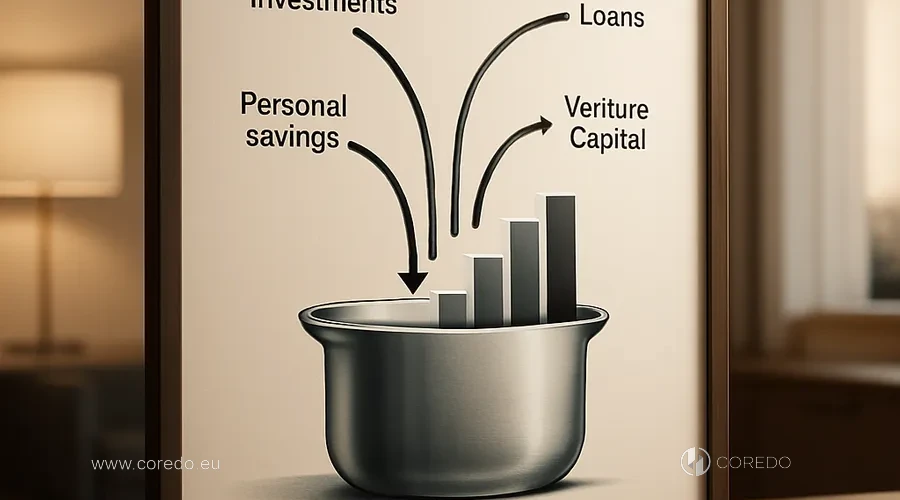
Classic sources of origin of funds and capital lie at the core of any financial compliance system and client reliability assessment. Understanding which specific sources of funds (SOF) and capital form assets allows you to properly design checks, reduce regulatory risks and transparently justify large transactions.
Sources of origin of funds
Typical sources of a client’s funds:
- profit and turnover of an operating company (invoice‑based);
- dividends from business;
- sale of a stake (SPA/share purchase agreement);
- loan repayment (loan agreements);
- investment income (capital markets, funds);
- crypto income (after conversion to fiat through regulated providers);
- refinancing or lending (facility agreements, bank loans).
Documentary evidence of source of funds:
- contracts, invoices, acceptance certificates, specifications;
- bank statements confirming receipt;
- tax returns and company financial statements;
- deal documents (SPA, loan agreements, security documents).
Sources of Wealth (SOW)
Sources of the client’s wealth:
- long-term business profits;
- sale of a business/holding (exit, IPO);
- investment portfolio (stocks, bonds, funds, private equity);
- inheritance;
- employer stock options and shares (especially in IT and the digital sector);
- crypto-assets, early investments in projects, online business.
Documentary evidence of source of wealth:
- financial statements and audited company reports;
- share purchase agreements, valuation reports, closing documents;
- inheritance documents;
- reports from brokers and investment platforms;
- digital traces (work history in large IT companies, data about startups, public deals, media);
- socio-economic biography: career, positions, participation in governing bodies.
Risk-based approach: how deep the checks go

Regulation in the EU, the UK, Singapore and other countries requires a risk-based approach when vetting clients.
This means: the depth of customer due diligence and enhanced due diligence depends on:
- the client’s jurisdiction and that of its counterparties (high-risk jurisdictions);
- the industry (cash‑intensive business, gambling, crypto, financial services);
- the status (PEP, high-risk customers, UBO of a complex structure);
- the size and nature of transactions (high-value transactions, M&A, large tranches).
If the client:
- is the owner of a large holding company,
- has a multi-level structure,
- has cross-border transactions through several jurisdictions, they will almost certainly be subject to enhanced due diligence on source of wealth, not just on SOF.
Cases from COREDO practice
Source of funds when purchasing real estate in the EU
Task:
a corporate client is purchasing commercial real estate in an EU country. Price: high‑value transaction.
Problem:
the bank requested AML source of funds. The client provided only the purchase agreement and internal management reporting. The bank intensified its requests, and delays began.
Solution developed by COREDO:
- analyzed the company’s business model, its transaction flow vs economic origin of funds;
- structured the SOF/SOW documentation:
- contracts with key buyers,
- invoices,
- bank statements for incoming payments,
- tax filings,
- a brief explanation of the economic logic (economic rationale of transactions);
- prepared an explanatory letter to the bank on behalf of the client, linking:
- the company’s turnover,
- margins,
- accumulation of profits,
- movement of funds prior to the purchase of the property.
Result:
the bank confirmed the source of funds and closed the deal without additional requests.
the bank confirmed the source of funds and closed the deal without additional requests.
Source of wealth of a fast-growing IT business owner
Task:
opening an account in a European bank for the holding company of an IT group owner with assets in several countries in Asia and the EU.
Problem:
the bank questioned the realism of the declared source of wealth:
over a relatively short period the entrepreneur showed a significant increase in net worth, some income came from the sale of stakes in startups and crypto assets.
Solution:
- collected digital traces as confirmation of source of wealth: participation in well-known IT projects, public transactions, mentions in the media, profiles on professional networks;
- documented the transaction history: SAFEs, convertible notes, SPA, valuation reports;
- for crypto assets – wallet exports, reports from verified crypto providers, KYC confirmations on exchanges;
- prepared a structured dossier on lifetime wealth analysis: how the client’s capital changed year by year, linked to specific events (project launches, share sales, investor exits).
Result:
the bank accepted the SOW, opened the account and did not increase the client’s risk rating beyond what was reasonable.
Mistakes in verifying source of funds and wealth
Over the years the COREDO team has seen dozens of recurring mistakes.
For businesses and beneficiaries
- Confusion between SOF and SOW: the same documents are sent “for all occasions”, without focus on the specific transaction.
- Ignoring ownership structure: multi-level holdings, trusts and funds without clear UBO documentation.
- Mismatch between source of wealth and income/lifestyle level:
lives like an UHNWI, but documents show average income. - Attempt to “overwhelm” the bank with documents instead of a structured package:
compliance officers care about logic, not the volume of paperwork. - Underestimating cross-border specifics: different jurisdictions in the flow of funds, lack of explanation of tax / legal rationale.
client checks for fintech and banks
- Unclear internal company policy on collecting SOF/SOW data.
- Formal risk-based approach: clients are assessed by checkbox, without regard to the business model.
- Lack of automation of transaction monitoring and SOF/SOW checks where justified.
- Insufficient integration of KYC / KYB compliance processes, customer due diligence and ongoing due diligence.
- Poor recording of decisions: no one plans in advance how to document source of wealth check results for the regulator.
How to prepare for an SOF/SOW review
I often tell entrepreneurs:
“the better you prepare before a bank’s request, the less likely you are to face freezes and delays.”
“the better you prepare before a bank’s request, the less likely you are to face freezes and delays.”
For the business owner / UBO
- Your wealth map (SOW)
– where the business originated,
– what the key transactions were,
– how capital changed year by year. - Document portfolio for primary sources
– business (financial statements, audit, contracts, dividends);
– sale of shares (agreements, valuation, closing documents);
– inheritance (notarial documents);
– investments (broker statements). - Readiness to explain “non-standard” cases
– crypto assets;
– online business;
– rapid growth over a short period. - Consistency between lifestyle and SOW
If your standard of living is clearly higher than the documented source of wealth, be prepared for additional questions.
For businesses that perform client checks themselves
- Approve at the board level internal AML policies & procedures for SOF/SOW.
- Set up a risk-based approach: who is subject to SDD, CDD, EDD; which triggers require enhanced due diligence.
- Describe regulatory expectations for SOF/SOW in the jurisdictions where you operate (EU, Asia, CIS).
- Define the data you collect at stages:
- onboarding of high-risk clients;
- ongoing monitoring;
- for high-value transactions.
- Decide what you do manually and where automation of processes for source of funds / source of wealth checks is appropriate (RegTech, screening, transaction monitoring).
Client at risk: discrepancies and indicators
When analyzing SOF/SOW the compliance officers we work with in the EU and Asia pay attention to red flags:
- mismatch of source of funds with the client’s profile:
for example, large payments from an industry unrelated to the declared business; - discrepancy between source of wealth and income level:
significant assets with minimal documented income; - complex multi-level structures without economic rationale;
- frequent cross-border transactions without a clear business rationale;
- use of companies from high-risk jurisdictions without a logical explanation;
- sudden appearance of large amounts without a history of their formation (no lifetime wealth analysis);
- client’s unwillingness to disclose information about the UBO and their SOW.
In COREDO’s practice there were cases when, due to unconvincing SOF/SOW:
- banks refused to provide services,
- blocked accounts until documents were provided,
- the client had to change financial partners and reorganize the transaction structure.
Automation of SOF/SOW: manual work and RegTech
For financial companies, crypto platforms, payment providers and licensed entities in the EU and Asia the challenge is:
how to scale AML compliance without drowning in operational manual KYC.
The approach that the COREDO team applies in projects:
- digital onboarding and eKYC: collection of basic KYC/KYB‑data and initial information on SOF/SOW online;
- integration of screening and sanctions compliance (sanctions lists, PEP, adverse media);
- transaction monitoring tied to typical SOF‑scenarios:
- operational revenue,
- investment transfers,
- loan repayments;
- risk triggers and alerts tailored to SOF/SOW:
- a sharp increase in transaction volume;
- changes in counterparties’ jurisdictions;
- emergence of unusual sources of funds;
- KYC remediation: periodic updating of SOW data as part of ongoing due diligence.
At the same time, the key is the balance:
- what can be automated,
- where human judgement is essential,
- how to record in the system the decision taken and its justification to confidently pass a regulatory review.
How COREDO builds the SOF/SOW system
Our experience at COREDO has shown that work with SOF/SOW is never limited to a single task of ‘collecting documents for the bank’. It is always a combination of:
- structuring the business (legal entities in the EU, Asia, the CIS and their linkages);
- licensing (banking, payment, crypto, forex licenses);
- AML architecture (assistance with internal AML policies, CDD/EDD procedures, transaction monitoring);
- and preparing UBOs and management for the questions regulators and banks will ask them.
We often start with the basics:
- Audit of the current AML framework for SOF/SOW.
- Mapping risks by jurisdiction (EU, United Kingdom, Singapore, Cyprus, Estonia, Dubai, etc.).
- Setting up governance: who is responsible for what (business, compliance, internal audit, MLRO), how the three lines of defence model works.
- Training key employees to understand the difference between transaction flow and the actual source of funds, where the money really comes from.
COREDO’s practice confirms:
the earlier a business builds a clear, documentable and logical approach to source of funds and source of wealth, the more smoothly the following proceed:
the earlier a business builds a clear, documentable and logical approach to source of funds and source of wealth, the more smoothly the following proceed:
- opening accounts,
- obtaining financial licenses,
- scaling into new jurisdictions,
- M&A deals and attracting investment.
And the fewer surprises owners and senior managers will face in the form of sudden compliance requests or freezes at a critical moment.