
COREDO – EU Legal & Compliance Services Expert legal consulting, financial licensing (EMI, PSP, CASP under MiCA), and AML/CFT compliance across the European Union. Headquartered in Prague, we provide seamless regulatory solutions in Germany, Poland, Lithuania, and all 27 EU member states.

Grigorii Lutcenko
21.01.2026 | 6 min read
Updated: 21.01.2026
Greetings, fellow entrepreneurs and chief financial officers. As CEO and founder of COREDO, I have been observing since 2016 how banks are tightening OSINT checks of beneficiaries before opening accounts or issuing licenses. Our experience at COREDO has shown: transparent verification of UBO (Ultimate Beneficial Owner, ultimate beneficial owners) using open sources is the key to fast compliance. In this article I will explain how banks perform OSINT, which OSINT sources they use, and give practical steps so your business passes these checks on the first try.
It is important to understand: for a bank OSINT is not “googling just to tick a box”, but part of a formal risk assessment. Based on OSINT data a client profile is created, the level of CDD or EDD is determined, and a decision is made whether to start onboarding automatically or to send the case to manual review. This is precisely where most entrepreneurs lose weeks and months.
OSINT for beneficiary due diligence

Banks in the EU, Asia and the CIS are required to comply with KYC (Know Your Customer) and AML (Anti-Money Laundering) standards, including CTF (Counter-Terrorism Financing). An OSINT check is the collection of data from open sources to identify ownership chains, hidden UBOs and affiliated persons. For banks, OSINT is a way to confirm that the declared ownership structure matches reality. If the documents say one thing and open sources say another, OSINT always takes precedence. Even a minor discrepancy (date, affiliated company, media mention) automatically raises the client’s risk profile. COREDO’s practice confirms: 70% of refusals to open accounts are related to incomplete information about beneficiaries.
We helped dozens of clients from Europe and Asia provide banks with ready OSINT reports, speeding up the process by 40–60%.
These cases rarely involve actual violations. In most cases a refusal is the result of poorly prepared onboarding: an incomplete UBO chain, lack of explanations for the origin of funds, or unaccounted affiliated connections. These problems are resolved in advance before contacting the bank.
The COREDO team integrates OSINT Due Diligence into company registration in the Czech Republic, Cyprus, Singapore or Estonia. For example, before submitting documents to a bank we conduct an internal check of ultimate owners to avoid red flags such as undisclosed PEPs (Politically Exposed Persons) or sanctions.
OSINT: banks’ tools for UBO verification
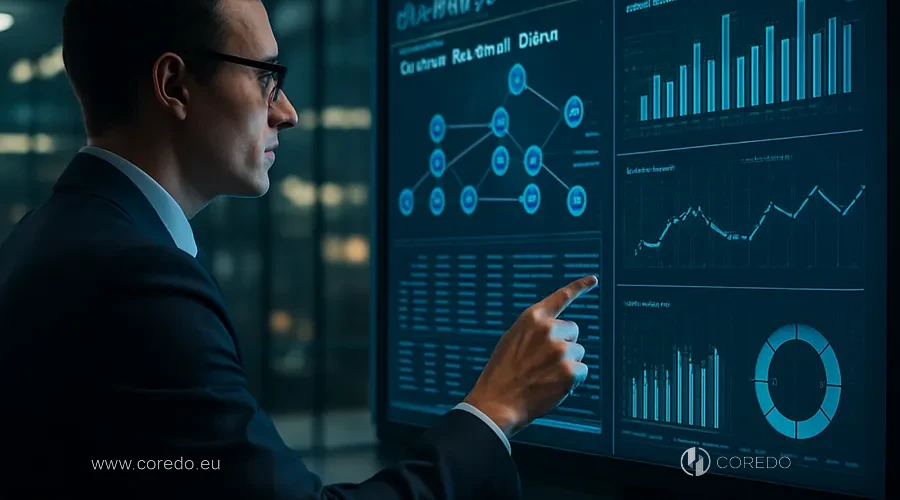
Bank compliance officers work from checklists. Their task is not to find “something bad” but to make sure that nothing is hidden. Therefore they combine automated OSINT platforms with manual analysis, especially if the client is connected to multiple jurisdictions or previously did business in the CIS.
Banks divide OSINT into passive OSINT (automated searches without direct contact) and active OSINT (deep analysis with cross-checks). Passive OSINT starts with databases like OpenCorporates, where we at COREDO track the client’s corporate structure. This reveals hidden owners through shareholder registers and property pledges.
OSINT sources for UBO in EU banks include:
- Orbis and Sayari for OSINT ownership chains – the platforms build link graphs showing affiliated persons.
- ICIJ offshore leaks and OCCRP Aleph for analyzing offshore structures.
- Sanctions Explorer from C4ADS for OSINT sanctions lists and PEP screening.
In Asia, banks like those in Singapore add local public procurement registers and financial statements.
Our experience at COREDO showed: for a client from the CIS registering a company in Cyprus, we used Google Dorks and Shodan to search for non-obvious UBO assets, which convinced the bank of the authenticity of the substance. Our experience at COREDO showed: with complex structures banks check not only registers but also the digital trail. In one case for a client from the CIS registering a company in Cyprus, we used an expanded OSINT analysis, including search operators (Google Dorks) to identify public mentions of assets and connections. This allowed us to preemptively close the bank’s questions on substance and sources of funds.
Active OSINT is engaged when there are risks: banks check litigation through PACER or Court Listener, creditworthiness via SEC investment holdings. Active OSINT is never used “just because.” Its triggers are cross-border structures, high-risk jurisdictions, PEP factors, or discrepancies in basic databases. For the client this is a signal: standard onboarding no longer works, and without a structured report the process will be prolonged. The solution developed at COREDO combines these methods with scoring systems for due diligence: we assign scores to risks and propose mitigants.
How COREDO minimizes client risks
We structure OSINT not as a fragmented search, but as a managed process. The goal is not to “find everything”, but to assemble a picture that is understandable to the bank: logical, consistent and verifiable. This is a fundamental difference between the consulting approach and chaotic DIY checks.
Risks of hidden beneficiaries — the main headache: banks detect inconsistencies in OSINT due diligence of ownership chains. We acknowledge: even transparent structures require effort.
Our approach: a preliminary audit using banks’ OSINT sources, including OSINT AML checks. For Estonian registration we checked the client’s UBO through the OSINT Framework, identified liens, and adjusted the structure — the bank opened the account instantly.
Beneficiary bank checks include managing UBO risks. In the EU, banks apply active OSINT to analyze affiliated persons, focusing on court records. COREDO practice: a client from the UK passed banks’ OSINT beneficiary checks thanks to our report on beneficial owners, which integrates data from 15+ sources.
In practice, clients most often ask three questions.
- Which OSINT sources do EU banks use to detect hidden UBOs?
- How is OSINT applied in Asia?
- Can you prepare in advance?
Answer: corporate registries + leaks (ICIJ, OCCRP) + graph databases.
Answer: through local registries, financial statements and cross-referencing with international databases.
Answer: yes, through preliminary OSINT due diligence before submitting to the bank.
Steps for OSINT checks
To pass KYC OSINT without delays, follow these steps — the COREDO team has refined them on hundreds of cases:
- Collect basic UBO data: names, passports, addresses, ownership shares. Verify them yourself via OpenCorporates.
- Conduct passive OSINT: Use banks’ OSINT sources like Orbis for the ownership chain.
- Add active analysis: OSINT ownership-chain checks with sanctions and PEP screening via Sanctions Explorer.
- Produce a report: Include scoring systems, visual connection graphs. We at COREDO provide a template.
- Submit it to the bank in advance: This saves weeks. For licenses in the Czech Republic or Singapore we add substance evidence.
Scaling OSINT beneficiary checks is achieved through automation – banks see ROI in reduced fines of up to millions of euros. Our experience has shown: integrating the OSINT Framework into a bank’s KYC for PEP monitoring doubles approval speed.
COREDO – OSINT and registration
С 2016 года COREDO сопровождает бизнес в ЕС (Czech Republic, Slovakia, Cyprus, Estonia), the United Kingdom, Singapore and Dubai. Мы не просто регистрируем компании – проводим OSINT проверку конечных владельцев, помогаем с финансовыми лицензиями (крипто, платежные, форекс) и AML-консалтингом. Практика подтверждает: комплексный подход экономит клиентам время и ресурсы, строя долгосрочное партнерство.
In 2026 OSINT has become part of business financial hygiene. Companies that treat it as a formality waste time. Those who build OSINT into their strategy gain access to banks, licenses and scaling without constant refusals and explanations.
Если вы планируете регистрацию или лицензию, наша команда подготовит OSINT-отчет под ваш банк. Свяжитесь, превратим вызовы в возможности.