
COREDO – EU Legal & Compliance Services Expert legal consulting, financial licensing (EMI, PSP, CASP under MiCA), and AML/CFT compliance across the European Union. Headquartered in Prague, we provide seamless regulatory solutions in Germany, Poland, Lithuania, and all 27 EU member states.

Pavel Kos
15.03.2026 | 6 min read
Updated: 15.03.2026
Since 2016 I have been leading COREDO through dozens of jurisdictions and hundreds of projects on company registration, licensing and AML consulting. During this time I have seen how a technology once considered “nice to have” has become a real market access requirement: KYT, Know Your Transaction. When a business handles payments in the EU, the United Kingdom, Singapore or Dubai, real-time transaction monitoring is no longer an option but an infrastructural necessity. In this article I systematize COREDO’s approach to KYT and AML, showing how to embed them into a company’s processes, calculate ROI, reduce false positives and meet regulators’ requirements without sacrificing speed and scalability.
The COREDO team has implemented KYT integrations in banks, payment institutions, cryptocurrency services and fintech startups. We have gone through Licensing for PI/EMI in the EU, EMI and crypto registration in Estonia, compliance with FCA requirements in the United Kingdom, MAS in Singapore, as well as projects in the Czech Republic, Slovakia, Cyprus and Dubai. COREDO’s practice confirms: a proper KYT integration provides not only compliance with AMLD5/AMLD6 and FATF recommendations, but also concrete economics — reduced operating costs, manageable risks and accelerated product time-to-market.
KYT, AML and KYC – what an executive needs

KYT is the monitoring of transaction behavior over time, not a one-off customer check. If KYC answers the question “who is the customer”, then KYT — “what, with whom, through whom and why they transfer”. It is transactional patterns, not only the customer’s profile, that form risk scoring and the basis for SAR/STR (suspicious activity reports).
We link KYT with KYC and beneficial ownership control (UBO) through a single AML framework. Our experience at COREDO has shown: when KYC/UBO data, watchlist screening, PEP screening and sanctions lists (UN, EU, OFAC) are fed into a single rules engine and supplemented by graph analysis of transactions, false positives drop noticeably. Additionally, entity resolution and link analysis — resolving entities and mapping connections by UBO, addresses, identifiers and counterparties — help.
Regulatory guidelines remain clear. In the EU: AMLD5/AMLD6 and EBA guidelines; in the UK – the FCA Handbook; in Singapore: MAS Notices; in Hong Kong, HKMA. For cross-border data processing we comply with GDPR, data retention policy, and audit trail and logging requirements. These frameworks determine the depth of transaction monitoring and what exactly must be set out in the KYT policy.
How to implement KYT in a project

There is no universal recipe for KYT. But there is a robust methodology I follow in COREDO projects: start from business‑risks and data sources and move to rules, models and the operational process.
Data and process diagnostics
I start with a map of business‑processes: onboarding, payment interfaces (SEPA, SWIFT, local schemes), correspondent relationships, currency corridors, P2P and remittance channels. The team analyses data sources: payment messages (for example, ISO 20022), KYC profiles, sanctions lists, external data enrichment feeds. We check the quality of data normalization, the identifier scheme and fields available for risk scoring.
KYT platform and vendor Due Diligence
KYT‑solutions are split between platforms with a strong rules engine and systems with an advanced ML stack and explainability. I conduct vendor due diligence and procurement with a focus on:
- supported integrations (API, webhooks, batch vs real‑time processing);
- latency and throughput, SLA and uptime;
- capabilities for rule tuning and threshold management;
- presence of case management;
- GDPR compliance, encryption and secure logging;
- on‑premise vs cloud, data residency and local requirements.
KYT via API and payment stacks
Integration of KYT into business‑processes should be native. We connect to core banking, billing and transaction processing, set up webhooks on events (initiation, authorization, clearing, refunds). A solution developed at COREDO for an EMI in the EU processed alerts right at pre‑authorization, which allowed blocking risky operations before funds were debited and reduced chargebacks.
How to configure rules and risk scoring
Rules engine: it is the skeleton of KYT. I start with transaction typologies and cross‑border risk: turnover speed, geography, time zones, bridge operations, counterparties with reputational red flags. We design a rule‑set, tying each scenario to a rationale from FATF recommendations and local regulators. KYT transaction analysis includes thresholds, time windows, pattern clustering and adaptation by segments: retail, B2B, exchange wallets, correspondent payments.
Machine learning and explainable AI
ML is useful where rules get tired. I use anomaly detection algorithms, clustering and outlier detection, complementing them with explainable AI for regulators and internal auditors. Model governance is a mandatory part: backtesting, model validation, model risk management, retraining and drift monitoring. For testing scenarios I use synthetic data to avoid privacy risks, complying with GDPR.
Pilot: backtesting and validation
In the pilot I check precision/recall, the level of false positives/false negatives, response time and throughput. Backtesting on historical data shows where rules miss known cases, and validation on live traffic calibrates thresholds. In one project for a payment provider COREDO’s team reduced false positives by 42% without losing recall after three iterations of threshold management and typology refinement.
Rollout and continuous compliance
In production rollout checkpoints matter: continuous monitoring, alert governance, SLA for case handling and periodic rule reviews taking into account new fraud schemes. I establish a regular rule review, a performance testing plan and a process for updating sanctions lists and PEP databases.
KYT Policy: nuances of international business
KYT policy, a document that links risk strategy and operational practice. It should answer the question «how exactly the company controls transactions every day».
Minimum structure of the KYT policy
The minimum structure includes:
- objectives and scope;
- regulatory references (AMLD5/6, FATF, local guides FCA/MAS/EBA/HKMA);
- roles and responsibilities (compliance officer, analysts, product owners);
- risk model and risk scoring;
- KYT procedures: monitoring, rules, sanctions checks, PEP screening, UBO linkages with KYC;
- escalation criteria, blocking thresholds, case triage;
- procedure for preparing SAR/STR and interaction with the regulator;
- data governance: sources, data retention, GDPR, encryption, audit trail;
- performance monitoring: metrics, threshold values, improvement process;
- staff training and quality control.
Payment provider structure
For a payment provider I add:
- coverage of SEPA, SWIFT and local schemes;
- scenarios for high-risk MCCs, merchant aggregators and marketplaces;
- rules for cross-border and correspondent payments;
- real-time blocks at the pre-authorization level;
- integration of KYT with chargeback processes and anti-fraud.
What to consider in the international context
In international business I record differences in data residency, requirements for PEP/sanctions checks and the specifics of remittance and P2P channels. The KYT policy should acknowledge local differences, but maintain a unified standard of transaction analysis and reporting. At COREDO we form the «core» of the policy and local appendices by jurisdiction.
ROI Metrics and Manageability
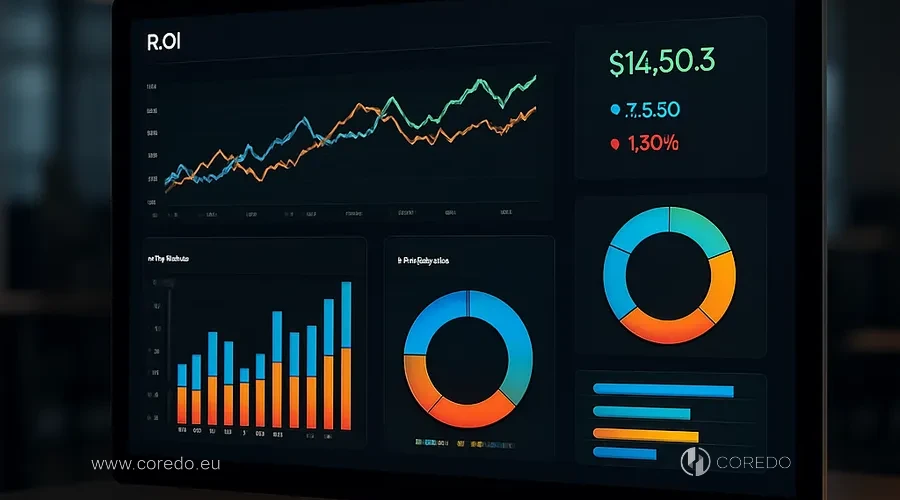
I assess KYT not only by compliance but also by economics. This requires clear metrics and a straightforward ROI/payback formula.
KYT Metrics
Basic set:
- precision and recall (precision/recall), ratio of false positives to false negatives;
- average time to investigate and resolve (MTTR), alerts per analyst per day;
- conversion of alerts into cases and into SAR/STR;
- SLA adherence and the share of real-time decisions;
- impact on fraud losses and chargebacks;
- model stability: feature drift and performance.
How to reduce false positives
COREDO’s practice confirms the effectiveness of three tactics:
- rule tuning and contextual enrichment (data enrichment) – add behavioral features instead of crude thresholds;
- segmentation and differentiated risk scoring for different customer types and channels;
- human-in-the-loop: the analyst closes the “gray areas”, and the system retrains on approved cases.
How to calculate the ROI of a KYT tool
I start from TCO: licenses and infrastructure, integration, support, analysts, FTEs and training. Benefits consist of reduced fraud, fines and freezes, saved analyst time, and faster transaction throughput thanks to real-time decisions. ROI calculation = (loss reduction + OPEX savings + prevented fines) / TCO. In several projects the margin effect was already apparent after reducing false positives and MTTR by 20–30%.
Architecture and scaling without compromises

The engineering side of KYT determines whether the platform will withstand peak loads and the regulator’s requirements for continuous monitoring.
Real-time and SLA performance
I set target SLAs: latency up to 100–200 ms per decision in real-time, uptime 99.9% and guaranteed throughput matching peaks. We design event queues, isolate critical services and use idempotency keys to avoid duplicate alerts when events are re-submitted.
Batch vs real-time and latencies
I use batch processing for nightly recalculations of risk scoring and detection of long chains. Real-time for pre-authorization and instant blocks. To optimize latency we cache sanctions lists, use local indexes and asynchronous webhooks, not blocking the payment flow beyond the specified SLA.
Scaling x10 and load tests
I plan growth of 10x as the norm. Load tests include a profile of real transactions, synthetic peaks and resilience of external feeds. Performance testing also checks models: we measure degradation of precision/recall during traffic spikes and feature updates.
Data placement and security
When choosing on-premise vs cloud I take into account data residency and local requirements. Encryption “in transit” and “at rest”, secure logging without sensitive fields, access policies based on least privilege and regular audits as a baseline. The data retention policy is aligned with GDPR and local retention periods, and the audit trail provides full traceability of decisions.
Triage and investigation automation
Technology doesn’t work without a well-tuned operational process. The case management system is the nervous system of KYT.
Automation of triage/human-in-the-loop
I implement multi-level triage: auto-closing of low-risk alerts, prioritization of high-risk by typologies and SLAs for escalation. RPA helps automate the collection of artifacts and the preparation of dossiers. Human-in-the-loop remains key for borderline cases and model training. Analyst KPIs: alerts per analyst per day, proportion of justified escalations, and mean time to resolution.
SAR/STR reporting and audit
The reporting system generates regulatory reports, monitors SAR/STR thresholds and records the reasons for decisions. The audit trail stores the version of the rule or model, input data, enrichments and explanations for triggers. This level of explainability facilitates communication with auditors and reduces operational risk.
KYT for banks and crypto services
The segment dictates the risk profile and depth of analysis. There are no universal scenarios, but there are recurring patterns.
Financial institutions and correspondent banks
For banks and correspondent relationships I enhance cross‑border risk assessment and graph analysis of chains. KYT for correspondent banks accounts for nested relationships, geographic corridors, and country typologies. Integration with core banking and sanctions filters is mandatory, and the accuracy of entity resolution directly impacts the reduction of false links.
Payment providers: P2P and remittance
KYT for payment providers focuses on high‑risk merchants, instant transfers, and atypical account behavior. For remittance and P2P, behavioral profiles matter: seasonality, “mules”, and unusual fund trajectories. Real‑time transaction monitoring KYT prevents cash‑outs and the “smurfing” of amounts.
cryptocurrency companies, wallets, exchanges
Crypto projects in the EU, Estonia, Cyprus, and Dubai strengthen KYT with address risk. We use blockchain enrichment, wallet categorization, sanctions and PEP screens, links to high‑risk services, and address clustering. KYT for cryptocurrency companies is supplemented by watchlist providers and integration with off‑ramp/on‑ramp KYC.
COREDO International Cases in Practice
Practical stories help assess the depth of solutions better than any presentations. I’ll present a few typical scenarios and results.
EMI/PI, SEPA and ISO 20022 in the EU
For one European EMI the COREDO team handled licensing, built an AML/KYT policy and integrated the platform with ISO 20022 support. We linked the rules engine with SEPA events and added graph analysis for correspondent chains. Result: a 35% reduction in MTTR, an 18% increase in precision and stable compliance with EBA guidelines during the annual audit.
FCA and MAS in the UK and Singapore
For a payment institution supervised by the FCA I configured explainable AI and decision auditing down to the feature level. This simplified interaction with the regulator and sped up model approval. In Singapore under MAS the focus shifted to cross‑border remittance and local data residency; the solution developed at COREDO used a hybrid scheme: real‑time in the cloud with local sanction caches and synchronization via secure channels.
Crypto licensing Estonia Cyprus Dubai
In Estonia for a crypto exchange we implemented a KYT platform with blockchain enrichment and automatic triage. Three iterations of threshold management reduced false positives by 40% and accelerated the listing of new tokens without compromising AML controls. In Cyprus and Dubai the emphasis shifted to documenting case management, penalty thresholds and the SAR process, which helped pass regulatory inspections without last‑minute fixes.
Frequently Asked Questions from Clients: Precise Answers
We answer clients’ frequent questions briefly and precisely so you quickly get clear, actionable solutions for compliance procedures. Below: brief explanations of what data are needed for effective KYT and how to collect and protect them correctly.
What data are needed for KYT?
You need transaction events (initiation, authorization, clearing), counterparty data, KYC/UBO, watchlists (UN/EU/OFAC sanctions, PEP), geolocation data, device signals and external data enrichment feeds. It is important to ensure data normalization, stable identifiers and linkage with payment formats (for example, ISO 20022).
How to integrate KYT into AML/COMPLIANCE?
Connect KYT and KYC into a single risk scoring, document escalations in policy, synchronize sanctions checks and PEP screening. Include case management with an audit trail, SLA and the SAR/STR process. COREDO’s practice confirms that a common rules engine and a unified typology catalog reduce discrepancies in team decisions.
How to determine blocking thresholds
Base them on backtesting: assess losses from missed incidents vs the cost of false blocks. Set thresholds by customer segments and channels, apply time windows and additional context. Review thresholds quarterly or when patterns change sharply.
What SLAs should you require from a KYT vendor?
Specify latency to decision, uptime, sanctions list update time, RTO/RPO for resilience, support response time and scaling limits. For real-time payments I recommend latency no more than 200 ms and uptime of at least 99.9%.
How to provide explainability to the regulator
Use models with local explanations (SHAP/LIME), record feature versions, weights and data lineage. In the model governance policy describe backtesting, validation, retraining and drift control. Prepare examples of typical cases with step-by-step explanations.
How to scale KYT for 10x growth
Separate real-time and batch pipelines, implement event queues and horizontal scaling. Cache sanctions directories, optimize requests to external feeds, run regular stress tests. The COREDO team uses synthetic data for safe growth testing and quality control.
KYT Integration Checklist via API
- Define key events and the data schema, ensure data normalization and idempotency.
- Choose a platform with the required integrations and confirmed SLAs.
- Configure the rules engine, risk scoring and explainability, align thresholds.
- Run a pilot, perform backtesting, measure precision/recall and MTTR.
- Set up case management, triage, RPA and human-in-the-loop.
- Document the KYT policy and model governance, conduct team training.
- Plan continuous rule review, drift monitoring and stress tests.
COREDO’s reliability in KYT and AML projects
I build projects so that business accelerates growth rather than being slowed by controls. The COREDO team has configured KYT for banking and non-banking institutions, payment providers and crypto services in the EU, the UK, Singapore, Estonia, the Czech Republic, Slovakia, Cyprus and Dubai. Our solutions pass EBA/FCA/MAS audits, undergo GDPR assessments, scale for peaks and reduce operational costs. This experience is more important than any list of features: it adds confidence that implementation will proceed smoothly and predictably.
We start with your goals: licensing, entering a new market, reducing sanctions risk or optimizing operational expenses. Next we design KYT processes, choose platforms, integrate with the payment infrastructure and train the team. As a result, you get a transparent transaction monitoring system, explainable decisions and robust performance metrics.
Conclusions
KYT is not just a fashionable term, but the foundation of risk management and the gateway to international payments. When the KYT policy is clear, the rules and models are explainable, and the investigation process is fast and predictable, the company confidently passes licensing, withstands audits and grows without unnecessary losses. I have seen this dozens of times in COREDO projects in Europe and Asia, and each time I was convinced: the right architecture and execution discipline turn compliance into a strategic advantage.
If you are planning company registration, obtaining a financial license or updating AML frameworks, start with a data map and metrics. Check integration via API, SLA, explainability and GDPR compliance. Build in continuous monitoring and improvements. The COREDO team is ready to walk this path with you, from designing a KYT policy to industrial operation and regular reporting. It’s a reliable route to international growth where control and speed do not conflict but reinforce each other.