
COREDO – EU Legal & Compliance Services Expert legal consulting, financial licensing (EMI, PSP, CASP under MiCA), and AML/CFT compliance across the European Union. Headquartered in Prague, we provide seamless regulatory solutions in Germany, Poland, Lithuania, and all 27 EU member states.

Alena Sharykava
26.03.2026 | 6 min read
Updated: 26.03.2026
For many years I have observed how proper AML case management turns a regulatory requirement into a real competitive advantage. Since 2016 the COREDO team has been helping entrepreneurs from Europe, Asia and the CIS register companies abroad, obtain financial licenses, build AML controls, and grow their businesses through transparent processes. During this time we have implemented dozens of projects in the EU, the Czech Republic, Slovakia, Cyprus, Estonia, the United Kingdom, as well as in Singapore and Dubai – from payment organizations and forex brokers to crypto providers and family offices.
In this article I present an approach that has proven effective in the payments, brokerage and crypto segments. I will show how to build AML case management as a systematic process: from alert triage and the compliance officer’s role in investigations to Explainable AI, KPIs, and audit readiness. I will share COREDO cases where we managed to reduce false positives by 40–70%, speed up time-to-close, streamline interaction with the FIU, and at the same time comply with GDPR and local regulations.
Why a business needs mature AML case management
Today regulators require not only transaction monitoring scenarios but also demonstrable governability of the entire AML case management process. This means a clear algorithm for handling an AML alert, a robust audit log and traceability of case actions, managed escalation and transparent SAR decisions. Without such operational maturity, Licensing, banking access and business scaling become difficult tasks.
COREDO’s practice confirms: by investing in AML case management, companies not only minimize risks. They accelerate onboarding, increase the compliance team’s throughput, improve precision/recall metrics and translate SLA and KPI into language management understands: from time-to-close to cost-per-case and throughput.
AML case management: from alert to SAR
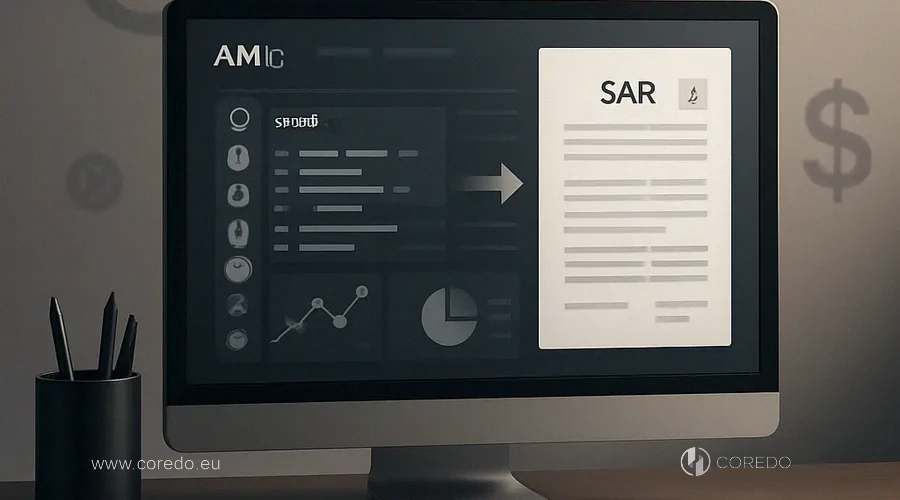
A properly designed AML case management architecture sets a unified framework for an incident to progress through all stages, from alert receipt to SAR preparation. Next, we’ll look at AML alert triage and risk prioritization to understand how to promptly allocate resources and turn signals into well-founded decisions.
AML alert risk prioritization
We start with risk-based approach (RBA). AML alert triage (alert triage) allocates incoming events by risk levels taking into account jurisdiction, counterparty type, amount and behavioral anomalies. Our experience at COREDO has shown that a scoring model combining threshold rules and dynamic scoring reduces the queue of low-risk cases and frees resources for complex investigations.
We design triage as a combination of static rules and an initial risk assessment model. An important element is risk assessment and alert prioritization considering customer risk rating, geography, UBO and typologies. Add a separate layer for sanctions hits and adverse media so as not to lose critical signals amid information noise.
Roles and segregation in AML case management
Managing roles and segregation of duties is critical to trust in the process. In a mature workflow there is a role matrix: investigator, reviewer, approver; an escalation matrix and multi-layered approval by risk levels. The AML analyst’s role focuses on data collection and correlation, link analysis and forming conclusions, while the compliance officer’s role in investigations is decision-making, assessing legal risks and final approval with the CCO.
We enforce RBAC (role-based access control), access control and action auditing. The solution developed at COREDO records every change in case status and comments, providing an audit trail and chain of custody for evidence.
AML alert handling algorithm
The AML alert handling algorithm is simple in form and strict in substance: triage; data verification; pattern analysis, enrichment, interviews/document requests; decision — if necessary, registration and filing of a SAR with the FIU — case closure and feedback into rules/models. The COREDO team has implemented playbooks for AML investigations across main typologies: structuring, layering, sanctions evasion, trade finance.
A standardized AML alert investigation process supports SLAs at each stage: acknowledgement of receipt, preliminary assessment, request for KYC/CDD/EDD, final verdict. This approach facilitates incident and SLA management, creates a predictable time-to-close and reduces variability in quality.
Transaction monitoring and case linking
Transaction monitoring scenarios include both real-time and batch monitoring. For complex transaction chains, correlating events from different systems and case linking – combining related alerts into a single case by common entities, devices, IPs, behavioral patterns – is useful. This reduces duplication, speeds up investigations and increases recall for network schemes.
The AML alert escalation system is built on scoring thresholds, typology and jurisdiction criticality. Escalation to internal audit is triggered when control gaps or conflicts of interest are detected. In complex multi-jurisdictional cases we involve lawyers to coordinate cross-jurisdictional investigation challenges.
Audit log and chain of custody
The audit log and tracing of case actions provide protection for decisions. We record timestamps, the author of changes, the version of rules/models and all document flow. Evidence management and the chain of custody ensure the immutability of files, signatures and source links.
Documenting decisions and the audit trail meet the requirements of FATF, EU AML Directives (AMLD5, AMLD6), EBA recommendations and local guidelines. Such discipline increases preparedness for AML regulator inspections and reduces response time in case of a request.
Workflow for AML and integration
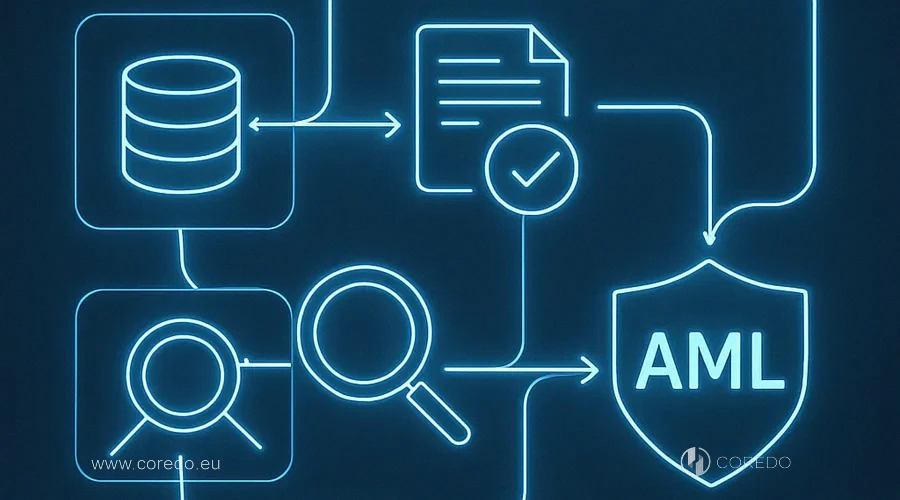
An effective workflow for AML is built on clear process alignment and reliable integrations between monitoring tools and case management. In the following subsections we review practical approaches to integrating TMS and case management and choosing an API‑oriented stack for stable data exchange.
Integration of TMS and case management API
Integration of TMS and case management is a fundamental principle. API‑oriented integration of the AML stack brings together TMS, KYC providers, sanctions screeners, a graph database and the case system. Orchestration and RPA tools help automate data collection, bulk case uploads and status updates.
Integration of sanction and KYC screener APIs reduces manual operations and creates a single source of truth for the analyst. In COREDO projects we use an architecture with a message bus, which makes it easy to add new sources and scale processing.
Sanctions lists, PEP and KYC/CDD/EDD
Sanctions lists and screening go hand in hand with PEP screening, adverse media and negative information. We configure integrations with multiple providers to minimize blind spots and manage AML false negatives. KYC, CDD and enhanced Due Diligence (EDD) levels depend on the risk profile, jurisdiction and product.
Identification and verification of UBO are performed via beneficial ownership registers and third‑party sources, including corporate registers in the EU and Asia. This step is critical for layering scenarios and trade‑based schemes when the true ownership structure is hidden behind trusts or SPVs.
GDPR, beneficial ownership, cross-border
GDPR compliance in AML investigations is a mandatory constant. We take into account GDPR impact assessments and cross‑border data transfer, apply data minimization and legal bases for processing, and embed legal hold for regulatory requests. We control access via RBAC and maintain logging to demonstrate compliance.
The COREDO legal team prepares data retention and storage policies to meet timeframes and the principle of purpose limitation. This helps pass audits without rework and prevents regulatory claims.
Data lineage, data quality, enrichment
Data quality determines the quality of investigations. We measure data quality metrics: completeness, accuracy, timeliness, consistency, and also build data lineage for critical attributes. Enrichment through third‑party data sources — geolocation, corporate links, phone databases, court registries — sharply increases precision.
Data enrichment and entity resolution tools deduplicate records, merge profile fragments and reduce false positives. In one project COREDO’s entity resolution solution detected a scheme involving proxy devices and synthetic identities that simple rules missed.
AML Automation with Explainable AI

Automation combined with Explainable AI for AML makes it possible to take a systematic approach to filtering and prioritizing risk events, reducing the load on analytics teams. This is especially important for rule triage, tuning scoring models and managing false positives/false negatives — these aspects will be covered in the following subsections.
Rule triage and scoring: FP/FN
Managing false AML alerts: it’s not about “turning off rules” but about deliberate false positive tuning. Combine threshold rules and dynamic scoring, take into account customer context, seasonality and behavior. Reducing false positives in AML is achieved through filters for known beneficiaries, certified counterparties and contextual features.
At the same time we manage AML false negatives: backtesting detection scenarios on labeled cases, periodic model audits and adding typologies of sanctions evasion and pattern discovery. Such a balance improves the F1 metric and keeps regulatory risk under control.
Unsupervised detection and drift detection
Anomaly algorithms: unsupervised detection — isolation forest, autoencoders — help to find new schemes. Supervised learning for fraud detection, gradient boosting, logistic regression: strengthens the filter based on labeled cases. Drift detection and model retraining are critical in dynamic segments, especially in crypto and e-commerce.
We document ML model testing practices and validation: hold-out, cross-validation, feature stability, fairness. Model management and governance in AML describe who and when changes parameters, how changes are approved and where documentation is stored.
Explainability: SHAP, LIME and governance
Explainable AI for AML solutions is not a trendy topic but a real answer to the regulator “why did you miss/alert”. Model explainability: SHAP, LIME show feature contributions and support decision-making by the compliance officer. This speeds up reviews and increases trust in automation.
We prepare model cards, versioning and change control in rules and governance. Such discipline addresses questions during external inspections and internal audits, and also speeds up alignment with the CCO.
Graph analytics and entity resolution
Detection of transaction network patterns is an area where link analysis techniques and graph analytics are indispensable. A graph database for link analysis reveals multi-hop connections, shared infrastructure, IP clusters and indirect beneficiaries. Graph visualization tools reduce investigation time and support case linking between incidents.
In one COREDO case, graph analytics combined 18 disparate alerts into a single scheme, proved a common cash-out point and allowed preparing a convincing SAR.
SLA, KPI and Quality Control
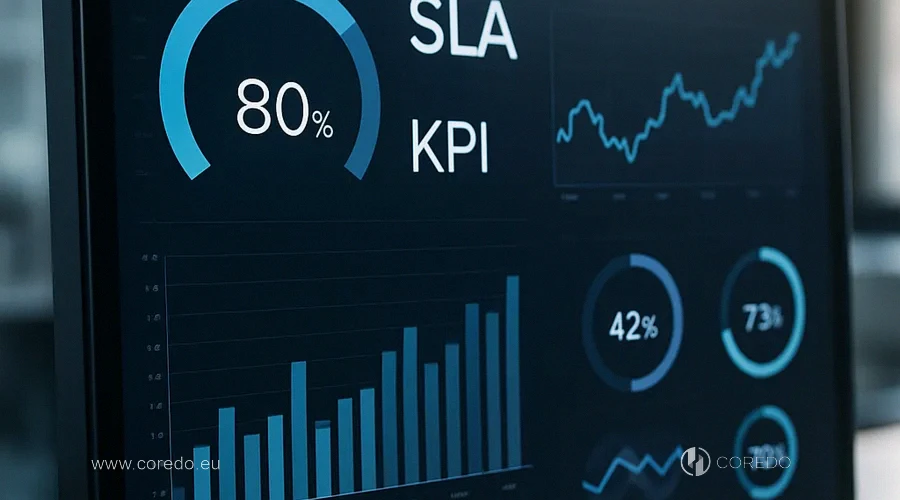
In operational management, SLA, KPI and quality control play a key role: they set service standards and customer expectations. Specific metrics are used to meet these standards: time-to-close, throughput and queue time, which allow measuring the speed of task resolution and queue load.
SLA and KPI: time-to-close and throughput
Without measurements there is no management. I set SLA and KPI for AML investigations at the levels of time-to-first-triage, time-to-close, throughput and queue time. Efficiency metrics — time-to-close, cost-per-case — give the CFO a clear picture and help plan resources.
We track precision, recall, F1 on samples and in production, as well as operational SLAs by case type. Such a dashboard becomes the “common language” for compliance and the business.
Team performance monitoring
Monitoring the performance of the investigation team, case allocation by complexity, automatic case distribution and load balancing taking skills into account. The COREDO solution supports analysts’ competencies, sets thresholds on the number of parallel cases and prevents bottlenecks.
The team workflow and communications are integrated into the system: comments, mentions, request templates. This reduces operational noise and keeps the focus on the substance of investigations.
Quality control: backfilling and backtesting
Quality control and case backfilling include secondary peer review, thematic checks and adjustment of decisions when new information appears. Backtesting scenarios show how results would change with updated thresholds or features.
Process testing and quality control are formalized in playbooks and checklists. Such routine adds confidence when meeting with auditors and regulators.
ROI metrics and cost-benefit of automation
The evaluation of ROI for automation of AML investigations is built on three pillars: reduction of cost per case, decrease in FPR and reduction of regulatory risk. The cost-benefit analysis of AML automation includes the cost of licenses, integration, training and support versus savings in FTEs, penalty risks and acceleration of turnover.
COREDO’s practice has shown that even moderate automation of triage and enrichment pays off in 6–12 months for medium-sized payment organizations in the EU. For multi-jurisdictional groups the effect comes sooner due to standardization.
Frameworks and readiness for inspections
Compliance with regulatory frameworks and readiness for inspections are becoming a decisive factor for organizations seeking to manage risks and preserve their reputation. International standards and European requirements are particularly important: from FATF and EU AML Directives to EBA recommendations – which set practical guidelines for internal procedures and controls.
FATF, AML Directives and EBA recommendations
regulatory requirements: FATF recommendations, EU AML Directives (AMLD5, AMLD6), and EBA monitoring recommendations set the basic principles: RBA, CDD/EDD, sanctions screening, staff training, and audit. We align internal policies with these frameworks and prepare a roadmap to close gaps.
The COREDO solution transforms requirements into practice: who does what and when, which artifacts are created, where they are stored, and how quickly they are accessible for review.
Registration and submission of SARs to the FIU
Registration and interaction with the FIU are part of the operational cycle. SAR templates and required fields are embedded into the platform, taking into account local formats in the EU, the UK, Singapore and Dubai. Legal support for SARs and disclosures ensures that wording is accurate, facts are verified, and deadlines are met.
I pay particular attention to the reminder system and checkpoints. This disciplines the process and reduces the risk of missing critical deadlines.
Data retention policy and legal hold
Data retention and storage policies are established by jurisdiction and document type. Data confidentiality and legal hold come into effect in response to external requests and investigations. We record sources, versions and retention periods to avoid violating either the GDPR or local laws.
This approach prevents “forgotten archives” and preserves the evidentiary value of cases during appeals or subsequent reviews.
RBAC, access control and activity auditing
RBAC access management for the case system separates development, testing and production environments. Access control and activity auditing prevent unauthorized changes and ensure the recoverability of the history.
The COREDO solution supports multi-factor authentication, separation by jurisdiction and segregation of duties in complex corporate groups and counterparties.
COREDO case studies in Europe and Asia
COREDO’s practice shows how, in real cases from Europe and Asia, technical and organizational solutions lead to measurable business results. In particular, for a payments organization in the EU, integration of case management and reduction of FPR are critical – below we’ll examine this and other examples.
Case management and FPR reduction in the EU
For a licensed payments company in the EU, the COREDO team implemented integration of TMS and an AML case management platform, built triage and a scoring model. As a result, FPR decreased by 63%, time-to-close was reduced by 38%, and throughput increased by 29%.
Entity resolution, integration with two sanctions providers, and automatic case assignment played a key role. The regulator approved the approach during a scheduled inspection, noting the transparent audit trail.
Estonian crypto provider: KYC and sanctions
crypto companies find it harder to balance false positives/negatives. The solution developed at COREDO combined KYC/CDD, sanctions screening, and SHAP explanations for key decisions. This allowed the compliance officer to approve disputed cases faster and to justify the model’s logic.
At the same time, we implemented adverse media monitoring and case linking by wallet addresses, which increased recall on network schemes. The FIU noted the quality of SARs and the speed of response to requests.
Broker in the UK and Singapore
For a multi-jurisdictional broker, COREDO built cross-jurisdictional investigations taking into account UK and MAS requirements. We synchronized playbooks, normalized terminology, and set up an escalation matrix considering differences in thresholds and disclosure timelines.
Case management supported batch scoring vs streaming scoring, which preserved real-time alerts on the front end and enabled deep nightly backtesting. The team cut queue time by 45% and passed the audit without significant findings.
Outsourcing vs in-house in Dubai/Cyprus
Some clients choose managed services vs in-house investigations. In one project we offered a hybrid: outsourcing AML investigations for peak loads and an in-house team for day-to-day. The balance produced the expected effect on cost-per-case and met the SLA for the high-traffic season.
We formalized a role matrix, segregation of duties, and SLAs for outsourcing. Such a contract is transparent for the regulator and convenient for the client’s finance department.
Launching AML case management in 90 days
A reliable platform and well-designed playbooks are key elements that allow deploying AML case management in a short timeframe, often within 90 days. A clear role matrix and an agreed team workflow ensure rapid task allocation and process transparency at every stage of implementation.
Role matrix and team workflow
We start with a role matrix: investigator, reviewer, approver, model owners and rule administrators. We embed the team workflow and communications into the platform: comments, tags, checklists, checkpoints. This minimizes context loss and speeds up handover.
Our SSoD (segregation of duties) template prevents self-review and records accountability. Such clarity removes disputes, accelerates escalations and strengthens the culture.
Playbooks for investigations and escalation
We deliver AML investigation playbooks and playbook templates covering sanction hits, unusual behavioral patterns, trade finance and crypto transactions. An investigation scenario contains a list of actions, enrichment sources, escalation criteria and SAR templates.
An escalation matrix and multi-layered approvals provide predictability of timelines. Priorities and SLAs are visible to the whole team, which disciplines the process.
RPA orchestration and bulk upload
Orchestration and RPA tools automate statement collection, address verification, pulling adverse media, and bulk uploading of cases at the start of migrations. Bulk upload tools support deduplication and linking to existing entities.
A combination of APIs and message queues increases resilience, and monitoring provides transparency on errors and delays.
Training and certification of AML analysts
AML analyst training and certification include courses on RBA, sanctions, KYC/EDD, graph analytics and Explainable AI. We run investigation simulations with error reviews and update the material quarterly for new typologies.
Such a program creates a common conceptual language, raises the quality of decisions and meets the regulatory requirements for staff competencies.
Scaling and change management
When scaling solutions and managing changes, establishing a clear model management policy and governance principles, as well as reliable change control, becomes critical. Without these mechanisms, quality, reproducibility and compliance quickly deteriorate as the system grows.
Model management and change control
Proper model management and governance in AML describe the lifecycle: problem formulation, development, validation, deployment, monitoring, drift detection, retraining. Change control for rules and governance records authorship, reason, expected effect and A/B results.
The COREDO solution adds a “red button” to roll back to a previous version of rules in case of unexpected results in production. Such discipline reduces operational risks.
Monitoring: streaming or batch scoring
Continuous monitoring and AML scenarios operate in two rhythms: streaming scoring for real-time and batch scoring for nightly layers and re-scoring. We support both so responses remain fast and quality high thanks to deep recomputations.
Periodic health checks of models and data prevent degradation. This is a necessary condition for stable F1 and a controlled FPR.
Case linking for corporate groups
Groups with multiple jurisdictions require normalization of reference data, currencies and business rules. Managing complex corporate groups and counterparties comes down to entity resolution, UBO reconciliation and cross-border data retention rules.
Case linking and pattern discovery connect subsidiaries, beneficiaries and service providers into a single picture. This saves investigation hours and improves SAR quality.
Data warehouse and ETL graph visualization
Data warehouse and ETL for AML create a reliable reporting and backtesting layer. We build data marts for KPI, SLA and regulatory reporting, and also persist features for re-analysis.
We connect graph visualization tools to the marts for quick diagnosis of risk clusters. Such a stack helps both analysts and management see the “forest, not just the trees”.
Choose a platform and design the ROI
Choosing a platform for AML case management requires a balance between functionality, integration capabilities and a pre-calculated economic impact. selection criteria and integration help design the ROI already at the evaluation stage so the platform delivers measurable impact and reduces operational risks.
Selection and integration criteria
An AML case management platform should be able to: integration with KYC providers, integration of a sanctions screener API, support for workflow and escalation, RBAC, audit trail, evidence management, case linking, explainability, data lineage and orchestration. API-oriented integration eases coupling with TMS and external data.
When choosing, I look at the openness of the data schema, no-code configuration tools and the maturity of logging. This speeds up deployment and reduces the cost of ownership.
Metrics: cost-per-case, time-to-close, F1
From day one we embed performance metrics: time-to-close, cost-per-case, precision, recall, F1, throughput and queue time. ROI metrics: reduction in cost per case, lower FPR, faster onboarding. This set creates shared goals for compliance and the business.
We separately calculate the effect of reducing manual steps and repeat checks. In COREDO projects this is key to payback.
Cost of ownership and managed services
TCO consists of licenses, integration, support, infrastructure and training. Outsourcing AML investigations makes sense when there is peak load or a shortage of expertise. Managed services vs in-house: not a binary choice; a hybrid provides better elasticity.
I establish SLAs, responsibilities, audit and data rights. This preserves control and regulator trust.
Security and compliance by design
Security: end-to-end. Access control and action auditing, encryption, segmentation, zero trust and regular pentests. Retention policies and legal hold are built into the design.
Compliance by design saves resources: a correctly designed process withstands audits for years.
Checklist of Practices to Implement
- AML case management as a single workflow: triage, investigation, escalation, SAR, feedback into rules/models.
- Building an AML workflow with role matrix, RBAC, audit trail and chain of custody.
- Integration of TMS and case management via API; data correlation and entity resolution in AML.
- Sanctions lists and screening, PEP screening, adverse media; integration with KYC providers.
- Risk assessment and alert prioritization; rule triage and scoring model.
- Reducing false positives in AML and managing false negatives in AML through backtesting and tuning.
- Explainable AI: SHAP, LIME; drift detection and model retraining; governance and change control.
- Link analysis techniques and graph analytics; graph database and visualization.
- SLAs and KPIs for AML investigations: time-to-close, cost-per-case, throughput, queue time, F1.
- Quality control and case backfilling; documenting decisions and audit log.
- Registration and filing of SARs with the FIU; legal support and readiness for inspections.
- GDPR, cross-border data transfer, data retention and legal hold; RBAC access management.
- Scaling AML case management for complex groups and multi-jurisdictional investigations.
- Assessing ROI of AML investigation automation and cost-benefit analysis; orchestration and RPA.
- Incident management and SLAs; team workflow and communications; escalation matrix.
AML as a competitive advantage
I often tell clients: a mature AML case management system is both insurance and a growth engine. It opens doors to licenses (crypto, payment services, forex, Banking licenses), simplifies interaction with banks, speeds up deals and strengthens partners’ trust in the EU, the United Kingdom, Singapore and Dubai markets. COREDO’s practical experience shows that a transparent case system, strong playbooks and explainable models deliver measurable results in metrics and increase business resilience.
If you are planning to register a company in a new jurisdiction, obtaining a license or rebuilding your AML function, build case management into the foundation. The COREDO team has already walked this path with clients in Europe and Asia: from designing RBA and integrations to training analysts and preparing for audits. Ready to share our experience and help turn AML from an obligation into a strategic asset for your business.