
COREDO – EU Legal & Compliance Services Expert legal consulting, financial licensing (EMI, PSP, CASP under MiCA), and AML/CFT compliance across the European Union. Headquartered in Prague, we provide seamless regulatory solutions in Germany, Poland, Lithuania, and all 27 EU member states.

Grigorii Lutcenko
03.04.2026 | 6 min read
Updated: 03.04.2026
Since 2016 I have been running COREDO as a company that helps entrepreneurs and finance directors build international structures, obtain licenses and comply with regulatory requirements in Europe, Asia and the CIS. Over this time one of the most “invisible” but critically important elements has become the data processing agreement (DPA) and the entire architecture of working with vendors that handle customer data. Company registration, licensing of payment services or crypto business, AML processes – without a competent DPA and supplier data risk management this construct either doesn’t take off, or over time turns into a source of regulatory problems.
I have compiled in this article our real experience: how we select a model for cross-border data transfers, how we integrate DPIA and DTIA into supplier onboarding, what we set out in DPAs and SLAs, which metrics and KPIs we use to assess vendor security, and how to reduce legal risks with a cloud model across different jurisdictions. COREDO’s practice confirms: a reliable foundation of DPAs, supplier due diligence and transparent processes accelerates projects – from licenses in the EU to expansion into Singapore and Dubai.
DPA in international registration

When a company expands into the EU, the UK, Singapore or the UAE and connects SaaS/cloud services, it effectively creates a network of processors and subprocessors. Without a formalized DPA (data processing agreement) and a clear data processing chain, regulators immediately raise questions: who is the controller, who is the processor, where and on what grounds are personal data transferred abroad, and how is compliance with data protection requirements demonstrated. The COREDO team regularly sees that this is exactly where the risks of license suspension and fines arise.
This is especially sensitive when obtaining financial licences – from payment and forex to cryptocurrency (VASPs) and banking. Regulators look not only at AML policies, but also at GDPR and contractors: how DPAs are structured, which standard contractual clauses (SCC) are used, whether risk management for data providers and the rights of the controller and processor are provided for. The solution developed at COREDO always links privacy and AML blocks into a single operational model.
Map of requirements: EU and Asia
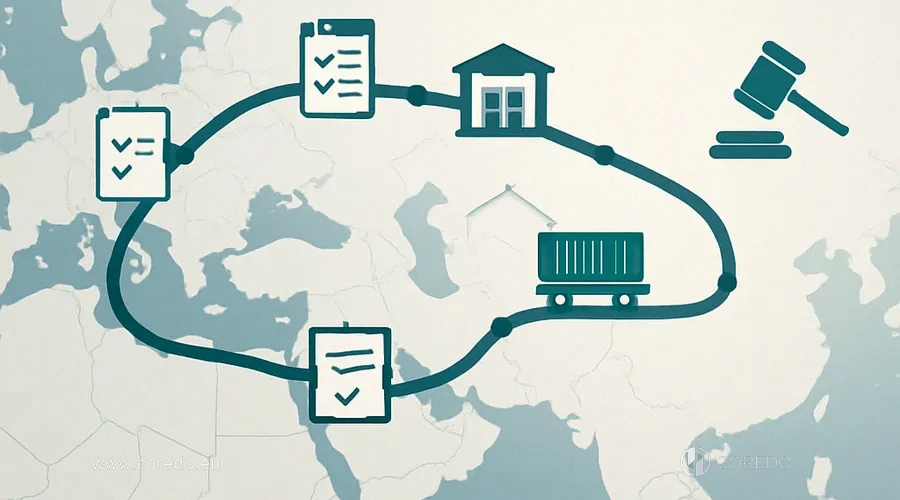
The GDPR applies in the EU; for transfers, there are Standard Contractual Clauses (SCC), Binding Corporate Rules (BCR), adequacy decisions and the EU–US Data Privacy Framework (DPF). After Schrems II, any US–EU data transfer mechanisms require an additional Data Transfer Impact Assessment (DTIA), and local Data Protection Authorities and the EDPB publish guidance on risk assessment and supplementary measures.
In the United Kingdom: the UK GDPR and tools such as the IDTA or the UK Addendum to the SCC, as well as the UK–US Data Bridge as part of the DPF. In Singapore, the PDPA is in force along with a data breach notification methodology; in the UAE, the federal PDPL applies, as well as independent DIFC/ADGM regimes with their own registries and requirements. In a number of Asian countries there are local restrictions on cross-border data transfers and specific requirements for data retention and deletion policies. Our experience at COREDO has shown: proper jurisdiction mapping at the start saves months and reduces the cost of subsequent remediation.
Roles: controller, processor, subprocessors
The controller determines the purposes and means of processing, the processor processes on instructions, subprocessors and the data processing chain must be transparent and formally approved. In the DPA we record the roles and rights of the controller and the processor, as well as flow-down clauses for subcontractors so that the subcontractor’s obligations in the DPA reflect the basic guarantees.
In the financial sector we often add sections related to AML screenings, KYC providers and transaction monitoring providers. The service provider’s liability for data is needed on a practical level: SLAs, response times (MTTR), RTO/RPO, incident-management checkpoints and the right to audit. This is not a formality: these are operational arrangements under which you will act in the event of a data breach.
How to conclude a DPA with a SaaS provider

I recommend the following approach, which the COREDO team has refined on dozens of projects:
- Pre-contract stage:
- Conduct Due Diligence of suppliers (vendor due diligence) with a focus on contractors’ certification standards ISO 27001 and SOC 2, encryption policy at rest and in transit, key management (HSM, BYOK), IAM and the principle of least privilege, presence of MFA, SIEM and continuous supplier monitoring.
- Assess the shared responsibility model (IaaS/PaaS/SaaS): where the boundary of responsibility lies for configurations, patch management and vulnerability management.
- Check legal risks of extraterritorial legislation (for example, the CLOUD Act) and reconcile them with DTIA.
- DPA structure:
- Describe the scope of processing, data categories and data subjects, data classification and data minimization, purposes and legal bases.
- Include standard blocks: standard contractual clauses for data transfer (SCC) or BCR/DPF, subprocessing mechanisms and a register of subcontractors, the right to audit and audit frequency (on-site/remote), data breach notification and data security SLA metrics.
- Add conditions for return and deletion of data upon contract termination, data retention and deletion policy, an NDA within the DPA, liability limitations and indemnity clauses.
- Security and SLA:
- Document SLA, RTO and RPO in the DPA for data processing, MTTR metrics and escalation procedures.
- Specify how to ensure contractors’ key encryption (BYOK), requirements for HSM, security logging and integration with your SIEM.
- Set requirements for penetration testing and validation of the contractor’s security, including red team/blue team exercises.
- Data subject rights and controller support:
- Specify how the contractor handles client DSARs (data subject access requests), timelines and communication channels.
- Specify which data will be included in the RoPA and who is responsible for updates.
- Formalities:
- Electronic signature and multijurisdictional validity, translation and legalization of contracts when necessary, legal dispute resolution mechanisms and arbitration, choice of law and jurisdiction.
DPA in international business: SCC, BCR, DPF
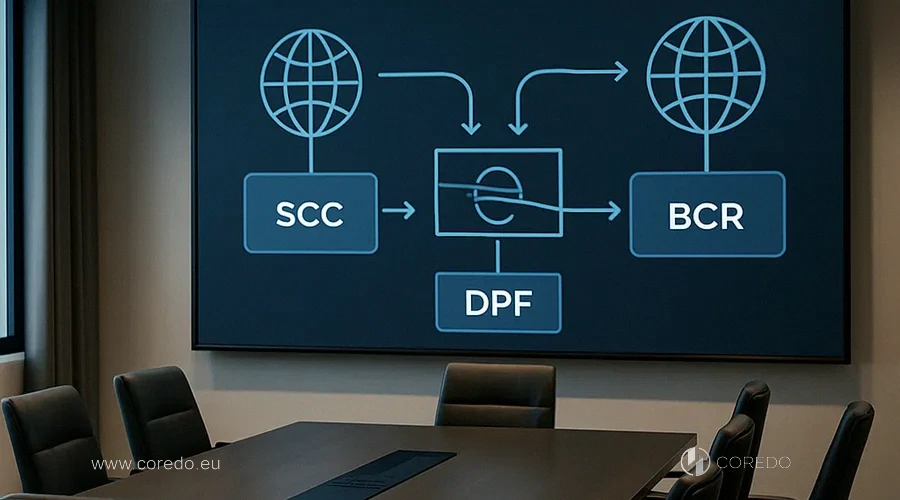
В ЕС базовые опции – SCC, BCR и DPF. SCC применимы быстрее и подходят для большинства внешних подрядчиков, в то время как binding corporate rules, мощный инструмент для внутрикорпоративных трансферов в группе компаний, но требуют времени и зрелости governance. EU-US DPF упростил трансферы в США для сертифицированных провайдеров, но оценка передачи данных (DTIA) и дополнительные меры остаются актуальны.
When to use BCR vs SCC vs DPF?
- BCR – if you have a large group across multiple regions and intensive internal transfers.
- SCC – if you are entering into a DPA with an external provider and need flexibility and speed.
- DPF – when your U.S. contractor is certified and you want to reduce the burden on the DTIA.
При передаче в Азию учитывайте локальные режимы и ограничения, а также альтернативные гарантии. Команда COREDO реализовала гибридные модели, где для одних стран применялись SCC, а для других: локальные механизмы с дополнительным шифрованием и псевдонимизацией.
Supplier due diligence and audit
We build a vendor assessment on a risk scale (vendor risk scorecard) across three dimensions: legal risks (transfer mechanisms, legal environment), technical controls (encryption, key management, IAM, MFA, SOC 2/ISO 27001), operational maturity (BCP/DRP, incident management, SIEM). We include KPIs for assessing contractor security: percentage of vulnerabilities closed on time, MTTR for incidents, share of subprocessors with current certification, compliance with RTO/RPO in recovery tests.
We implement continuous monitoring through GRC platforms and CLM integration (contract lifecycle management), connect tools for continuous vendor monitoring and automate checks via providers’ APIs. Our experience at COREDO has shown that automation reduces operational costs and improves compliance program ROI metrics by enabling early detection of deviations.
Integration of DPIA/DTIA and RoPA
Data protection impact assessments (DPIA) and DTIA should not be the last step before release. I insist on Privacy by Design and Privacy by Default: first we do data mapping and data lineage for contractors, then data classification and minimization, and only afterwards DPIA/DTIA and the implementation of controls. In RoPA we record operations involving each contractor, including subprocessors and flow-down clauses.
For development and testing we use test data and synthetic data as an alternative to real data. This reduces the risk surface and simplifies responses to regulatory requests. In COREDO projects this practice significantly reduces the cost of leaks according to the assessment method “cost of data leakage and savings from control measures”.
SLA and resilience metrics
Service-level agreements (SLAs) for data security must be measurable. We track:
- RTO/RPO, MTTR, and the frequency of BCP/DRP exercises;
- DSAR processing time;
- data breach notification timelines (in the EU, no later than 72 hours by the controller to the regulator under the DPA, and the processor must notify the controller significantly earlier);
- security service level and SLA metrics for patch management and critical vulnerabilities.
Incident scenarios are documented in an incident response playbook; we add escalation tables, points of contact, and the format of a “supplier security penalty audit” for material deviations. These conditions are embedded in the DPA and the main contract with a strict linkage to KPIs.
BYOK, HSM and IAM in practice
Encryption at rest and in transit is standard today, but the details determine the outcome. I recommend BYOK with key management in an HSM and clear rotation and revocation procedures. For the cloud – pay attention to the shared responsibility model so that issues around the client’s IAM configuration, MFA, and the principle of least privilege don’t remain unresolved.
In projects with increased data sensitivity we apply pseudonymization and anonymization, as well as bilateral key policies with a separation of duties between the customer and the provider. COREDO’s practice confirms that such an architecture facilitates DTIA for high-risk jurisdictions.
DPA enforcement: jurisdiction and arbitration
International agreements require care:
- We align legal dispute resolution mechanisms and arbitration taking into account presence in the EU/UK and the project’s geography.
- Electronic signatures and multi-jurisdictional validity are confirmed through applicable laws and certificate repositories.
- Translation and legalization of contracts are important when the DPA is included in the package for a local regulator.
- We include NDAs, liability limitations and indemnity clauses with clear liability caps (how to minimize liability in the DPA: a question of balancing risks and service cost).
- For clients in the EU we offer a Data Processing Agreement template (DPA template) adapted to local regulators (Data Protection Authorities) and recommendations from the EDPB/ICO.
Data lifecycle: return, deletion, migration
The DPA requires a clear policy for data retention and deletion, as well as the deletion and return of data upon termination of the relationship. We specify retention periods, the data portability format, deletion verification obligations, and vendor migration protocols. Further down the chain: subprocessors and the subcontractor registry are updated with notification to the controller and a right to object, especially when cross-border data transfers are involved.
An exit plan is a mandatory artifact. It reduces reliance on a single vendor and speeds up transition when licensing strategy changes or the infrastructure location shifts due to local data storage laws.
Compliance ROI for the Board of Directors
- compliance metrics: percentage of compliant vendors and remediation progress;
- cost of non-compliance: potential fines, service downtime, legal costs;
- incident KPIs: MTTR, success rate of recovery tests, meeting RTO/RPO;
- ROI metrics for compliance programs: reduction of cyber insurance premiums, shorter time-to-market in new jurisdictions, faster licensing due to predictable processes.
The COREDO team implemented GRC-based dashboards that consolidate the status of DPA, DPIA/DTIA, data vendor audits and reporting for the board of directors. This is one of those cases where transparency adds speed, not bureaucracy.
COREDO Case Studies: DPA, Licensing and AML
- Fintech in Estonia, handling payments within the EEA. We built an architecture on European clouds with SCCs for separate analytical tools outside the EEA, implemented BYOK and SIEM, defined SLAs and MTTR, and integrated DSAR handling. At the same time we updated the AML policy and KYC providers, executing a personal data processing agreement with subprocessors and a flow-down chain. The regulator accepted the dossier without additional rounds of questions.
- Payment provider in Singapore under the PSA (MAS). The client used a US SaaS for anti-fraud and marketing. We conducted a DTIA taking DPF into account, implemented pseudonymization of marketing data, included RTO/RPO in the DPA, and synthesized test data for pilots. As a result, partner bank approval and PDPA compliance were achieved within the expected timeframe.
- Brokerage company in Cyprus (CIF) with offices in London and Dubai. We established BCRs within the group and SCCs with external contractors, synchronized the requirements of the UK GDPR, DIFC and the Cypriot regulator. We conducted vendor due diligence, set KPIs for assessing contractors’ security, provided for the right to audit and documented an incident response playbook. This allowed the client to scale the operating model without repeated approvals.
- Crypto business in Dubai (VARA). We implemented a strict data minimization policy, ceased using some subprocessors with unclear localization, formalized the terms for data return and deletion upon termination, and conducted a «penalty» security audit of a supplier after an incident at one of the vendors. COREDO’s practice confirmed: preventive measures and rapid forensics protect the license and the relationship with the regulator.
What to check in a DPA before signing
- Role definitions: controller and processor: differences in responsibilities.
- Scope and purposes: data classification and data minimization.
- Transfers: SCC/BCR/DPF, DTIA, Schrems II and implications for transfers.
- Subprocessors: further down the chain and subcontractor register, flow-down clauses.
- Security: encryption, BYOK, HSM, IAM, MFA, vulnerability management.
- Certifications: ISO 27001, SOC 2, PCI DSS for card processing.
- SLA: security service level and SLA metrics, RTO/RPO, MTTR.
- Incidents: data breach notification, incident response playbook.
- Data subject rights: DSAR, RoPA when working with contractors.
- Deletion/return: conditions for returning and deleting data upon contract termination.
- Audit: right to audit and audit frequency (on-site/remote), “penalty audit”.
- Liability: limitations of liability and indemnity clauses, cyber insurance.
- Signature/law: electronic signature and arbitration, translation and legalization if necessary.
Scaling vendor compliance
Business is growing, the number of vendors is rapidly increasing. I recommend:
- segment vendors by risk and apply varying audit frequencies and depth of checks;
- centralize DPA in CLM and link it with GRC, setting up automated vendor compliance monitoring;
- implement tools for continuous vendor monitoring and API integration of compliance evidence;
- train teams and subcontractors, including security training and certification for contractors;
- set compliance metrics: percentage of compliant vendors, time to close remediations, share of vendors with up-to-date ISO/SOC.
The solution developed by COREDO includes a remediation strategy, remediation assessment methods and verification of fixes, as well as regular reports for management.
DPO when working with contractors
Data Protection Officer – not a ‘checkbox controller’, but a coordinator of data architecture. Their scope includes:
- integration of DPIA and DTIA into supplier onboarding;
- updating RoPA, oversight of data mapping and data lineage;
- coordination of DPA and SLA, engagement with local data protection regulators;
- preparation for audits and responses to data subject requests (DSAR);
- coordination of BCP/DRP and incident exercises;
- use of EDPB recommendations and ICO guidance when working with contractors.
Our experience at COREDO has shown that involving the DPO at an early stage reduces the risk of common mistakes and speeds up coordination with regulators.
What to do in the event of a data breach by a contractor
The action plan must be approved in advance:
- immediate notification of the controller by the processor, initial classification of the incident and activation of the playbook;
- technical isolation, forensics, assessment of affected data categories;
- legal assessment of notification thresholds for data subjects and the regulator, preparation of the notification within required deadlines;
- communication with clients and partners according to an agreed scenario;
- remediation, verification of fixes, and a “penalty audit” in case of material breaches;
- post-mortem and updates to the DPA/SLA, as well as KPIs for MTTR and reliability.
The COREDO team implemented such procedures in several jurisdictions, including the EU and the UAE. After incidents, companies not only regained services but also improved their standing with regulators thanks to transparency and speed.
BCR vs SCC vs DPF in Asia
Clients often ask when to use BCR vs SCC vs DPF. I summarize: BCR — a strategic choice for groups with extensive internal data flows, SCC — a practical tool for external contractors, DPF — an accelerator for the US when certification is available. In Asia it is important to consider local restrictions on cross-border subprocessing and data localization, and to add cryptographic measures, pseudonymization and a clear retention policy.
Legal risks of using cloud contractors in Asia are reduced through DTIA, additional encryption and BYOK, as well as choosing data centers in jurisdictions with an adequate level of protection. COREDO’s practice shows that a combined approach best withstands regulator scrutiny.
COREDO: DPA, licensing, AML and growth
In the licensing of payment and crypto projects we parallel three streams: legal configuration (SCC/BCR/DPF), technical security (ISO 27001/SOC 2, BYOK, SIEM, IAM) and an AML pipeline (KYC providers, transaction monitoring, reporting). This approach reduces the time for responses to the regulator, makes partner banks’ due diligence predictable and simplifies scaling to new markets — be it the Czech Republic, Slovakia, Cyprus, Estonia, United Kingdom, Singapore or Dubai.
Clients value time savings and transparency of processes. And I’m convinced: compliance with requirements for data protection and the management of data providers’ risks are not a brake on business, but a driver of sustainable growth.
A reliable foundation for international growth
DPA – a DPA is not just an addendum to a contract with a SaaS provider. It is a managed system of contractual, technical and operational mechanisms that holds the entire framework of international business in place, from company registration in the EU to obtaining a license in Dubai and launching payment products in Singapore. When a personal data processing agreement is backed by SCC/BCR/DPF, DPIA/DTIA, a subcontractor register, clear SLA, RTO/RPO, BYOK and the right to audit, a company reduces regulatory and cyber risks and speeds up time-to-market.
The COREDO team has, over recent years, guided dozens of projects along this route and knows where clients lose weeks and money, and where – they gain by getting the configuration right. If you need practical, comprehensive support – from DPA templates for European clients to automating vendor compliance monitoring and integrating AML providers into a unified model: my colleagues and I are ready to get involved. Reliable data protection and proper vendor management: it is an investment with a clear ROI, especially in an era of cross-border business and high regulatory demands.