
COREDO – EU Legal & Compliance Services Expert legal consulting, financial licensing (EMI, PSP, CASP under MiCA), and AML/CFT compliance across the European Union. Headquartered in Prague, we provide seamless regulatory solutions in Germany, Poland, Lithuania, and all 27 EU member states.

Grigorii Lutcenko
28.01.2026 | 6 min read
Updated: 28.01.2026
I see every day how even strong crypto companies and fintech projects face not so much technical challenges as banking and regulatory ones. The main choke points are correspondent banking, settlements and account freezes caused by insufficiently developed AML and weak “substance”. Over ten years my team and I at COREDO have gone through dozens of licensing processes, hundreds of legal-entity registrations in the EU, Asia and the Middle East, and numerous account-unblocking procedures. Below is a structured guide to the issues that most often lead to payment bottlenecks, and to the solutions that actually work.
Crypto business and correspondent banking

Crypto business and correspondent banking are directly linked today. If a correspondent bank detects an abnormal transaction velocity in your flows or “dirty” sources of funds, it will block the transfer before it is credited. Correspondent banks and crypto are an area of heightened scrutiny: SWIFT filtering and sanctions screening are in effect, and threshold rules and correspondent risk assessment models are applied.
Our experience at COREDO has shown that the key factor is the predictability and explainability of payment flows. When a business can separate fiat and crypto, produce correct proof of funds and maintain continuous blockchain monitoring, correspondent limits grow and credit lines are renewed without stress. COREDO’s practice confirms: a properly packaged client profile reduces the likelihood of crypto company account blocks many times over.
Choice of jurisdiction and company registration

Geography matters, but details decide: the required license, substance requirements, access to EMI and correspondent accounts, as well as local FIU and regulator support in dialogue with the bank. Below are the main areas where the COREDO team has implemented sustainable launch models.
EU: VASP/CASP/EMI and PKD codes
In the EU, crypto companies often find the best starting conditions in Lithuania and Estonia. VASP registration in Estonia today requires strengthened capital, designated AML officers and an internal auditor, as well as a precise description of Travel Rule procedures. The timeframe for document preparation and FIU review usually takes 2–4 months if KYC/E‑KYC and EDD on beneficiaries are set up in advance.
Cyprus is attractive for both CASP and EMI. An EMI license in Cyprus provides access to SEPA and the ability to build correspondent relationships through a sponsor bank and Nostro/Vostro accounts, provided the applicant has sufficient capital and demonstrated proof of business. In Poland it is important to specify PKD codes in the articles of association in advance for crypto operations and payment services to avoid discrepancies during subsequent bank checks. The solution developed by COREDO includes a matrix mapping PKD/NACE activities to banking profiles, which significantly speeds up the compliance assessment.
MPS/PSA in the UK and Singapore
In the UK the FCA’s regulatory requirements for crypto and payments are quite detailed, and a bank’s willingness to engage heavily depends on the transparency of UBO disclosure and the quality of the AML policy. Singapore sets a high bar on substance requirements: a local director, office, staff, and genuine operational activity. For MPS/payment licenses under MAS requirements, detailed AML/CTF procedures, IP/geo-analysis of counterparties and integration of an AML Rule Engine are critical.
The COREDO team implemented a “proof of presence” working model for Singaporean clients: a lease agreement, employment contracts, local accounting and an independent audit. Such a structure helps maintain accounts and reduces the likelihood of additional bank inquiries about the source of funds.
DFSA and DMCC in Dubai: nuances
Dubai via DFSA and DMCC offers flexibility but requires discipline. DFSA and DMCC in Dubai look at the Travel Rule, sanctions screening, and the separation of fiat/crypto flows when transferring via SWIFT and local clearing.
COREDO’s practice confirms: timely filing of a SAR (suspicious activity report) and engagement with the FIU help resolve potential blockages before an account is frozen.
EMI, forex, payment and crypto licenses

A license is not just a piece of paper, it is the language of communication with the bank and the correspondent. For EMIs, capital, governance and access to correspondent accounts via sponsorship arrangements are important. For forex providers and CASPs, EDD on beneficiaries, a KYC archive and storage of transaction metadata, as well as threshold monitoring, are critical.
Our approach at COREDO is to start with the business architecture: product map, client jurisdictions, currency of turnover, plan for correspondent relationships. When Licensing is backed by an operating model, the bank issues limits faster and is less likely to trigger SWIFT filtering with manual review.
Correspondent banks and crypto: risks

Correspondent risk (correspondent banking risk) – is a combination of jurisdiction, client profile, sanction exposures and data quality. The bank takes into account OFAC sanction lists, EU/UK lists, as well as your response to sanction updates and watchlists. If the profile includes P2P operations, OTC desks and mixers, the risk score increases instantly.
The COREDO team builds multi-level schemes: primary settlement infrastructure through an EMI and local clearings, international SWIFT: via a bank with a strict sanctions screening workflow and a GPI tracker. Such a hybrid distributes the load and reduces the likelihood of a complete business shutdown due to a single correspondent.
AML for crypto business: from Travel Rule to EDD
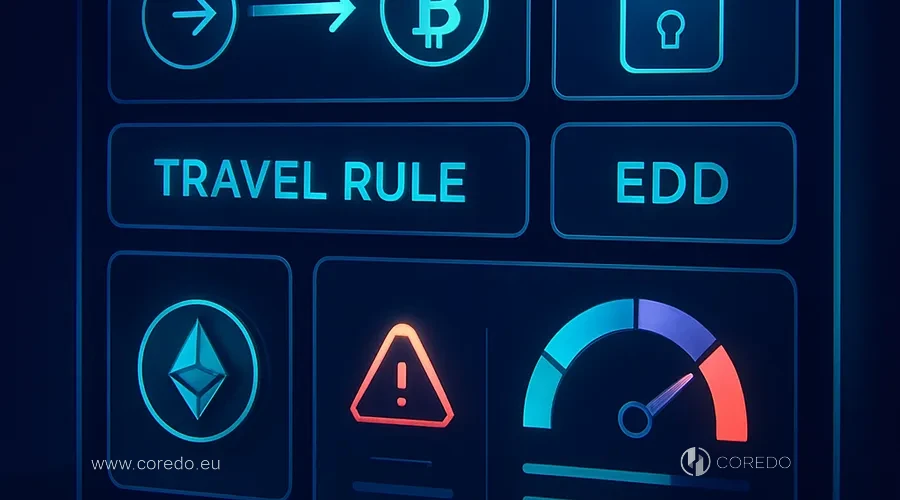
A strong AML is not a summary of rules, but a working pipeline. Here the Travel Rule and the FATF requirements, EDD configuration, continuous sanctions screening and transaction checks via blockchain analytics are important. Integration of Chainalysis and other blockchain‑forensic tools is already the standard, not an option.
The solution developed at COREDO provides an AML‑Rule Engine with transactional rules for velocity, structuring/smurfing patterns, geo‑behavior and ‘freshness’ metrics of funds. Such an engine logs events to SIEM, generates reports for the FIU and reduces manual alarm handling.
FATF Requirements and the Travel Rule
The Travel Rule requires transmitting information about the sender and receiver between VASP. Regulatory “overlays” are emerging in the EU and Asia, where ensuring provider compatibility is important. We configure field mapping and data validation processes to prevent rejections due to incompatible formats and unsynchronized time zones.
VASP compliance in the EU and Asia
In the EU, supervision is moving toward MiCA/CASP, with increased requirements for capital, reporting and risk management. In Asia there is a stronger emphasis on the technical side of monitoring and IP/geo‑controls.
Our experience at COREDO has shown that a hybrid approach delivers the best result: European‑level governance plus an Asian focus on technological detail.
Peer-to-peer Cryptocurrency Exchange Risk Control
P2P crypto exchange and risks is a topic where banks closely scrutinize escrow models, order allocation, turnover speed and sources of liquidity. In P2P there are sanction and entity risks, as well as an increased risk of payment structuring. The best AML practices for P2P exchangers in the EU include separate wallets for different classes of counterparties and separate fiat accounts for each on‑ramp channel.
The COREDO team implemented network segmentation of flows: “clean” inflows, OTC bridges, retail P2P and corporate clients are serviced through different accounting schemes. This helps avoid SWIFT filtering, maintain stable correspondent limits and pass regular checks without disruptions.
Account blocks: causes and mechanisms
The primary reasons for account blocks of crypto companies in the EU and Asia are lack of or vague AML policies, Travel Rule gaps, insufficient beneficiary documentation, and sharp spikes in transaction velocity. The use of privacy coins without compensating control procedures and suspicious links to mixers also trigger blocks.
When you receive a letter from the bank about the suspension of operations, it is important to act proactively. We prepare “evidence‑packages” with proof of funds, Chainalysis traces, counterparty profiles and KYC archives, as well as a plan of corrective measures. COREDO’s practice confirms that such a set works as a mechanism to unblock accounts in most typical cases.
Proof of Legality: KYC/E‑KYC
How to prove the legality of fiat inflows into a crypto company? We collect a chain: contracts, invoices, bank statements, tax returns, smart contracts and on‑chain evidence. Integration with Chainalysis for proof of legality routes addresses with “green” tags, shows a risk score and isolates toxic segments.
KYC/E‑KYC includes document validation, live verification, IP/geo comparison, telephony and email‑domain checks. EDD: enhanced Due Diligence for UBO – discloses beneficial ownership, source of wealth and professional biography. Such a package creates trust with the bank and speeds up unfreezing if it has occurred.
Confirm Substance and retain accounts
Substance is not a mailing address, but an ongoing operational presence: staff, office, contracts, reports, local taxes. Substance requirements in Singapore require a local director, an office lease and a clear hiring plan. In the EU and in Cyprus substance requirements also include a genuine managerial function and local payment arrangements.
We conduct an audit of substance and proof of presence: we verify that documents are consistent with each other and reflect actual operations. This reduces the risk of questions when renewing the account and during subsequent checks by the correspondent.
Opening and maintenance of accounts: banks, EMI
EMIs and access to correspondent accounts are a combination that banks assess through the lens of risk management and client profile. It is more appropriate to arrange several EMIs and one or two banks, using SWIFT‑GPI for transparency and separate Nostro/Vostro arrangements for different currencies. This provides resilience and manageable limits.
To reduce correspondent risk when entering the international market, we separate fiat and crypto flows, set limits on P2P volumes and configure the structure of payment counterparties. It is important to discuss correspondent limits and credit lines with the bank in advance so that scaling does not hit a ‘ceiling’.
Compliance technologies: Rule Engine, SIEM
Modern AML is built around the integration of AML‑Rule Engines, SIEM and API integrations for blockchain analytics. Sanctions screening operates through a multi-stage workflow: pre‑screening, on‑screening, post‑event review and escalation to case management. In effect, it is a compliance factory where every event is logged and can be presented to the FIU.
The solution developed at COREDO includes threshold monitoring and triggering rules that take regional thresholds, velocity and structuring patterns into account. We connect a response to sanctions updates and watchlists to automatically suspend high-risk operations until the review is complete.
Scaling without limits
Scaling a P2P‑platform without increasing correspondent limits can be achieved through segregated flows, local clearing systems and alternative rails. Alternatives to correspondent relationships for international fiat transfers include a sponsored payments model via a large EMI, local schemes (SEPA Instant, Faster Payments), as well as regulated on/off‑ramps with stablecoins, if compliance permits.
For privacy without blocks it is important to handle technologies properly. zk‑SNARKs and privacy coins (Monero, Zcash) carry increased risk: banks expect compensating measures: transparent on-ramps, address whitelists, ring signatures analysis and enhanced EDD. If the product uses such transactions, the control design must be agreed with the bank in advance.
COREDO Case Studies – practical stories
– Estonia, VASP registration. The client came with a ready product but without a Travel Rule and with “high-risk” beneficiaries. The COREDO team implemented EDD packages, integrated a Travel Rule provider and built a KYC archive. Registration took 11 weeks, the bank opened an account with a base limit, which was doubled after three months with consistently “clean” flows.
– Cyprus, EMI license. The client needed access to SEPA and correspondents for multiple currencies. We prepared a business plan, a risk framework, sanctions screening workflow and proof of funds for the capital. Through a sponsor bank the client obtained Nostro/Vostro agreements and GPI trackers, and also increased limits after the first quarter without incidents.
– Dubai, a DMCC structure for a crypto business. The project faced account blocks due to P2P volumes and mixed flows. The solution developed at COREDO separated flows, implemented blockchain monitoring and established local substance. Blocks stopped, and the correspondent bank renewed the credit line without additional conditions.
– Account unblocking in the EU. The bank requested additional documents regarding suspicious crypto activity. We compiled an evidence package: Chainalysis reports, contracts, tax records, KYC/e‑KYC logs and IP/geo analytics. The account was unblocked in nine business days, and the bank approved a plan of preventive measures.
Compliance ROI and outsourcing
Outsourcing compliance for crypto often pays back within 3–6 months thanks to reduced downtime and losses due to blocks. ROI metrics for blocks include Loss of Revenue, Downtime, Cost of Funds and an increase in CAC due to frictions on the on‑ramp.
When compliance processes are streamlined, GPI‑routes become more stable, and correspondents less frequently require manual confirmations. Compliance outsourcing frameworks (Compliance‑as‑a‑Service) used by the COREDO team cover AML policy, Rule Engine, SIEM, sanctions screening and regular data audits. This creates a control environment that is clear to the bank and the regulator, and allows management to focus on the product and scaling.
Answers to clients’ frequently asked questions
- What do banks pay attention to when assessing a crypto company as a client? The bank evaluates UBO disclosure, EDD‑packages, implementation of the Travel Rule, sanctions screening and segregation of flows. Substance and the quality of proof of business are important, as well as readiness for FIU interaction, including timely SAR/STR.
- In which jurisdictions is the risk of correspondent account blocks lower? Where there is a clear regulatory regime (EU, United Kingdom, Singapore, Cyprus, Dubai) and real substance. Jurisdiction: half the success, the other half: the actual AML model and predictability of flows.
- How to properly structure correspondent relationships when working with crypto flows? Start with a hybrid EMI+bank model, agree on limits and types of counterparties, document the Rule Engine and blockchain monitoring. Regularly share reports with the bank and do not mix P2P with corporate flows.
- What documents does the bank request in case of suspicious activity and how many should be prepared in advance? They usually request proof of funds, KYC/E‑KYC logs, contracts, invoices, tax documents and a Chainalysis report. Prepare a “box” in advance, update it quarterly and retain transaction metadata for at least the required period.
- How long does VASP registration in Estonia take? On average 8–12 weeks to prepare the package and 60–90 days for FIU review if there are no revisions. With quality pre‑screening of beneficiaries, the risk of delays is significantly lower.
- How to reduce correspondent risk with P2P and avoid SWIFT filtering? Separate fiat and crypto flows, configure sanctions screening and the Travel Rule, limit velocity and volumes per client. Agree with the bank on lists of allowed counterparties and route payments via GPI with transparent remittances.
- How much do FATCA/CRS affect opening accounts for crypto businesses? They have a significant impact, as tax reporting data forms part of the risk profile. It’s important to correctly and timely submit CRS/FATCA reports, avoiding discrepancies with bank questionnaires.
- Which banks are tightening checks for OFAC and sanctions? This is a trend among all banks with access to dollar liquidity and large correspondents like Deutsche Bank, MUFG and Citi. Therefore, sanctions screening and watchlist updates must operate without delays.
- Which licenses are suitable for scaling P2P? In the EU, CASP with a strong AML function, in Cyprus, CASP/EMI depending on the model, in Singapore, MPS/PSA with extended on‑ramps. The key: proper separation of flow risk segments and clear governance.
Checklists: documents, policies and steps
- Proof of funds and an evidence‑package for the bank. Gather contracts, invoices, statements, tax returns, and on‑chain reports. Supplement with KYC/E‑KYC logs, IP/geo analytics, a counterparty profile, and a fund‑routing map.
- Preparation of a business‑plan and AML policy for an EMI/Payment license. Describe the product map, customer segments, geography, and flow projections. Attach the AML policy with a Rule Engine, sanctions screening workflow, Travel Rule implementation, and an EDD plan.
- Due diligence of beneficial owners for the bank. Prepare UBO disclosure, biographies, source of wealth, and supporting documents. Conduct an independent media search, political exposure checks, and sanctions screening with findings.
- How to organize substance in Singapore to retain accounts. Sign a lease agreement, hire a local director and key staff. Maintain local accounting, document operational processes, and regularly confirm business activity.
- Which PKD codes to specify to minimize blocks. Analyze the code’s conformity with the declared services and the bank profile. Exclude “grey” formulations and reflect specific crypto operations in the classifier’s language.
- How to integrate blockchain monitoring into the AML policy. Describe data sources, threshold values, actions on alerts, and metadata storage. Include API integrations, white/blacklisting procedures, and case escalation to the FIU.
- What to do when you receive a letter about suspension of operations. Immediately acknowledge receipt, request the list of requirements and deadlines. Compile an expanded evidence package and propose a corrective action plan with deadlines.
Partnership with COREDO
Crypto business and correspondent banking are not about luck but about process architecture and data accuracy. When AML‑policy, the Travel Rule, sanctions screening, substance and the evidentiary base are combined into a single system, account blocks become rare exceptions and scaling turns into a manageable routine. The COREDO team has implemented dozens of such systems in the EU, Asia and the Middle East, and I see how mature compliance increases business valuation.
If your plans include registering legal entities for crypto business in the EU, obtaining an EMI or CASP, entering Singapore with its substance requirements, or structuring in Dubai through DFSA/DMCC: rely on experience and proven methodologies. COREDO’s practice confirms: transparent processes, predictive metrics and readiness to engage in dialogue with the bank are the best way to retain accounts, expand limits and move forward without interruptions.