
COREDO – EU Legal & Compliance Services Expert legal consulting, financial licensing (EMI, PSP, CASP under MiCA), and AML/CFT compliance across the European Union. Headquartered in Prague, we provide seamless regulatory solutions in Germany, Poland, Lithuania, and all 27 EU member states.

Nikita Veremeev
05.04.2026 | 6 min read
Updated: 05.04.2026
I founded COREDO in 2016 because entrepreneurs in Europe, Asia and the CIS countries were chronically lacking a partner who could consistently and confidently guide them through company registration abroad, obtaining financial licences, AML compliance and complex business sale transactions. Over the years the COREDO team has implemented dozens of cross‑border projects: from holding structures in the EU and the UK to licensing in Singapore and Dubai, from crypto licences and payment licences to support for IPO preparation. I see how a properly structured legal setup turns into a tangible valuation premium, removes entry barriers for strategic buyers and guarantees a clean and predictable exit for the investor.
Below is a distillation of the methodologies, solutions and case studies that my colleagues and I have worked through in practice. The text is intended for founders, chief financial officers and investors who want to go from preparing a company for sale to closing the deal and post‑transaction integration without losing value or momentum.
Legal packaging and exit price

Legal packaging - is more than "clean documents". It is an aligned architecture of ownership, corporate governance, IP, regulatory approvals and the contractual framework that reduces risks for the buyer and simplifies integration. When I calculate the "legal packaging premium" I look at how much of the risk-factor discount can be removed: from contingent liabilities and unregistered IP to weak corporate control. COREDO's practice confirms: systematic preparation reduces the "minority discount", increases the "control premium" and adds basis points to EBITDA multiples.
How does legal packaging increase company value in practice? First, uncertainty in Due Diligence is reduced: legal preparation answers sensitive questions in advance about the cap table, UBO, licenses, contracts, employment and IP rights. Second, a clear legal structure for the investor's exit gives the buyer transparency over the payment cascade (liquidation waterfall), conversion terms and priorities (liquidation preference), and also prevents disputes over anti-dilution mechanisms and convertibles. Third, improved corporate governance and an independent board increase confidence in forecasts, which affects valuation uplift after legal packaging.
Legal consequences of exit

Exit‑strategy for an investor depends on the buyer profile and the maturity of the asset. I distinguish several basic exit strategies: sale to a strategic buyer, to a financial investor (PE/VC), secondary sale (including secondary buyout: fund-to-fund), MBO/MBI, IPO/SPAC and sales on the secondary market. For each strategy I pre-formulate the legal packaging, the deal structure (share deal vs asset deal), an earn‑out and KPI plan, as well as a set of non‑compete agreements and client transition arrangements.
A strategic buyer vs a financial investor is, essentially, a choice between synergies and return on capital. Strategics are ready to pay a control premium, but expect strict conditions on non‑compete enforceability, assignment of key contracts (assignment of contracts, change‑of‑control clauses) and detailed post‑deal integration. Financial buyers pay more attention to governance due diligence, the quality of reporting (annual accounts, audits) and a clean cap table. The COREDO team has developed term sheet templates and SPA logic that account for both profiles, to speed up negotiations and reduce gaps in expectations.
Secondary sale is a sought-after option in growth-stage projects. Here tag‑along and drag‑along rights are critical, as well as clear documentation of liquidation preference, so the waterfall distribution of proceeds does not cause disputes between early and late investors. I always model investor exit scenarios in the cap table in advance and check whether an old shareholder agreement blocks new arrangements with the buyer on exit.
Architecture: holding, SPV, substance

Preparing a company for sale begins with the right ownership architecture. How to build a holding structure for an international exit? I prefer a holding company for selling a business in predictable jurisdictions with stable law: the Netherlands, Luxembourg, Ireland, the United Kingdom, Cyprus, Estonia, as well as Singapore and the UAE for the Asian direction. Such a structure simplifies profit repatriation, reduces withholding tax on dividend distributions and creates a clear choice of law for the SPA.
SPV for investor exit: a tool that solves three tasks at once: isolation of operating risks, a convenient entry/exit into a specific asset, and payment of taxes in a predictable manner. Preparing an SPV to attract a strategic buyer means meeting economic substance requirements: a real office, management decisions in the jurisdiction, a board of directors, expenses and personnel. Our experience at COREDO has shown that substance structures in the EU and Asia speed up banking compliance and reduce queries under DAC6 and GAAR.
The impact of BEPS and the rules of the OECD, ATAD, CFC and Pillar Two on exit structures can no longer be ignored. I conduct an audit of the place of effective management, chains of interest and licensing payments, intercompany loan agreements and transfer pricing documentation so that the map of tax risks in an international sale is transparent. The solution developed at COREDO includes automatic DTT (double tax treaties) checks, calculation of effective rates and tests for anti‑avoidance clauses.
Preparation for the transaction: 180–360 days

I start the preparation program at least 6–12 months in advance. This saves weeks on due diligence and makes the valuation more manageable.
- Due diligence: legal preparation. I assemble the data room: legal checklist, virtual data room and data security policies. These include corporate documents, statutory registers, minutes and board resolutions (corporate housekeeping), UBO registers and beneficial owner disclosure, licenses, IP and key contracts.
- KYC procedures and counterparty screening. I clean up legacy risks, close outdated relationships, update NDAs and review change‑of‑control clauses.
- Company secretarial clean‑up. I fix gaps in the cap table, document option programs, convert convertible notes, and align anti‑dilution provisions where they affect the waterfall.
- Compliance and AML when preparing for exit. I conduct AML risk assessments for corporate structures, sanctions compliance and buyer screening, update policies on FATF, 5AMLD/6AMLD, the Travel Rule for crypto services and MiCA requirements in the EU. COREDO practice confirms: transparency of UBO and CRS procedures speeds up the buyer's bank onboarding.
- IP and operational assets. How to arrange the transfer of intellectual property before the deal? I recommend centralising IP in a holding company, formalising Licensing and royalties, and checking the registration of trademarks and patents in target countries.
- People and governance. I initiate governance due diligence: board composition and director independence, committees, authority matrix. I prepare management retention terms and retention bonuses, as well as golden parachutes taking tax consequences into account.
share deal vs. asset deal
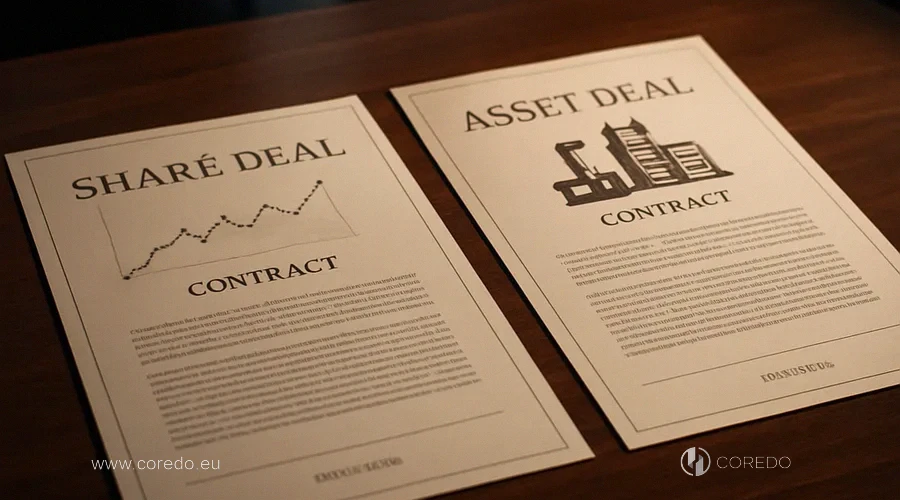
The difference between a share deal and an asset deal is not only the object of purchase. In a share deal the buyer inherits the corporate history and potential hidden liabilities; in an asset purchase agreement, risks are lower but the transfer of permits, employees and contracts is more complex. I assess industry regulatory requirements and licenses in advance so as not to lose business continuity.
SPA (share purchase agreement): the core structure of the transaction. I include in the term sheet the key mechanics: purchase price mechanisms (closing accounts, locked box), valuation adjustments, escrow mechanisms and unlocking conditions, representations and warranties insurance (RWI), closing conditions and completion triggers, post‑closing indemnities and limitation periods. choice of jurisdiction and choice of law in an SPA, as well as the dispute resolution formula: arbitration vs court — are critical for enforceability. In international deals COREDO often uses London arbitration or the Singapore International Arbitration Centre when the parties are from Europe and Asia.
Financing and capital structure when preparing for a sale require special attention. Preferred shares, liquidation preference, anti‑dilution and convertible notes are disclosed differently on exit. I model the liquidation waterfall to avoid conflict with minority shareholders, implement tag‑along/drag‑along, and propose put/call options in the exit scheme if the deal envisages an earn‑out or deferred payments. For earn‑out agreements I agree KPIs in advance, define accounting policies and controls so as not to dispute revenue recognition after closing.
Tax packaging of profits
Tax packaging before a sale is not about simply "attaching a holding in the EU". It's about aligning DTTs, checking withholding tax planning on the repatriation of dividends, interest and royalties, and ensuring sufficient substance and governance. I analyze tax residency and place of management, synchronize board resolutions and signatures to avoid creating "hidden management" in another country.
The regulatory reporting factor is intensifying. DAC6 and reporting on cross‑border transactions require transparency of motives, CRS and the automatic exchange of tax information — clarity of beneficiaries, FATCA affects the structure of a US investor, and ATAD and the EU anti‑abuse rules limit hybrid and excessively indebted positions. Pillar Two (the global minimum tax) changes the economics of low‑tax structures and pushes toward real presence. I review intercompany loan agreements, thin‑capitalization tests and transfer pricing documentation to minimize adjustments and disputes.
A map of tax risks in an international sale is a mandatory annex to the investment memorandum. I include stress scenarios for potential revisions of WHT rates, results of substance tests, GAAR analysis, assessment of CFC risks for beneficiaries and guidance on double tax treaties: optimizing taxes on the exit in each direction reduces the resulting effective rate.
Business valuation at exit: the impact of law
Business valuation at exit: it's not just EBITDA multiples. I align pre‑money and post‑money valuation with the soundness of the legal framework, measure the control premium for strategic buyers and the minority discount in cases of partial sales. When legal packaging eliminates uncertainty and embeds risks into clear mechanisms (RWI, escrow, indemnities), the valuation uplift after legal packaging becomes an empirical fact.
How to agree an earn‑out and control KPIs is a common question. I recommend defining KPIs at the EBITDA or gross profit level, synchronizing accounting policies, specifying access to management reporting, the right of audit and a neutral expert mechanism. It's important to fix non‑compete and non‑solicit provisions in advance so founders don't cannibalize the new owner's metrics. The COREDO team implemented several earn‑out agreements with two‑tier KPIs: financial metrics and legal milestones (obtaining a license, renewal of regulatory approval, completion of contract migration).
The investment memorandum and the legal section are your primary tool for managing risk perception. I include documents for assessing contingent liabilities, a list of open and closed disputes, licenses and regulatory letters, ESG risks, and results of internal audits and independent reviews. Data room: a legal checklist and the virtual data room allow the buyer to complete KYC faster, and transparency of the beneficial owner (UBO) and registries shortens the review cycles by the risk committee.
Registration and licensing - the foundation
Registration of legal entities is not a mechanical task. I take future exit into account already at the incorporation stage: I choose the holding jurisdiction, branches and subsidiaries, substance and the future tax structure. In the EU I more often use Cyprus, Estonia, the Czech Republic, Slovakia and the Netherlands; in the UK: Ltd/LLP structures for holdings and IP; in Asia, Singapore as a regional hub; in MENA - Dubai with its free zones and ESR.
Licensing is a separate value driver. For payment services (EMI/PI under PSD2/PSD3), investment firms (MiFID), forex brokers, crypto providers (VASP under MiCA and local regimes), e-money and even banking licenses - I build the compliance framework and AML/CTF policies in advance. The solution developed at COREDO links licensing with banking onboarding and account opening at PSPs/EMIs, as well as with a KYC strategy for key markets. This reduces the regulatory gap in due diligence and builds buyer confidence, especially among strategic buyers.
Risks and solutions for cross-border M&A
Regulatory approvals and antitrust reviews often determine the timing of a deal. I check concentration thresholds, sector-specific requirements (for example, for the financial sector and telecoms) and agree pre‑closing undertakings to avoid breaching the standstill. Sanctions compliance and buyer screening are becoming standard: I implement procedures to exclude prohibited counterparties already at the NDA and term sheet stage, so as not to waste months.
In international transactions the role of the escrow agent and trustee is growing. I like to use multi-level escrow mechanisms: part for general warranties, part for specific risks (for example, tax audits or licensing), with clear release conditions. Post-transaction integration: legal aspects are not "let's wait and see". I set out transition services, IP licenses for the migration period, assignment of contracts and third-party consents, as well as closing conditions and deal-completion triggers, so that the integration does not fall apart in the first month.
COREDO case studies
First case: a fintech payments provider with offices in the Czech Republic and Slovakia and a holding company in the Netherlands. We carried out a company secretarial clean-up, secured IP at the holding level, updated PSD2 licenses and prepared an AML risk assessment. We structured the transaction as a share deal with a mixed price: a fixed element and an earn-out; KPIs were licensing of a new product and an EBITDA threshold. Result: investor exit after 11 months, RWI covered the key warranties, and an 8% price escrow resolved a tax audit dispute.
Second case - a secondary sale of a stake in a crypto service between funds. I proposed an SPV for the investor exit in Estonia with substance and a transparent UBO, took into account MiCA requirements and the Travel Rule, and strengthened sanctions screening. The shareholders' agreement was updated on exit: we reworked the liquidation preference, resolved a conflict with anti-dilution provisions and secured a drag-along. The COREDO team implemented an 18-month earn-out agreement with KPIs for user growth and a license in one of the EU countries. The deal included an LCIA arbitration clause and closed without litigation.
Third case: preparing a PSP in Singapore for sale to a strategic buyer from the UK. We set up a holding company for the sale of the business in Singapore, conducted governance due diligence, replaced part of the board, and implemented an independent audit. In the SPA we added put/call options to buy an additional 20% based on performance metrics, as well as non-compete, non-solicit provisions and retention bonuses for the key team. The solution developed at COREDO regarding transfer pricing and the royalty model ensured tax neutrality on profit repatriation.
Practical steps and timeline
- 12–18 месяцев до выхода
Carry out legal restructuring: holding, SPV, substance. Create a tax risk map, align DTT and ESR/ESG policies. Strengthen AML/CTF and KYC methodologies, update UBO disclosures. Start governance due diligence and audit of annual accounts. - 6–9 месяцев до выхода
Data room: legal checklist, VDR, NDA with interested parties. Correct the cap table, options, convertible notes, liquidation preference and anti‑dilution. Transfer IP to the holding, agree assignment of contracts and change of control. Prepare the term sheet and the framework SPA structure, select governing law and arbitration. - 3–6 месяцев до выхода
Launch vendor due diligence, prepare the investment memorandum and the legal section. Set up purchase price mechanisms, escrow and RWI; agree on earn‑out and KPIs. Approve non‑compete, retention and golden parachute. Confirm regulatory approvals, antitrust notifications and sanctions screening of buyers. - 0–3 месяца до закрытия
Prepare closing conditions, intercompany clean‑up, debt‑free/cash‑free calculations. Check transfer pricing documentation, DAC6 and CRS obligations. Agree on post‑closing indemnities and the limitation period, arrange escrow mechanisms and unlocking conditions. - 90 дней после закрытия
Post‑closing: hand over registers, update statutory registers, close the VDR. Post‑deal integration: legal aspects: IP migration, transition services, alignment of employment contracts and dismissal/transfer of key employees in accordance with the labor law rules of the relevant jurisdictions. Complete reporting under DTT/withholding and confirm substance.
Common bottlenecks: how I address them
First, underestimating governance. Board composition and influence on valuation are real: independent directors, an audit committee and transparent minutes increase trust and reduce the risk discount. Second: weak contractual framework. I pre-check change of control clauses, third-party consents, and the licensing and transfer of IP before the deal. Third, tax mismatch. Anti-avoidance clauses and GAAR can wipe out benefits if the substance is nominal.
Fourth, minority protection. I balance tag-along/drag-along, propose shareholder dispute resolution: arbitration vs court depending on the composition of beneficiaries, and set out mediation procedures. Fifth, ESG. ESG risks affect multiples: data policy, labor law, environment and compliance — it's not a 'trend', but a requirement of investment committees.
How COREDO builds a reliable partnership
I build relationships based on transparency and the rhythm of execution. At the outset I create a roadmap of objectives: investor exit, valuations and exit strategy; legal packaging and due diligence: legal preparation; tax structuring ahead of sale; deal structuring: share deal vs asset deal; documents for the investor on exit. Then I synchronize the legal, tax and licensing tracks and bring in banks and payment providers.
In projects with licenses I separately provide AML‑consulting: I update the risk assessment, KYC‑procedures and counterparty checks, prepare reports for the regulator, and conduct training for the team. In registrations, I select jurisdictions from the perspective of the future exit, substance, DTT and a banking‑friendly environment. In deals: I work with buyers in the language of SPA/APA, escrow and RWI, organize the role of escrow agent and trustee to reduce frictions around price and warranties.
My guiding principle is simple, clear solutions. I don't promise incredible miracles, but I guarantee commitment, discipline and responsibility for the outcome. If a task is more complex than it appeared at the start, I'll say so and propose an alternative exit: IPO, SPAC, secondary market sales, or a staged exit via buy‑in/buy‑out schemes and a management buyout (MBO).
Conclusions
Legal packaging: this is not mere cosmetics before a sale. It is the foundation that supports a business valuation at exit, the speed of the deal, the quality of the earn‑out and the resilience of the integration. When I design the legal structure for an investor exit - holding, SPV, substance, compliance, licenses and the contractual framework: I am effectively managing risks and multipliers. Exit strategies are diverse, but the logic is the same: transparency, predictability and professional attention to detail.
COREDO grew on international registrations, licenses and AML‑compliance, and this experience directly converts into successful deals: from the EU to Singapore and Dubai. If you are planning an investor exit or preparing a company for sale, start with the map: ownership structure, tax and legal packaging, due diligence and SPA‑mechanics. I am ready to take this path with your team, carefully managing risks and protecting the value you have built over years.