
COREDO – EU Legal & Compliance Services Expert legal consulting, financial licensing (EMI, PSP, CASP under MiCA), and AML/CFT compliance across the European Union. Headquartered in Prague, we provide seamless regulatory solutions in Germany, Poland, Lithuania, and all 27 EU member states.

Gregory Lutsenko
18.03.2026 | 6 min read
Updated: 18.03.2026
I founded COREDO in 2016 with a simple idea: international business should grow not through "shortcuts", but through predictability, transparency and strategic compliance. Over the years the COREDO team has helped hundreds of clients from Europe, Asia and the CIS open accounts in banks in the EU, the UK, Singapore and Dubai, obtain crypto, payment and forex licenses, build AML processes and pass complex onboarding processes. Today I want to give a concentrated guide on a topic that most often causes stress for owners and CFOs — the compliance interview at the bank. It is inevitable when opening an account for a foreign company, when reviewing a risk profile (remediation), and when transaction monitoring is intensified.
In this article I will analyze question scenarios, the structure of answers, documents, checklists and "red flags" that the bank notices. I will show how an executive can confidently pass a KYC interview at the bank, how to explain the corporate structure and source of funds, and how to reduce the risk of account closure and unnecessary requests. COREDO's experience confirms: a properly prepared interview saves months and preserves business relationships with the bank.
What is a compliance interview in a bank?
A compliance interview in a bank is a conversation with a KYC/AML officer to confirm the company's identity, its beneficial owners, business model, sources of funds, and sanctions and tax status. It can take place in person or remotely (eKYC), sometimes in several rounds. The compliance interview for bank clients is part of the risk-based approach (RBA) adopted following the recommendations of FATF and regulators in the EU, the UK, Singapore and the UAE. The higher the risk profile, the deeper the checks (CDD/EDD) and the broader the range of questions.
In my experience, you should not treat the meeting as an interrogation.
It is an opportunity to manage risk perception and demonstrate corporate transparency. A well-prepared manager sets the pace of the conversation, relies on facts and documents, and shows the maturity of internal controls. As a result, the client risk assessment and scoring work in your favor.
KYC/AML Basics: frameworks for questions
Banks operate within the framework of international FATF standards, requirements on sanctions lists OFAC, the EU and the UN, as well as local rules on AML/CFT, GDPR for personal data, FATCA and CRS for tax reporting. In focus: KYC (Know Your Customer) and CDD (Customer Due Diligence), and for complex cases, EDD (enhanced due diligence). Questions in a compliance interview always concern four blocks: client identification and UBO, description of the business model and transactional activity, assessment of sanctions and PEP risks, proof of source of funds and source of wealth.
The COREDO team implements an RBA approach for clients: we map risk flags (red flags) in advance by jurisdictions, industries and ownership chains. Such mapping allows us to predict banking compliance interview scenarios and prepare targeted responses with documentary evidence.
How the interview is structured: roles and stages
Usually two profiles participate: your manager or an authorized director responsible for strategic decisions, and the bank's compliance officer. Sometimes a relationship manager for corporate clients and a representative of the transaction monitoring unit join. At the start there is a basic KYC interview, then CDD, and if there are signs of increased risk — EDD with in-depth questions and requests for supporting documents.
The scenario is predictable: the bank verifies the legal entity (including the Legal Entity Identifier, if issued), the ownership structure and controlling persons, then moves on to business operations and transactions, followed by: sanctions, PEP, tax residency, contractual framework and counterparties. At the end, obligations to update data are recorded, the interview is documented and an audit trail is created.
Checklist: Documents and Data for the Bank
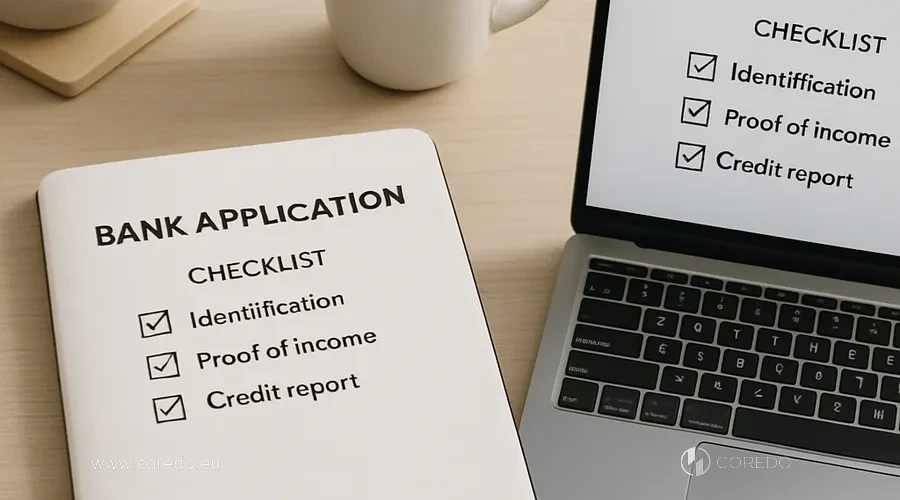
At COREDO we have built a "document per question" approach, matching each likely request with the exact supporting document. This checklist reduces onboarding time and removes unnecessary adjustments to KYC and AML.
- Incorporation documents and corporate structure. Prepare the articles of association, an extract from the registry, minutes of director appointments, trust agreements (if applicable), an ownership chain diagram indicating the ultimate beneficial owner (UBO). Each link must have documentary evidence.
- Proof of identity and address. Passports of directors and beneficial owners, address proofs, certificates of tax residency. For PEPs — an enhanced data package and a declaration of official status.
- Economic activity and financial model. Business plan, product descriptions, target markets, supply chain and key contracts. For startups — a financing roadmap and justification of the burn rate.
- Source of funds and source of wealth. Contracts, statements, auditor reports, documents on asset sales or dividends, certified tax returns. For investors — memoranda, cap table, letters on the origin of capital.
- Sanctions and compliance profile. Sanctions declarations, results of internal KYC/CDD, screenshots from sanctions lists, adverse media monitoring.
- Tax and reporting base. FATCA/CRS forms, confirmation of GIIN status for investment structures (if applicable), tax payment confirmations.
- Technical attributes and IT control. GDPR policies, data storage processes, access tracing, basic RMF (risk management framework) according to ISO 31000.
- Transactional scenarios and limits. Transaction profiling, expected corridors of amounts and countries, description of calculation logic and correspondent relationships.
Compliance responses: FACT-LOGIC-PROOF

I train managers to structure answers according to the three-step FACT-LOGIC-PROOF model. It disciplines thinking and reduces the risk of 'red flags'.
- FACT: a short fact in one to two sentences. You answer the question immediately, without going into details.
- LOGIC: explanation of the economic rationale and the control process. You show why the operation is structured this way and how risks are minimized.
- PROOF - a reference to a document, policy, or external registry. You support the answer with verifiable data.
For example, answers to questions about source of funds:
- FACT: "An investment of X was received from Fund A under a signed SAFE, in two tranches."
- LOGIC: "The fund operates in the EU, holds an AIFM license, has internal AML policies and its own KYC for investors."
- PROOF: "We attach the signed SAFE, a bank statement, the fund's beneficiary register, and the fund's compliance letter."
KYC and CDD in interviews: how to answer
In a basic KYC you will be asked to describe the business, the corporate structure and the geography of operations. Describe the market, sales channels, average transaction amounts and partners in the two or three countries that generate the core revenue. If the structure includes a holding company and an SPV, explain the roles: the holding owns the IP and consolidates capital, the operating company signs contracts and bears expenses, the SPV issues convertible loans. Confirm this with contracts and bank statements.
CDD will dig deeper into counterparties and third parties. Show the counterparty screening process: OSINT, Wiki screening, adverse media monitoring, sanctions lists and the verification log. Specify the trigger rules for transaction monitoring and the escalation procedures. Such an answer lowers the risk profile without unnecessary detail.
Enhanced due diligence for sanctions
EDD appears with complex corporate structures, funds and trusts, cross-border shipments of sensitive goods, as well as indicators of PEP. Expect interviews on sanctions risks, in-depth questions about beneficiaries, sources of wealth and the geography of payments. Check compliance against OFAC, EU and UN lists, prepare a position on correspondent relationships and circumvention channels - show that they are absent and excluded by CAPA procedures.
In one COREDO case for a client with multiple trust tiers we established transparency through certified trust declarations, trustees' letters and notarized UBO confirmations. The solution developed by COREDO enabled the bank to close the EDD without follow-up requests.
Interviews with export-import companies
The bank will ask about the supply chain, Incoterms, logistics, letters of credit and invoice discounting. Prepare a diagram: manufacturer, distributor - end buyer, indicate ports, insurance, check contracts for route compliance. Compliance questions on trade finance and letters of credit usually concern shipment confirmation, risks of double financing and counterparty due diligence. Describe controls: bill of lading reconciliation, independent verification, prepayment limits and sanctions screening for each participant.
The COREDO team implemented a process template set: standard payment terms, logistics KPI control, a "red button" for document discrepancies. Such elements demonstrate the operational resilience of the compliance function.
Ownership and funds in startups
Typical scenarios of questions from a bank's compliance department for startups concern burn rate, runway, investment terms and jurisdiction shopping. Explain why you chose the EU/United Kingdom/Singapore jurisdictions, how corporate governance is structured and which metrics (expenses/revenues) you will incur/realize over a 12–18 month horizon. If trust structures or funds-of-funds are present, collect GP/Trustee letters, LP disclosure and the fund's KYC policy in advance.
How to explain a complex ownership structure during an interview? Show ownership chains on a single sheet: percentage stakes, voting rights, convertible instruments. Separately identify the ultimate beneficiary (beneficial owner) and provide the ultimate beneficial owner (UBO) verification. Support corporate transparency with extracts from ownership registries and independent confirmation.
Sanctions, PEP and related parties
Questions about PEPs and related parties, standard. Give a direct answer about PEP status, family relationships and controlling structures. Describe regular sanctions screening of counterparties, the tools used (API for sanctions screening, rule engines, fuzzy matching), and how you respond to adverse media. For banks it is important to see a clear escalation procedure: who makes the decision, what SLAs and KPIs apply in the compliance process.
If questions arise about cross-border payments and tax jurisdiction, clarify the tax residency status of the companies and directors, provide certificates and FATCA/CRS forms. Clarity on tax matters reduces the likelihood of a SAR/STR from the bank regarding suspicious transactions.
Economic justification of transactions
How to argue the economic justification of transactions? Rely on three axes: business purpose, market price and documentation. Show why this particular buyer, why the price is market-based (quotes, offers from alternative suppliers), and which documents confirm the operation. Answers to questions about related parties and controlling structures are logically accompanied by a transfer pricing policy and intercompany agreements.
transaction monitoring and trigger rules: the core of AML. Describe thresholds, transaction profiling, fraud analytics and behavioral analysis. If you use machine learning, show metrics for reducing false positives and model interpretability. For banks this is a signal of maturity and a managed cost of compliance.
Audit and interaction with the bank
Documentation of interviews and the audit trail: a mandatory element. I recommend recording the meeting with minutes that include references to the submitted documents, deadlines, and responsible parties. This reduces the risk of repeat requests and speeds up onboarding. Escalation procedures and internal CAPA policies help close the bank's findings quickly and methodically, and reporting to the board of directors (RMF) demonstrates that tone from the top supports a culture of compliance.
If the bank initiates a SAR/STR, maintain a calm dialogue and provide a full picture of the transaction.
We rehearse practical examples of questions about politically exposed persons and sanctions matches with clients in a role-play format, which helps them respond confidently in a real interview.
eKYC, API screening and OSINT
Automation of KYC, eKYC and digital identification reduces the time for onboarding and the KYC backlog. I recommend a technology stack with APIs for sanctions screening, rule engines for business rules, and fuzzy matching to handle misspellings of names. Wiki screening, OSINT and adverse media monitoring should be built into the process and have SLAs for processing alerts.
For legal entities, tools for verifying beneficiaries and property registries, including LEI checks, are critical. Technical integration with providers helps lower the cost per client and increase accuracy. At the same time, it is important to comply with GDPR and local data protection requirements.
Compliance management: SLA/KPI portfolio
From a management perspective, set compliance performance metrics: onboarding time, percentage of false positives, cost of case handling, number of escalations. Client portfolio management and de-risking should be based on transparent scoring and RBA. In some cases, AML outsourcing (BPO) is more effective than in-house compliance; COREDO's practice has shown that a hybrid model reduces peak workloads while maintaining quality control.
Operational resilience of the compliance function is regular auditing and independent review, stress testing, staff training and a remediation plan. Having a clean-up plan for existing clients and a clear schedule for KYC updates addresses the key regulatory expectations.
COREDO cases: complex interviews
Case 1: a holding structure in the EU with operations in Asia. The bank requested Enhanced Due Diligence questions and a detailed beneficial owners check during the interview. The solution developed at COREDO included an ownership diagram with notarized confirmations, letters from the trust manager and a source-of-wealth package for the beneficial owners. The interview took place over two rounds, the account was opened, and transactional limits were agreed in advance.
Case 2: an export company with letters of credit and factoring. Questions arose about suspicious transactions and answers were required on short notice. The COREDO team prepared a package of evidence: bills of lading, independent cargo verification, letters of credit terms and route logs. The bank closed the incident without SAR/STR, adjusted monitoring and removed unnecessary alerts.
Case 3: a fintech startup with investments from several funds. An interview arose regarding sanctions risks and a PEP among the LPs in one of the funds. I personally conducted role-plays and scenario testing of the compliance responses with the founders, and the team prepared LP disclosures, GP letters and confirmation of the funds' RBA processes. The bank accepted the position, requests stopped, and the account remained active.
What to say and how to conduct yourself as a director
How should a company executive go through a compliance interview? Prepare as you would for a meeting with an investor: clearly, confidently, without trying to hide difficult points. Give answers about trust management structures and holdings in the language of economic logic, avoiding legal jargon. If you don't know the answer - say that you will check and come back with the document. This style builds trust.
The COREDO team conducts management training and interview workshops: role-play, frameworks for composing interview scripts, scenarios for corporate and private businesses. In one to two sprints we prepare a "field folder": templates of answers to compliance questions for legal entities, a checklist for compliance interviews, contacts of those responsible and a KYC update calendar.
How to reduce the risk of account closure
Bank interview: how to reduce the risk of account closure? Keep your data up to date, update KYC and CDD packs promptly, and inform the bank in advance about new markets and large transactions. During remediation, present an improvement program: new policies, monitoring automation, reduction of false positives, and team training. Legal risk minimization practices for the interview include an independent assessment of processes and an audit by an external consultant.
Data portability and cross-border compliance are important when changing banks. Make sure you have complete KYC archives, an audit trail, and technical process descriptions. This will speed up onboarding in another jurisdiction and reduce the cost of compliance.
Compliance: ROI and cost per client
Profitability and ROI from compliance automation are real. We calculate the economics at the level of metrics: onboarding time, KYC backlog, SLA for alerts, the cost of verifying a single counterparty. Technical solutions — rule engines, fuzzy matching, ML for behavioral analysis — reduce the share of manual work and improve quality. At the same time, don't forget about ethical issues and the corporate culture of compliance: technologies amplify what already exists within the company.
Correspondent banking relationships and the risk of sanctions require caution. beneficial owner transparency and compliance with ownership registries are the best protection against de-risking. Our experience at COREDO has shown: companies that treat compliance as a business function, not as a "paper duty", get through interviews faster and negotiate more favorable arrangements with banks.
Question scenarios and response guidelines
- Source of funds / source of wealth. Specify the specific transactions, dates, amounts and documents; explain the economic nature of the funds and internal controls; attach bank statements, contracts, auditor reports.
- Beneficial owner и UBO. Show the ultimate beneficiary, ownership shares and control; explain corporate governance mechanisms; provide registers and certified declarations.
- Связанные лица и контролирующие структуры. Describe the policy for identifying related parties, the restrictions and transfer pricing rules; attach intercompany agreements and TP reports.
- Санкции, PEP и adverse media. Confirm regular screening, the tools and escalation procedures; record the results and the absence of matches in the OFAC/EU/UN lists.
- Трансграничные платежи и торговое финансирование. Disclose routes, contracts and logistics; show independent shipment verifications; specify limits and controls on prepayments.
- Налоговая юрисдикция и резидентство. Provide certificates of residency, FATCA/CRS forms and a commentary on the tax reporting structure; confirm the absence of hybrid mismatches.
Present each item in the FACT-LOGIC-PROOF format, and you will give the banker a sense of control and maturity.
Compliance: Strategic Advantage
A compliance interview is not a formality or an obstacle. It is a moment of truth where the robustness of your processes, the transparency of beneficiaries and the economic rationale of the business are confirmed. When a company is prepared for KYC and CDD, understands EDD and sanctions risks, speaks confidently about the source of funds and can document every answer, the bank sees a partner for the long term.
COREDO has been supporting the registration of legal entities in the EU, Czechia, Slovakia, Cyprus and Estonia since 2016, providing support in the United Kingdom, Singapore and Dubai, Licensing of payment and crypto providers, AML consulting and client remediation. If you are preparing for an interview when opening an account for a foreign company, if you need scenarios and role-play, a checklist and a package of evidence, the COREDO team has solved these tasks many times. Let’s turn your next conversation with the bank from a test into confirmation of your business’s maturity.