
COREDO – EU Legal & Compliance Services Expert legal consulting, financial licensing (EMI, PSP, CASP under MiCA), and AML/CFT compliance across the European Union. Headquartered in Prague, we provide seamless regulatory solutions in Germany, Poland, Lithuania, and all 27 EU member states.

Nikita Veremeev
29.01.2026 | 6 min read
Updated: 29.01.2026
Multi-level ownership structures in the EU: how I design sustainable holdings that meet compliance requirements and scale
Since 2016 I have run COREDO as a practicum for creating and developing international companies. Each new project confirms: multi-level holding structures in Europe give businesses flexibility, tax predictability and asset protection, but require impeccable compliance discipline. I see entrepreneurs from Europe, Asia and the CIS come for international registration and licenses, and leave with working operating models where UBO transparency, economic substance and risk management are built into the group's DNA.
Our experience at COREDO has shown that the structure strategy matters more than the choice of jurisdiction. The market is changing under the influence of BEPS and ATAD, AML directives 5AMLD/6AMLD, DAC6 and CRS/FATCA. I embed these frameworks into the ownership architecture from day one, because the legal risks of multi-level ownership manifest not at the moment of registration, but at the stage of bank onboarding, licensing, M&A and profit distribution. Below: a practical system that I use in projects with the Czech Republic, Slovakia, Cyprus, Estonia, EU countries in general, the United Kingdom, as well as Singapore and Dubai as international hubs.
Why businesses need multi-level holding structures

Multi-level holding structures in Europe serve several purposes: asset protection, tax planning taking into account anti-abuse provisions, access to capital and licensing, risk management and segregation of functions. When I evaluate the economic benefit of a multi-level structure, I look not at theory but at economic effect: reduction of the overall tax burden within the law, lowering regulatory costs per unit of turnover and increased financeability of the business. Such an ROI assessment when creating a holding in Europe is built on value creation drivers: bank and provider fees, audit and reporting costs, speed of approvals, liquidity and distribution of dividends within the holding.
There are limitations on the use of offshore companies in ownership chains, and I accept them as a given: many banks and regulators block access to services when there is an offshore intermediate link. The cost of maintaining multi-level companies in the EU is higher than for single-level ones, so I always carry out a cost‑benefit analysis of creating an additional layer. It is important for me to set scalability metrics and growth criteria for the structure: when a new layer improves manageability, reduces risks and opens markets, and when it only creates costs and the risk of loss of control as ownership layers increase.
Limits of layers and permissible ownership levels in the EU
There is no single formal limit in Europe on the depth of corporate structures, but the limits of ownership layers of legal entities are determined by other regulatory mechanisms. Permissible limits of multi-level ownership in the EU are in practice set by the rules of substance over form, economic substance requirements and economic nexus criteria. The depth of corporate structures in Europe is limited where there is no real substance: an office, staff, independent directors, functions and risks confirmed by service agreements and intercompany agreements.
Place of effective management and the management and control test for holdings remain key factors of tax residency. I design board meetings, signatures, treasury management and document flow so that the place of effective management does not conflict with the declared residency. The EU has a ban on bearer shares, and control over letterbox company and shell company criteria and indicators has been strengthened: registrars and banks detect artificiality by desk presence requirements, the absence of payroll and duplicate nominal functions.
Transparency of UBO, RBO and management of beneficial control
Control of ultimate beneficiaries in complex structures is not a formality but the foundation for access to bank accounts and licenses. UBO transparency and multi-level groups are now tightly linked to the beneficial owners register (RBO) and public registers: beneficial ownership thresholds in the EU usually start at 25%, but banks often require disclosure of the full ownership chain up to the ultimate beneficial owner. I use chain-of-ownership mapping and ownership visualization to eliminate «blind spots» before signing the first banking questionnaire.
The COREDO team implements beneficial ownership verification services, a digital audit trail and blockchain for traceability where it increases counterparties’ confidence. CRS and the automatic exchange of information about owners, as well as CRS/FATCA interaction and disclosure risks, require pre-establishing the UBO position and tax residency. We comply with data protection when exchanging beneficiary data and prepare country-by-country reporting (CbCR) and profit transparency for international groups where applicable.
Tax rules: BEPS, ATAD, CFC, DAC6 and anti-abuse
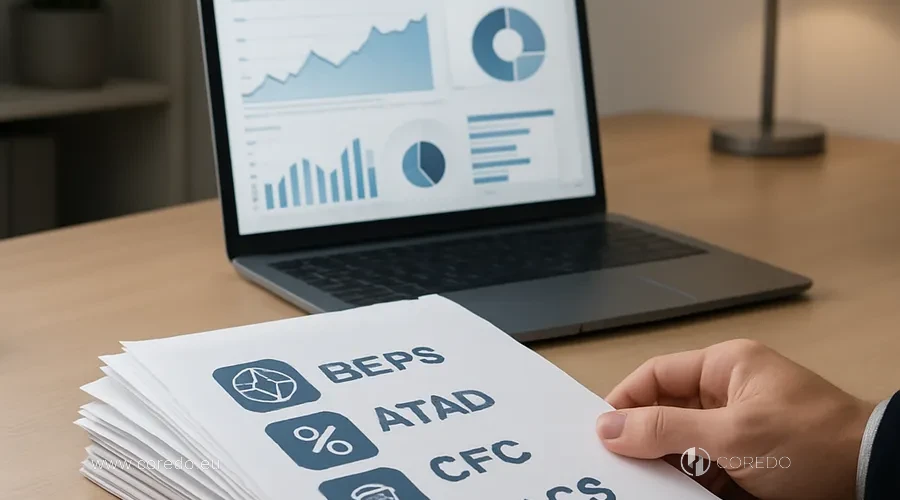
BEPS and the implications for multi‑level structures manifest through ATAD and the EU anti‑avoidance rules, controlled foreign company (CFC) rules and the impact on residents of different countries. Applying CFC rules to multi‑level structures requires justification of the allocation of functions, risks and assets; I record this in intercompany agreements and transfer pricing documentation. I eliminate hybrid mismatch rules and tax traps at the design stage to avoid double non‑taxation or double taxation.
Double tax treaties and anti‑abuse provisions provide legal opportunities to optimise dividend withholding tax and payment planning, but create treaty shopping risks in multi‑level ownership. I do not permit schemes that look like treaty shopping and prefer transparent economics in agreements. The impact of DAC6 on multi‑level structures and mandatory disclosure rules and reporting means that the adviser must pre‑qualify "hallmarks" and ensure legal certainty. The solution developed at COREDO includes preliminary memoranda and pre‑transaction legal opinions to reduce the likelihood of disputes and provide legal certainty.
AML framework: 5AMLD/6AMLD, KYC/CDD/EDD and sanctions
anti‑money laundering and multi‑level schemes in the EU have moved to a risk‑oriented supervisory approach. KYC and CDD requirements for subsidiaries deepen with each level of ownership, and enhanced due diligence (EDD) for complex chains is the standard when there are non‑resident links. At the same time banks and providers apply PEP screening for politically exposed persons, sanctions screening and automation of controls, as well as transaction monitoring in multi‑level chains.
The group framework is particularly important: group‑wide AML policy and standards, compliance control through the group's internal policies and internal audit provide a predictable compliance profile. AML supervisory authorities and national practices differ somewhat, but COREDO's practice confirms: a unified governance framework reduces the risk of de‑risking banking relationships and increases access to financial services. Sanctions compliance and the response of the corporate network have already become a regular task, and I build contingency procedures at the holding level so as not to halt business processes in the event of external restrictions.
Directors, nominee services and liability

Nominee directors and nominee shareholders are permissible in Europe within narrow limits, but nominee arrangements: the legal and risk aspects require caution. Fit and proper tests for directors and nominees in regulated segments (payment services, forex, crypto, investment firms) are becoming ever stricter. I rely on fiduciary duties and directors' liability and do not use nominee solutions as a disguise for control, as this leads to piercing the corporate veil and precedents confirm the risks.
corporate governance in multi‑level groups: it is not an org chart, but a practice. I build a governance framework for multi‑level groups with regular meetings, a matrix of authorities, related‑party policies and treasury management. Regulatory enforcement: fines and enforcement measures in the EU and the United Kingdom have increased, so the reputational profile is more important than any short‑term savings; reputational risk assessment for complex schemes has become a mandatory stage of COREDO projects.
Structure tools: SPV, trusts, foundations and escrow
The use of SPVs and special purpose entities in structures is appropriate for basic risk isolation: an M&A deal, bond issuance, project financing. A combination of trusts and companies in multi‑level schemes is also possible, but I carefully compare trust vs foundation: the choice for asset protection has tax and regulatory consequences. Foundations in civil law jurisdictions play a different role from trusts; sometimes a foundation in Liechtenstein or the Netherlands provides predictable succession and independent management.
A trust protector and trust governance add a level of control but require a high‑quality legal infrastructure and UBO transparency for banks. In transactions I use escrow and protective mechanisms to minimise settlement risks and ensure the transfer of assets on the agreed terms. In some countries there is ring‑fencing and national restrictions on holdings, so I take local firewall rules for regulated assets into account in advance.
Design and registration: steps, jurisdictions, restructurings

company registration in the EU through a holding provides advantages in managing dividends and capital if the economic substance confirms the reality of the group. In Estonia we often use e‑Residency and EU business registration, combining it with an operational team in the Czech Republic or Slovakia and a holding in Cyprus with sufficient substance. In the United Kingdom and Singapore I consider the place of effective management when running the group so as not to create competing residency, and in Dubai I structure SPVs and regulated links with regard to local substance.
Cross‑border restructuring: legal steps include redomiciliation, cross‑border merger, migration of legal entities within the EU and restructuring of debts and equity. Before M&A the COREDO team conducts M&A Due Diligence for multi‑level purposes, prepares pre‑transaction legal opinions and checks obligations
Matters relating to DAC6 and ATAD. In international disputes I rely on forensic accounting and asset tracing in international disputes and on mechanisms of mutual legal assistance and cross-border investigation.
Financial model: liquidity, dividends, exit and repatriation
Liquidity and the distribution of dividends in a holding require not only tax planning but also operational treasury. I model dividend flows, interest and royalties in advance, taking into account the dividend regime, WHT and substance requirements. Exit strategies and profit repatriation depend on double tax treaties, anti‑abuse provisions and country‑by‑country reporting, as well as on how service agreements and transfer pricing are structured.
Compliance costs vs economic benefit: my ongoing benchmark. The holding's operating expenses and scalability metrics should decrease relatively as the business grows; if this does not happen, the structure is obsolete. The COREDO team regularly reviews the cost‑benefit and proposes cross‑border restructuring or simplification of ownership levels to maintain efficiency.
Technologies and compliance control
KYC digital identification and e‑KYC reduce frictions in onboarding if a correct set of UBO and source of funds evidence is established. Beneficial ownership verification services, sanctions screening and control automation, as well as transaction monitoring in multi‑level chains increase compliance throughput. I implement compliance control through group internal policies, internal audit and independent oversight of the structure, as well as a digital audit trail for decision transparency.
Mutual recognition and regulator cooperation simplify Licensing when the group complies with unified reporting and AML standards. The COREDO team implemented a centralized repository for transfer pricing documentation, intercompany agreements and corporate protocols; this speeds up responses to requests from banks and regulators. This approach reduces the risk of blocks and simplifies access to payment providers, EMIs and banks in the EU, the UK, Singapore and Dubai.
COREDO cases: how it works in practice
For a payments group seeking an EMI license in the EU we designed a two‑tier holding with an operating company in Lithuania and a sub‑service‑centre in the Czech Republic. The solution developed at COREDO ensured economic substance requirements in European jurisdictions, evidenced by staff, offices and independent directors. We conducted a fit and proper check, built a group‑wide AML policy, carried out a DAC6 assessment and eliminated treaty shopping, and the bank approved onboarding without additional conditions.
For a crypto broker applying for a VASP license we built a structure with an SPV in Dubai and an operation in Estonia, where e‑Residency sped up the registration stage. I took into account the management and control test and place of effective management to avoid creating residency conflicts, and ensured EDD on beneficiaries and sources of funds. Sanctions and PEP screening we covered with an automated framework, and transaction monitoring was tuned to the jurisdictions' risk profile.
For an investment group with assets in multiple EU countries and the UK, we carried out a cross‑border restructuring, replacing the outdated, overloaded nominee arrangements setup with a managed holding with a transparent UBO. Legal support for the holding networks included updating RBO, CbCR, transfer pricing, as well as preparation for possible asset tracing and mutual legal assistance in case of dispute. As a result, compliance costs decreased, dividend distribution accelerated and access to banking services improved after a period of de‑risking.
Role of providers and the team
The roles of corporate service providers when creating layers are critical: registration, company secretary services, licensing, audit and taxes must work in synchrony. At COREDO I bring together lawyers, tax advisers, AML officers and project managers into a single team so the client receives a holistic solution. We maintain compliance control, train directors on their fiduciary duties and build processes that withstand regulatory enforcement and legal scrutiny.
Limitations on the level of company ownership in the EU are shaped not by formal limits but by the risk profile: the more layers, the higher the likelihood of document errors, payment delays and questions from banks. I set the minimally sufficient number of levels and fix it in the governance documents so the structure remains manageable. This approach increases business continuity and risk management in the holding, as well as improves legal certainty.
Practical checklist: how to go through the process without mistakes
-
Goals and ROI
- Formulate the economic goals and metrics: estimated ROI metrics for the ownership structure, scalability metrics, maintenance costs and the expected effect.
- Conduct a cost‑benefit analysis of creating an additional level and a stress test for the risk of loss of control.
-
Tax architecture
- Check BEPS/ATAD risk factors, apply CFC and hybrid mismatch rules, eliminate treaty shopping risks.
- Prepare transfer pricing documentation, intercompany agreements and service agreements for real substance.
-
Residence and substance
- Document the place of effective management, the management and control test, economic nexus and desk presence requirements.
- Confirm economic substance requirements: office, staff, independent directors, local contracts and payments.
-
UBO and transparency
- Set up chain of ownership mapping, RBO updates, beneficial ownership verification services.
- Ensure CRS/FATCA compliance, CbCR (if applicable) and data protection.
-
AML and sanctions
- Implement a group‑wide AML policy, KYC/CDD/EDD, PEP and sanctions screening, transaction monitoring.
- Take into account national AML supervisory authorities and practices, set up internal audit.
-
Licensing and personnel
- Check fit and proper for directors, avoid controversial nominee arrangements, and train on fiduciary duties.
- Prepare pre‑transaction legal opinions and a DAC6 assessment.
-
Operations and banks
- Test payment scenarios, liquidity, dividend withholding tax and double tax treaties.
- Reduce the risk of de‑risking through transparent documentation and a single repository.
-
Restructuring and exit
- Prepare a plan for cross‑border restructuring, M&A due diligence, escrow mechanics.
- Formulate exit strategies and profit repatriation taking into account anti‑abuse provisions.
What complicates life and how I handle it
Cross-border holdings and tax consequences always carry uncertainty if the structure "lives" on paper. I avoid letterbox company by signs of sham and create a real footprint of activity in key points: contracts, risks, personnel, reports. impact of sanctions and freezes on multi-level networks I mitigate through alternative banks, providers and geographic diversification, as well as through sanctions procedures at the group level.
Nominee directors и номинальные акционеры иногда кажутся быстрым решением, но юридические и репутационные риски перевешивают выгоду. Вместо этого я формирую совет с квалифицированными резидентными директорами, прохожу fit and proper тесты и закрепляю ответственность через внутренние политики. В спорных кейсах я готовлю доказательственную базу на случай piercing the corporate veil и судебных разбирательств: протоколы, делегирование полномочий, казначейские политики.
Where this is especially important: licensing and international hubs
For licenses (crypto, banking, forex, payment services) regulators emphasize substance, risk management and UBO transparency. In the EU and the UK attention goes to AML, governance and capital adequacy, while in Singapore and Dubai - to risk management and technological control. The COREDO team supports licensing, sets up mandatory disclosure, prepares responses to inquiries and builds communication with regulators to accelerate mutual recognition and simplify onboarding.
In projects with the Czech Republic, Slovakia, Cyprus and Estonia I combine tax and regulatory advantages with real substance. For groups with international exposure I use separate SPV by lines, take into account ring‑fencing and national restrictions on holdings, and also arrange centralized internal audit. This approach ensures predictable taxation, access to accounts and readiness for inspections.
Conclusion: an architecture of trust and growth
Multi-layered ownership structures are a tool, not an end. When I design a holding, I build an architecture of trust: transparent UBO, sufficient substance, predictable taxes, a manageable AML framework and clear corporate governance. COREDO's practice confirms: such a structure gives the business scalability, reduces the cost of capital and opens doors to licenses and banks.
If you plan to register companies in the EU through a holding, aim for licensing or are preparing M&A, lay the foundation from the start: substance over form, a clear ownership chain and risk control. The COREDO team has implemented dozens of projects in the EU, the UK, Singapore and Dubai, and I continue to develop an approach in which legal certainty, economic efficiency and compliance go together. This is the reliable path to sustainable international growth.