
COREDO – EU Legal & Compliance Services Expert legal consulting, financial licensing (EMI, PSP, CASP under MiCA), and AML/CFT compliance across the European Union. Headquartered in Prague, we provide seamless regulatory solutions in Germany, Poland, Lithuania, and all 27 EU member states.

Gregory Lutsenko
11.01.2026 | 6 min read
Updated: 11.01.2026
As CEO and founder of COREDO, I see every day how entrepreneurs from Europe, Asia and the CIS face the challenges of international business. Company redomiciliation: it is a strategic tool that allows transferring registration to a new jurisdiction while preserving the structure, minimizing risks and opening access to markets. In this article I will share a practical guide based on the experience of the COREDO team since 2016: from assessing the need to change jurisdiction to full support.
Important to understand: redomiciliation is not an emergency "rescue" measure, but a managed strategic step. In 2023-2025 we observe a steady trend: companies change jurisdiction not because of a crisis, but for scaling, preparing for investment or entering new markets.
According to European corporate registers, more than 18% of companies that underwent redomiciliation in the EU over the past 2 years did so before regulatory or sanctions problems arose. This indicates a change in mindset: business no longer waits for blockages, but builds a resilient architecture in advance.
In COREDO practice redomiciliation is increasingly used as part of M&A preparation, pre-IPO structures or restarting bank onboarding after refusals.
When a business needs redomiciliation

The decision to relocate a company does not happen by chance. Our experience at COREDO shows: entrepreneurs choose redomiciliation when the old jurisdiction limits growth.
In practice we identify several categories of business for which redomiciliation is not just advisable, but critically necessary:
- Financial and fintech companies that require Licensing (EMI, SPI, crypto, forex). Without a "white" jurisdiction the license is either impossible or economically impractical.
- Holdings with international flows facing bank refusals due to the origin of the old jurisdiction.
- IT and SaaS businesses preparing for venture financing — investors almost always require an EU/UK/Singapore structure.
- Companies from offshore or grey-list countries for which continued operation becomes toxic from the point of view of AML and sanctions.
- Export-oriented businesses that need the customs, tax and regulatory advantages of the EU.
For each of these categories redomiciliation solves different tasks, but always — by increasing trust in the legal shell of the business.
Imagine a fintech startup from the CIS aiming for the EU. Customs barriers and compliance restrictions slow down exports, and the tax burden eats into ROI. The COREDO team recently performed a redomiciliation from an offshore for a client in the crypto sphere: the move to Estonia provided good standing status, eliminated debt to the budget and opened doors to European banks.
Key signals for action:
- Sanctions risks block partnerships.
- Lack of economic presence in target markets reduces investment attractiveness.
- The political stability of the new jurisdiction promises corporate secrecy and protection of property rights.
- The need for AML compliance for financial licenses.
COREDO's practice confirms: timely redomiciliation increases ROI by 20–30% due to tax benefits and scaling.
The financial effect of redomiciliation is rarely limited to taxes alone. In COREDO's real cases the main increase in ROI is driven by:
- re-establishing banking services and reducing transaction costs;
- access to European and Asian payment systems;
- lower compliance costs thanks to a clear regulatory environment;
- increase in business valuation during investments (multiples in the EU are on average higher by 15–40%).
In one case redomiciling an IT company from an offshore to Estonia allowed not only to reduce the tax burden, but also to obtain a bank account in 12 business days — after 8 months of refusals in the old structure.
Choosing a jurisdiction: EU, Asia or new ones
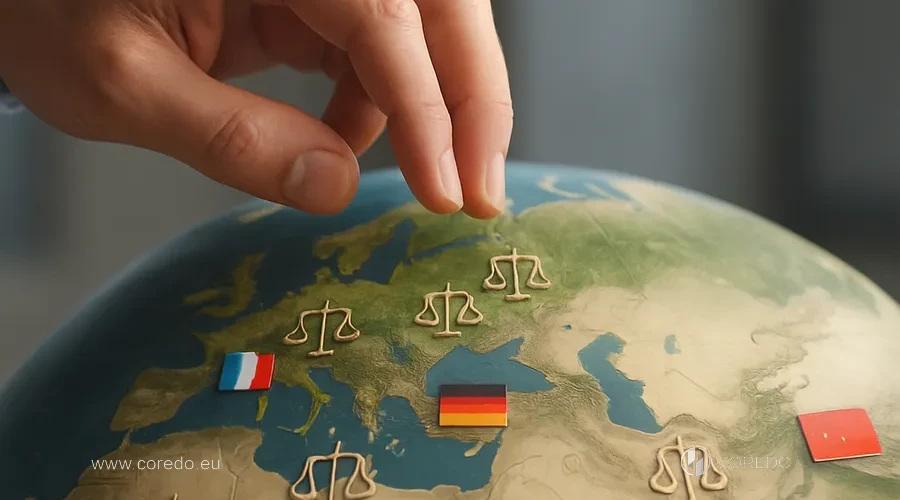
choosing a jurisdiction for relocation is a balance between the business environment, regulatory requirements and business objectives.
The most common mistake is to view redomiciliation as a "technical transfer", without changing the management and compliance logic. In such cases the company formally changes jurisdiction but retains the old risks.
Typical mistakes we encounter:
- transfer to the EU without readiness to disclose beneficial owners;
- lack of real substance when declaring activities;
- ignoring AML requirements at the preparation stage;
- choosing a jurisdiction based on taxes rather than on banking compatibility.
In COREDO's practice about 30% of clients come after an unsuccessful redomiciliation, which has to be essentially redone.
In the EU, for example, the Czech Republic, Slovakia, Cyprus and Estonia lead in simplified procedures for registering legal entities. Redomiciliation in the EU is ideal for business in Europe: beneficiary and director registers are harmonized here, and a white jurisdiction ensures compliance. A solution developed by COREDO helped a manufacturing company from Asia move to the Czech Republic: the client preserved the share capital structure, adapted option programs and gained access to EU markets without double registration.
Asia attracts relocations to Singapore or Dubai: free zones offer zero repatriation taxes, corporate secrecy and asset protection. For businesses in Asia this opens export to ASEAN. At COREDO we accompanied a redomiciliation to Asia for a logistics firm from the CIS: integrating AML services minimized risks, and the new structure raised investment attractiveness.
Don't forget Africa: redomiciliation to Africa is gaining momentum for commodity companies. Political stability in key hubs combines with benefits, but requires analysis of economic presence. The COREDO team assesses ROI: for a client from Europe the transfer provi
chil scaling the business with expansion into African markets.
Compare the options in the table for clarity:
| Jurisdiction | Advantages | Risks | Ideal for |
|---|---|---|---|
| EU (Estonia, Cyprus) | Access to markets, AML standards, beneficial owners register | Strict compliance | Fintech, export |
| Asia (Singapore) | tax incentives, free zones | Economic presence | Trading, logistics |
| Dubai | Asset protection, corporate governance | Cultural adaptation | Holdings |
| Africa (hubs) | ROI from resources, stability | Regulatory barriers | Commodities, scaling |
Redomiciliation steps: from preparation to launch
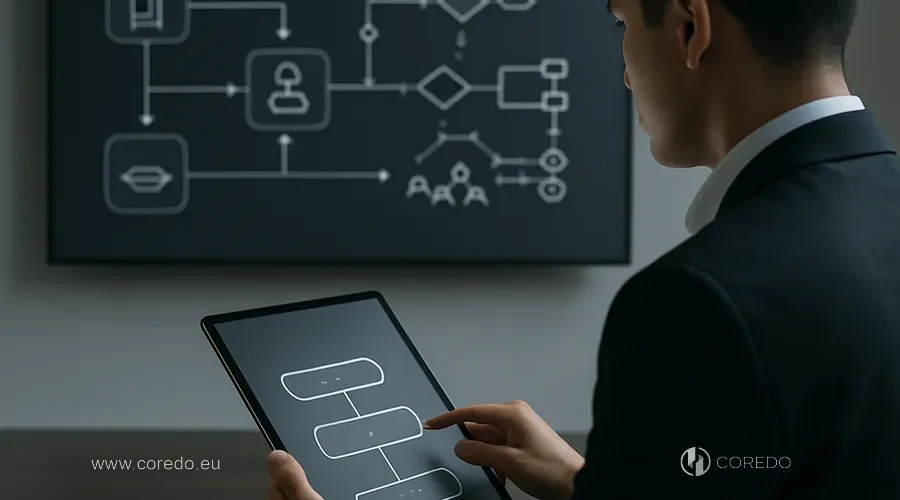
The redomiciliation procedure for a business requires precision. Start with an audit: check good standing, the absence of litigation, bankruptcy or debts. Notify creditors; publication is mandatory in most jurisdictions. COREDO's practice emphasizes: 80% of refusals are due to weak Due Diligence.
- risk analysis: We assess sanctions risks, compliance and the impact on partners. We model scenarios showing how redomiciliation and compliance strengthen reputation.
- Document preparation: We adapt the share capital structure, registers. For redomiciliation from an offshore jurisdiction to the EU we integrate AML compliance according to FATF standards.
- Filing and approval: In the EU - through national authorities or EUIPO. In Asia, free zones speed up the process. The COREDO team handles legal support, including legal opinion.
- Post-redomiciliation: Tax optimization, account openings, licenses. We ensure economic presence through local offices.
A key stage after redomiciliation is bank and regulatory onboarding. This is where the real quality of preparation becomes apparent.
Banks and regulators assess:
- continuity of the legal history;
- absence of a «break» in the ownership structure;
- alignment of the new jurisdiction with actual activities;
- quality of AML documentation and risk assessment.
COREDO supports this stage comprehensively: from preparing a Legal Opinion to participating in dialogue with banks and regulators. This helps avoid repeated refusals and speeds up the start of operations by 2–3 times.
Practical example: a client with a forex platform carried out redomiciliation to Lithuania. They obtained a payment license (SPI), overcame barriers to export. The ROI of the redomiciliation paid off in 9 months thanks to access to EU banks.
Licenses and AML when relocating
financial licenses: banking, crypto, forex, payments: open global opportunities. In Poland (NPI/SPI), Estonia or Singapore COREDO accompanies from application to compliance. Our experience has shown: a cryptocurrency license in the EU requires strict AML consulting, including KYC and monitoring.
For company relocation we integrate AML services: policy, training, audit. A client from Asia obtained a license in Cyprus after our redomiciliation, anti-money laundering protection ensured partnerships with EU bankers.
Comprehensive support at all stages

COREDO offers company registration in the EU, outsourcing, trademark protection under the Madrid Protocol. We register in the Czech Republic, the United Kingdom, Greece, Switzerland - the full range. Legal support saves time: from trademark registration to dispute resolution.
Long-term consequences? Redomiciliation strengthens corporate governance, adapts option programs and increases investment attractiveness. For businesses from the CIS, relocation to the EU addresses compliance pain points, enabling scaling.
If you are considering changing jurisdiction, contact us. In modern international business, jurisdiction is not just a place of registration, but part of a strategy. Redomiciliation allows you to restart relationships with banks, regulators and investors without losing operational business.
Companies that approach this process systematically gain not only tax benefits but also long-term resilience. Those who postpone the decision are often forced to act in crisis mode.
The COREDO team will provide transparent processes, time savings and reliable results. Your success: our mission since 2016.