
COREDO – EU Legal & Compliance Services Expert legal consulting, financial licensing (EMI, PSP, CASP under MiCA), and AML/CFT compliance across the European Union. Headquartered in Prague, we provide seamless regulatory solutions in Germany, Poland, Lithuania, and all 27 EU member states.

Gregory Lutsenko
11.12.2025 | 6 min read
Updated: 11.12.2025
Over recent years EU regulators have called the real estate sector one of the key channels for money laundering: according to the European Commission's estimates, up to a quarter of major AML cases are linked to property purchases through convoluted structures and nominee beneficiaries. In several European jurisdictions the share of suspicious real estate transactions, according to national FIUs, has grown many times after mandatory reporting for real estate agents was introduced.
If you run a real estate agency or a development group, you have effectively become a "quasi‑financial institution" with the same AML obligations as banks. A mistake in KYC or ignoring Europe's new AML requirements turns from a technical glitch into a risk of fines up to €1 million or 10% of annual turnover, and sometimes into disqualification of management.
Are your processes, IT system and team ready for AML in the EU 2025, for the launch of the AMLA and the direct application of the AML Regulation (AMLR)? Or is realtor AML compliance in your company still reduced to a passport copy and the manager's "common sense"?
I am convinced: 2025 will be the moment when the European real estate market splits into those who have embedded AML into their business model and calmly scale operations, and those who will be firefighting inspections, blocked transactions and unhelpful refusals from banks and partners.
In this article I, as the founder of COREDO, will break down how a realtor in Europe can comply with the new AML requirements of 2025 without paralyzing the business: from the regulatory framework (6AMLD, AMLR, AMLA) to implementing eKYC, digital onboarding, AI monitoring and CRM integration. If AML in real estate for you is not about "box‑ticking" but about a protected and scalable business, I recommend reading to the end.
AML for real estate agents in Europe in 2025

AML for real estate agents in Europe – the main requirements of 2025 are no longer limited to formal client checks: unified pan-European rules, new fines and enhanced supervision of real estate transactions come into play. To operate confidently in the market, it is important to understand how exactly 6AMLD, AMLR and the new agency AMLA shape the regulatory framework and what obligations they add for real estate agents as of 2025.
Regulatory framework: 6AMLD, AMLR and AMLA
Сейчас AML for business in Europe relies primarily on the Sixth Anti-Money Laundering Directive, 6AMLD (Sixth Anti-Money Laundering Directive). It:
- expanded the list of predicate offences (specified offences), including tax offences, cybercrimes and corruption;
- strengthened personal liability of managers, up to criminal liability;
- clarified reporting obligations for suspicious transactions.
With the launch of the AML Regulation (AMLR), AML rules become directly applicable in all EU member states without "dilution" during transposition. For real estate agents this means:
- unified AML standards for real estate agencies on KYC, monitoring and reporting;
- mandatory compliance with the cash payment limit (ban on cash transactions over €10,000);
- machine-readable AML reporting and an emphasis on automated transaction monitoring.
A separate storyline is the creation of AMLA (European Anti-Money Laundering Authority), a new supranational regulator. AMLA will:
- develop common guidelines and risk assessment templates for real estate agents;
- coordinate supervision, including targeted inspections of high-risk entities;
- harmonize the application of AML sanctions and fines in the EU in 2025.
COREDO's practice already shows: large agencies and developers in the EU are beginning to build internal policies that take into account not only national law but also drafts of AMLA's technical standards.
Expansion of covered entities: real estate as high risk
6AMLD and AMLR have finally established real estate agencies and rental intermediaries as obliged entities under AML controls. This affects:
- brokers and agencies working with sale transactions and long-term rentals;
- developer structures selling properties directly to investors;
- consulting companies supporting real estate investment deals and investment migration.
Our experience at COREDO has shown that many international groups still do not realise that their SPV companies, created "for the asset" in the EU, also fall under AML and require formalised procedures, especially when attracting foreign capital.
New standards for KYC, eKYC and digital onboarding
From 2025 the focus shifts from minimalist KYC to risk-based and digital KYC/eKYC:
- identity verification through reliable electronic identification schemes (eIDAS), national eID, video identification;
- digital onboarding, a fully digital onboarding process in which data collection, document verification, sanctions and PEP screening are carried out online;
- enhanced procedures for high-risk clients: politically exposed persons, investment migration, complex offshore and trust structures.
The COREDO team implemented the transition to eKYC for a European real estate agency using national identification schemes and integrating with external sanctions and PEP databases. This reduced average onboarding time from several days to 30–40 minutes without losing the depth of screening.
AML and registration of legal entities in the EU for real estate agents
AML requirements directly affect the registration of legal entities in the EU for real estate:
- registrars and banks require a transparent ownership structure and proof of beneficial owners;
- open registers of beneficial owners (and their updated, partially restricted versions) are used for AML and KYC checks;
- schemes with nominee owners or opaque funds trigger additional Due Diligence and often — refusal.
Solutions developed by COREDO enable structuring ownership of assets and SPVs in a way that simultaneously takes into account tax efficiency and AML requirements for checking beneficial owners in the EU, including for investment migration projects.
Practical AML rules for realtors in Europe

Practical AML rules for realtors in Europe: these are not abstract standards but concrete steps that need to be implemented in the agency's day-to-day work. To comply with these rules, realtors must establish a clear internal control system: approve regulations, build a risk model, and document standard procedures for working with clients and transactions.
Internal AML control: regulations and procedures
AML compliance in real estate begins with an AML internal control system. In practice this is not a "thick policy to tick a box", but a set of living documents:
- policy for assessing AML risks and their management (risk-based approach);
- detailed KYC procedures and beneficiary checks;
- AML rules for monitoring real estate transactions, including escalation triggers;
- regulations on reporting obligations to the FIU and regulators.
At COREDO we usually start a project by mapping the agency's business processes: from client acquisition to post-deal support. This allows building AML rules for realtors in Europe so that they fit into operational reality rather than breaking the sales funnel.
Realtors' responsibilities: KYC and beneficiary monitoring
By 2025 the basic set of duties for a realtor in the EU includes:
- client identification (KYC): collection and verification of documents, determination of PEP status, assessment of purpose and source of funds;
- beneficiary checks: identification of ultimate owners, analysis of ownership structure, working with trusts and funds;
- ongoing monitoring: monitoring transactions and client behavior, review of KYC when risk changes;
- recording and storage of data: audit logs, screening results, client and transaction dossiers.
AML requirements for client checks in the EU are tightening: regulators expect agencies to be able to justify why a particular client was assigned a certain risk level and what measures were taken.
Liability and fines for ignoring AML
AML sanctions and fines for realtors in the EU are becoming proportionate to the banking sector. In accordance with 6AMLD and AMLR:
- fines can reach at least €1 million or up to 10% of the company's annual turnover;
- for individuals (directors, compliance officers) criminal liability is provided, up to imprisonment;
- professional activity bans, license revocations, and inclusion in registers of dishonest entities are possible.
Fines for AML violations in the EU in 2025: these are not only formal amounts. They affect access to banking services, relationships with international partners and, essentially, the value of the business upon sale. COREDO's practice confirms: investors' due diligence in European real estate increasingly starts with an assessment of AML compliance history.
Real estate transactions and investor migration
Regulators pay special attention to AML in investment migration and the sale of «golden visas» through real estate. For such transactions:
- heightened requirements for the source of funds and documentary evidence;
- enhanced monitoring of transactions and beneficiary structure;
- mandatory escalation of suspicious operations and suspension of the transaction until clarified.
AML and combatting money laundering in real estate in this area are often associated with international checks and interaction between different regulators. The COREDO team has supported several investment real estate projects in the EU where properly structured AML compliance helped avoid transaction blocks by correspondent banks.
Table of key AML compliance areas for realtors
| AML compliance area | Main requirements | Recommendations for realtors |
|---|---|---|
| Client identification (KYC) | Identity checks, PEP status, beneficiaries | Implementation of eKYC and digital onboarding |
| Transaction monitoring | Automated monitoring of suspicious operations | Integration of AML systems with CRM and a KYT engine |
| Liability and fines | Fines up to €1 million or 10% of turnover, personal liability | Regular training, internal audit, role of a compliance officer |
| Reporting and control | Machine-readable AML reporting, compliance with 6AMLD and AMLR | Use of explainable AI and graph-based risk models |
AML Automation in Real Estate

Technologies and AML automation in real estate are becoming a key tool for transaction control and for reducing money laundering risks in complex chains of property transactions. They bring automated transaction monitoring and solutions based on *explainable AI* to the fore, which allow not only detecting suspicious operations but also transparently explaining the logic of each flag to compliance teams and regulators.
Automated transaction monitoring with explainable AI
AML in the EU in 2025 is objectively impossible to handle "manually". The solution: AML automation in real estate through:
- automated transaction monitoring using rules and behavioral models;
- explainable AI (interpretable artificial intelligence), which allows seeing the logic behind alerts and explaining it to the regulator;
- KYT (Know Your Transaction) scenarios that analyze payment structures, jurisdictions, and counterparty types.
The solution developed by COREDO for a group of agencies in Central Europe combined transactional data, the client profile and property characteristics into a single risk model, which reduced "false positives" by 40% and sped up alert review.
Integration of AML with CRM: efficiency and savings
Integrating AML processes with CRM systems is one of the key drivers of AML automation and cost reduction:
- client and transaction data are entered once and used simultaneously for sales, KYC and reporting;
- AML alerts appear directly on the client's record in the CRM;
- the compliance officer sees the full history of interactions, documents, and transactions.
The integration of AML systems with CRM for agencies, implemented by the COREDO team in several EU jurisdictions, increased the ROI from AML system deployment by saving employee time and reducing manual data entry.
Graph neural networks for complex schemes
Money laundering schemes through real estate often use "network" structures: chains of SPVs, trusts, transit payments. Standard rules are blind to these. Therefore we increasingly apply:
- graph neural networks for AML that analyze connections between companies, beneficiaries and transactions;
- models combining transactional, behavioral and geographic features;
- a hybrid approach: AI to detect patterns, human for final qualification.
The use of AI for AML monitoring in real estate, provided explainable AI and a documented process, is well received by regulators, especially when it comes to large multi-jurisdictional groups.
eKYC and digital onboarding for sales growth
Implementing eKYC and digital onboarding in real estate not only improves the quality of client verification but also:
- shortens the deal cycle, especially in international transactions;
- reduces customer drop-off due to "paper bureaucracy";
- increases conversion of online leads.
COREDO's practice confirms: after implementing digital client identification for AML compliance, one of the agencies in the EU increased the share of foreign investors completing full KYC by more than 20% — simply because it became convenient for them to undergo verification remotely.
AML compliance in crypto transactions and international operations

The specifics of AML compliance in cryptocurrency transactions and international operations become critical as digital assets are increasingly used in cross-border payments and complex corporate structures. In such conditions, regulators tighten requirements for verifying the origin of funds, which is especially noticeable in niche cases: from real estate transactions paid with cryptocurrency to multi-level international schemes.
Cryptocurrency and real estate: risks and requirements
AML and cryptocurrencies in real estate transactions, a topic that no longer seems exotic. EU regulators expect:
- the application of the same AML requirements to real estate transactions paid with cryptocurrency as to those paid with fiat;
- the use of licensed virtual asset service providers (VASP) complying with AMLD and the Travel Rule;
- increased attention to the source of crypto funds and links to sanctioned jurisdictions.
COREDO has supported transactions where part of the property's price was paid in cryptocurrency via a regulated platform. The key to a secure structure: a clear division of responsibilities: the VASP covers AML for crypto transactions, the agency: AML in real estate and client verification.
Travel Rule and KYT in real estate
The Travel Rule requires transmitting key payer and payee data for cross-border transfers, including crypto operations. For a realtor this means:
- the need to take into account data received from banks and VASPs in their AML picture;
- the use of KYT tools to analyze the route of funds and detect anomalies;
- documenting decisions to accept/reject suspicious transactions.
FATF, CFT and multi-jurisdictional standards
The FATF international standards on AML and combating the financing of terrorism (CFT) directly affect AML under international regulation:
- FATF recommendations on real estate and investment migration set the «bar» for the EU;
- countries not in the EU but oriented toward the European market (for example, jurisdictions where clients register holding companies) are raising AML rules to the European level;
- multi-jurisdictional standards require a unified risk framework for groups operating in multiple European countries and beyond.
The COREDO team often builds a single AML framework for such groups, where European requirements serve as the «upper bound», and local rules are adapted as special cases.
Foreign investors and capital migration
AML specifics for investment migration and international real estate transactions include:
- enhanced due diligence on the source of wealth;
- checks across multiple jurisdictions, including country of citizenship and tax residence;
- coordination with banks, migration consultants and legal advisers.
AML and money laundering risks through investment migration are becoming the focus of close attention from the AMLA and national regulators. Our experience shows: having transparent AML procedures increases regulators' trust in investment residence projects and reduces the number of additional inquiries.
Preparing a Real Estate Agency for an AML Audit and Staff Training
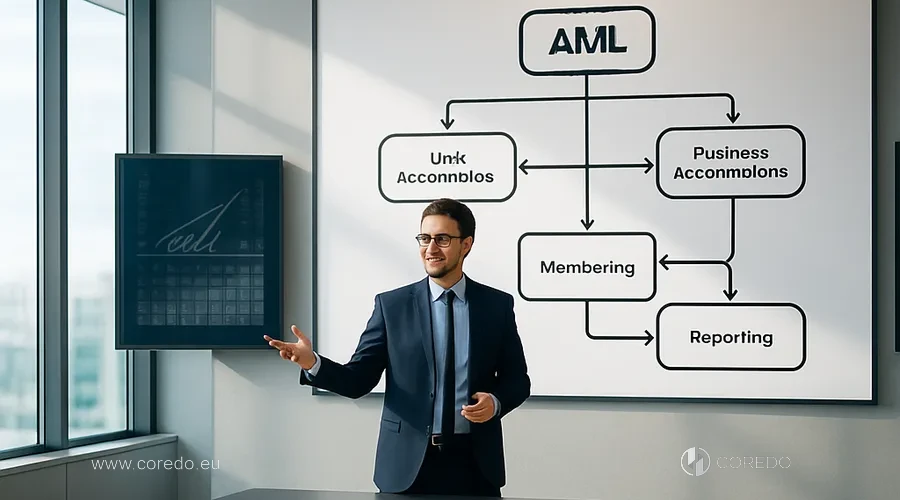
Preparing a real estate agency for an AML audit and staff training begins with building transparent processes that are clear not only to regulators but to every employee. To confidently pass inspections and reduce risks, it is important to establish internal control, regulations, and a system of regular AML audits in advance, which then underpin all staff training.
Internal control and audits
Effective AML internal control includes:
- an annual independent review of AML procedures (internal or external audit);
- regular review of the risk model in light of new threats and AMLA guidance;
- testing of random transactions for completeness of KYC and correctness of decisions.
At COREDO we often begin cooperation with a "diagnostic" AML audit: based on its results a roadmap to compliance with AML standards for real estate agencies is formed.
Staff training and compliance culture
How to prepare for an AML audit and staff training in real estate:
- conduct regular training for the front office, middle office, and management;
- use case studies based on real predicate offences in real estate;
- record staff participation and test results.
AML compliance in real estate works only when managers understand, why they need these procedures, and not just "sign the form".
Role of the compliance officer
The role of the compliance officer in AML for realtors is being strengthened by 2025:
- responsibility for developing and updating AML policies;
- oversight of AML reporting and interaction with regulators;
- coordination of training and internal investigations.
In COREDO projects we often help clients build a turnkey compliance officer function: from describing the role and KPIs to implementing monitoring tools.
Metrics and KPIs for assessing AML
So that the 2025 AML requirements do not turn into a "black box", it is important to measure effectiveness:
- share of clients who have completed full KYC/eKYC;
- the number and quality of submitted suspicious activity reports;
- average onboarding time and alert handling;
- the number of violations identified in internal audits and their trend.
AML and the ROI from implementing AML systems are directly related: the better processes and technologies are configured, the less manual work, errors, and regulatory risk.
Key findings and recommendations for real estate agents
This section contains key findings and practical recommendations for real estate agents to help them smoothly adapt to the new AML requirements. Below you will find which main changes to AML requirements by 2025 will affect your daily work and what steps you should plan now.
Key changes to AML requirements by 2025
A brief overview of what is changing for AML affecting real estate agents in Europe:
- direct effect of the AMLR and the launch of AMLA with unified AML compliance standards for real estate agents;
- strengthening of KYC, requirements for eKYC and digital onboarding, emphasis on a risk-based approach;
- increase in fines and personal liability;
- heightened scrutiny of investment migration and cryptocurrency transactions.
AML compliance checklist for a real estate agency
A practical checklist that the COREDO team often uses as a project baseline:
- Conduct a comprehensive AML diagnostic and risk assessment.
- Update policies and procedures in line with 6AMLD and AMLR.
- Define and formalize the role of the compliance officer.
- Implement eKYC and digital onboarding for clients.
- Integrate AML processes with CRM and accounting systems.
- Launch automated transaction monitoring (including KYT).
- Organize regular staff training and internal audits.
Technology: selection and integration
When selecting technologies, COREDO recommends focusing on:
- availability of explainable AI and transparent scoring algorithms;
- ready-made connectors to CRM and external registers (sanctions, PEPs, beneficiaries);
- support for multi-jurisdictional profiles and varying risk levels;
- a quantifiable effect on ROI and business scaling considering compliance.
How to minimize risks and fines and grow
AML risks and their management in real estate are not about «slowing growth», but about a sustainable model:
- design processes so that it is easier for managers to comply with AML than to circumvent it;
- invest in digital technologies in real estate, eKYC, AI, integration with state registers and eIDAS;
- consider AML digital trust infrastructure as an asset that increases the value of your business to banks, investors, and regulators.
COREDO's experience in the EU, Asia and the CIS shows: real estate agencies that adopted AML as a strategic priority in a timely manner already feel more confident in negotiations with banks and investors and are more relaxed about AML in the EU 2025.