
COREDO – EU Legal & Compliance Services Expert legal consulting, financial licensing (EMI, PSP, CASP under MiCA), and AML/CFT compliance across the European Union. Headquartered in Prague, we provide seamless regulatory solutions in Germany, Poland, Lithuania, and all 27 EU member states.

Alena Sharykava
05.01.2026 | 6 min read
Updated: 05.01.2026
I welcome you as the CEO and founder of COREDO. Over nine years my team and I have helped hundreds of entrepreneurs from Europe, Asia and the CIS register companies in key jurisdictions, from the Czech Republic and Cyprus to Singapore and Dubai, and successfully complete bank onboarding. Today we’ll examine, why EU banks refuse even licensed companies, and share proven solutions so you save time and avoid account freezes.
It’s important to note right away: bank onboarding in the EU is not a technical procedure of opening an account, but a full assessment of the company’s business model. The bank actually conducts its own mini-due diligence, comparing the ownership structure, the economic logic of transactions, the tax profile and the AML framework.
This is why a license by itself does not guarantee account opening: for the bank it is only one element of the overall risk picture, not a free pass.
Reasons for rejection during bank onboarding

Imagine: you register a company in Estonia or the Czech Republic, obtain a license for payment services, but the bank blocks the account application. Our experience at COREDO shows that in 70–90% of cases the issue is the Legal Opinion, a legal opinion that analyzes corporate registers, tax liabilities, licensed activities and AML aspects. EU banks, following EBA guidelines 2024-2025, require a complete package: a flawless opinion with an apostille, confirmation of UBO and source of funds.
In practice the legal opinion for a bank is not a formal “from a lawyer” document, but a tool the bank’s compliance officer relies on when making a decision. If the opinion does not close at least one of the key blocks — ownership structure, applicable regulation, tax risks or AML exposure — the bank either escalates the application to EDD or refuses it without the possibility of remediation.
Typical problems of a weak Legal Opinion: lack of analysis of corporate registers, tax liabilities or applicable regulation. If the document does not cover key AML aspects (UBO, source of funds, cross-border risks), the bank treats this as non-compliance with requirements.
We regularly see legal opinions that describe the company abstractly, without tying it to specific operations and jurisdictions. For a bank this is a critical drawback: if the document does not explain why this particular company in this structure performs these specific payments, it is perceived as formal and useless.
The COREDO team recently assisted a client from Singapore with a Pte Ltd license. EU banks refused due to cross-border AML risks: the logic of cross-border payment flows from Asia. We conducted a forensic UBO analysis, checked against the ACRA registry and notarized the chain of ownership. Result: the account was opened in a Czech bank within 14 days, without EDD delays.
This case well illustrates the approach of EU banks: the problem was not the license itself or the jurisdiction, but the lack of a clear explanation for cross-border flows. Once the chain of ownership and the movement of funds became transparent and documented, the company’s risk profile dropped sharply.
Another trap: shelf companies or ready-made companies older than 5 years. COREDO’s practice confirms: 40% of AML onboarding failures are related to dormant status, where governance analysis reveals gaps in actual control. Regulators require an AML audit before onboarding, especially for high-risk profiles.
For banks, a high-risk profile is not an accusation but a signal for enhanced due diligence. Problems begin when a company is not ready for that level of transparency: no internal AML controls, monitoring procedures are not described, decision logs are missing. In such cases, refusal becomes the bank’s safest option.
UBO verification and source-of-funds checks to prevent account blocking

UBO (Ultimate Beneficial Owner), ultimate beneficiaries: this is the foundation of KYC Due Diligence. Non-compliance with public registers leads to onboarding refusals and EDD. At COREDO we always start with a full verification: declarations of control, a forensic audit of the chain, confirmation of source of funds through bank statements and contracts.
EU banks check UBO data not only against public registers but also against internal databases, the history of past onboardings and sanctions sources. Any discrepancy — even a formal one — automatically moves the application to EDD. Therefore a forensic approach to beneficiary verification today is a standard, not an “extra complication”.
One case: a company from Dubai with a forex license faced onboarding refusal in Slovakia. FATF risks from grey list jurisdictions triggered the block. The solution developed at COREDO: a strategic business plan with evidence of economic presence, integration of GDPR data protection and an AML audit. The account was activated, and foreign trade operations increased by 30% without fines.
The key success factor here was not “convincing” the bank, but demonstrating manageability of risks. The bank saw that the company understands its risk profile, controls sources of funds and can scale operations without breaching AML requirements.
Source of funds often becomes a trigger for account blocking. A common mistake by companies is limiting themselves to declarations of origin of funds. For banks this is not enough: a verifiable chain of documents is required, showing the link between business activity, contracts, receipts and the distribution of funds. The absence of even one link is interpreted as increased risk.Banks request evidence: not just declarations, but the full chain from supplies to payments. Under AMLA 2025, a deep audit is mandatory for PEP onboarding, we integrate it into onboarding, reducing risks by 80%.
EDD for shelf companies and 6AMLD
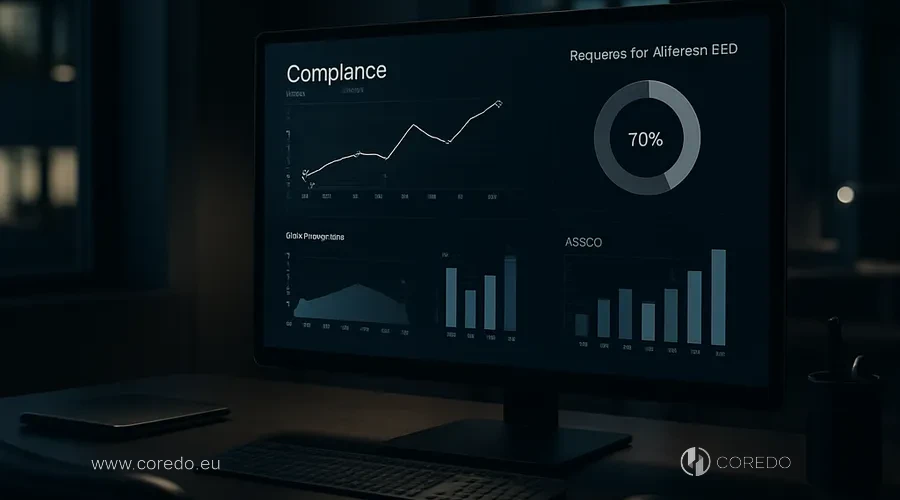
High-risk clients: PEPs, companies from Asia with AML non-compliances or ready-made companies: require EDD (Enhanced Due Diligence). The 6AMLD directive strengthens AML for payment providers and card issuance: banks block if there is no forensic analysis. Our approach at COREDO: we combine digital KYC 2025 with notarization, minimizing blocking metrics.
This hybrid approach is especially effective for shelf companies and cross-border structures: digital procedures speed up onboarding, and notarial confirmation reduces banks’ doubts about the authenticity of the data. This allows you to undergo EDD without delaying timelines.
Practical example: an Estonian fintech with a shelf company from the Czech Republic. Bank refusal due to weak corporate governance. The COREDO team conducted a governance analysis, updated the articles of association, confirmed substance (office, staff). Now the client issues cards under 6AMLD. This example shows that bank onboarding problems are rarely fatal. In most cases they point to managerial and structural weaknesses that can be fixed before the next submission – provided the company is ready to rebuild governance and AML frameworks.
Cross-border AML risks for Singapore or the UAE? We model payment flows, integrating FATF compliance and substance requirements since 2024. A client from Dubai with a crypto license passed onboarding in Cyprus: the ROI from investment in EDD paid off within a quarter, with no license revocations.
Your strategic steps
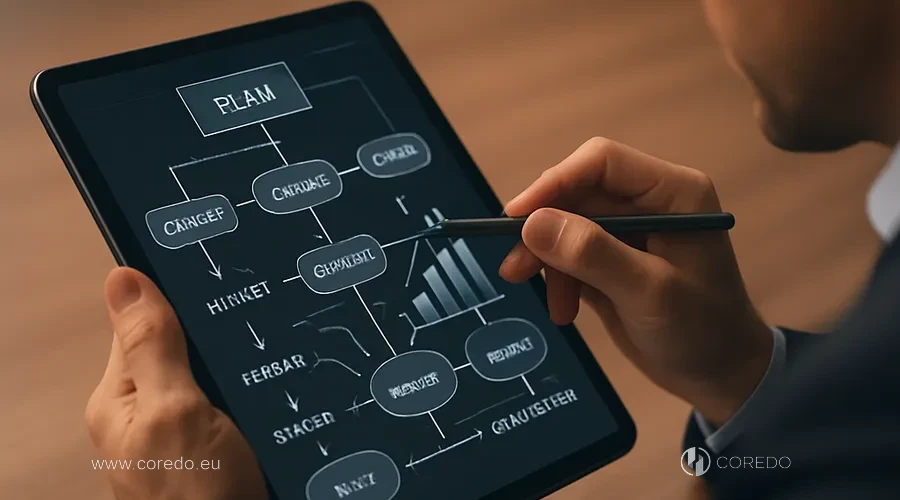
- Invest in a Legal Opinion in advance: a full registry analysis reduces rejections by 70-90%.
- Conduct an AML audit: mandatory for scaling foreign economic activity (FEA) in high-risk zones.
- Manage UBO and source of funds: forensic EDD for shelf companies prevents loss of operations.
- Integrate governance into KYC: the key to fintech expansion into Estonia or the Czech Republic.
In 2025 successful bank onboarding is the result of preparation, not luck. Companies that invest in a Legal Opinion, AML architecture and transparent corporate governance in advance pass checks faster and scale without repeated rejections.
The COREDO team implements this at every stage: transparently, with reporting and support. We acknowledge the challenges; regulations are tightening, but with our experience you will scale your business without losses.
Contact us if you need details about your case. Together we’ll build a reliable structure for the EU, Asia and the CIS.