
COREDO – EU Legal & Compliance Services Expert legal consulting, financial licensing (EMI, PSP, CASP under MiCA), and AML/CFT compliance across the European Union. Headquartered in Prague, we provide seamless regulatory solutions in Germany, Poland, Lithuania, and all 27 EU member states.

Pavel Kos
19.12.2025 | 6 min read
Updated: 19.12.2025
In 2025, 70% of banking onboarding rejections for companies from the EU and Asia are due to AML non-compliance: account freezes caused by incomplete KYC checks or a weak source of funds. Imagine: your business is ready for cross-border payments, but the bank suddenly freezes operations due to suspicions of money laundering or terrorist financing. Is an AML audit mandatory before opening an account, especially with a PEP among the ultimate beneficiaries? In this article I will analyze the triggers for mandatory audits, the risks of ignoring them, and a step-by-step plan to get through onboarding without delays. Read to the end – receive a checklist and an ROI calculation, validated by COREDO’s practice in Europe, Singapore and Dubai: COREDO.
What is an AML audit in bank onboarding?

An AML audit is an in-depth review of a business’s compliance with AML/CFT standards before bank onboarding, going beyond basic identification. The COREDO team has conducted such audits for fintech startups in the Czech Republic and Estonia, where a focus on beneficiary transparency reduced onboarding time from 8 weeks to 3.
AML audit before onboarding: stages and differences
AML audit before onboarding includes client identification, verification of the source of funds, PEP (Politically Exposed Persons) screening and analysis of ultimate beneficiaries: it is KYC for business with an emphasis on internal AML controls. Unlike a standard KYC check, which verifies a passport and address, the audit assesses beneficial ownership and the risks of large cash transactions.
COREDO’s practice shows: for a Pte Ltd in Singapore via ACRA they first collect the articles of association, data on resident directors and the register of beneficiaries, then conduct a compliance audit, which reduces returns for compliance reasons by 50%.
| Aspect | KYC check | AML audit before onboarding |
|---|---|---|
| Focus | identity verification | Risk of money laundering/terrorist financing |
| Scope | Basic documents | Full compliance audit, transaction monitoring |
| Timeframe | 1–3 days | 1–4 weeks (high risk) |
| Mandatory | Always | When risk > average |
Risk-based AML approach in banks, 2025
The risk-based AML approach in banks 2025 classifies clients according to an AML risk map: low (local retail), medium (foreign trade settlements), high (offshore schemes, FATF lists). A solution developed by COREDO for a client from Slovakia with operations in the UAE integrated such a map; AML reputational risks fell and AML in banks 2025 became predictable.
When an AML audit is needed before onboarding

Mandatory AML audit is activated at high risk: cross-border payments, PEP or jurisdictions like Turkey and Kazakhstan. Our experience at COREDO with CIS companies in the EU has shown: ignoring it adds +60 days to onboarding.
Mandatory AML audit in the EU (AMLA 2025)
For companies in the EU, an AML audit is required by EU banks under the EU AMLA 2025 in cases of PEP, source of funds from high‑risk areas or the new AMLA rules for onboarding 2025 — with strengthened data protection (GDPR) and 6AMLD for card issuance. FATF AML updates require an AML audit for companies in the EU before account opening, especially when ultimate beneficiaries are from the grey list.
An AML audit before card issuance in the EU in 2025–2026 is now standard for high‑risk cases, as in COREDO’s practice with payment providers in Cyprus.
| Jurisdiction | Mandatory AML audit | Triggers |
|---|---|---|
| EU (AMLA) | Yes, for high‑risk | PEP, FATF lists |
| Czechia/Slovakia | Yes, for cross‑border | UAE/Turkey risks |
AML audit before account opening in Asia and Africa
In Asia, AML before account opening is critical under the MAS Digital Onboarding Framework; the impact of FATF assessments on banking onboarding in Singapore is increasing MAS supervision, with checks of the ACRA database and MyInfo Business. How to pass KYC checks in Asian banks in 2025? A mandatory audit is required for non‑obvious discrepancies in ACRA/MyInfo that cause delays of +2 months, as with a COREDO client from Hong Kong.
In Africa and in ‘clean’ jurisdictions like Dubai, an AML audit ensures FATF compliance, minimizing sanctions compliance issues for foreign economic activity (FEA).
AML requirements and KYC checks: risks without an audit

AML requirements and KYC checks, the basis of AML compliance, but without an audit risks grow exponentially: mandatory AML compliance for cross-border payments prevents account blocks.
Risks of account blocking without an AML audit for foreign trade businesses
The risks of account blocking without an AML audit include suspension of AML-related transactions, financial fines for non-compliance (up to millions of euros) and additional penalty assessments. For AML audits and source of funds for foreign trade businesses, COREDO’s practice found: without an audit 25% of accounts are blocked due to suspicious transactions, losing licenses and contracts.
Long-term consequences: compliance incidents, loss of business reputation.
Impact of PEPs and beneficiaries on onboarding timelines
Does PEP status affect the requirement for an AML audit and onboarding timelines in 2025? Yes: preparing documents for bank onboarding with a PEP requires enhanced Due Diligence, doubling the timelines. PEPs (Politically Exposed Persons) and ultimate beneficiaries trigger situations when an AML audit is mandatory before bank onboarding; COREDO accelerated this through legal AML support.
AML compliance in 2025: digital onboarding
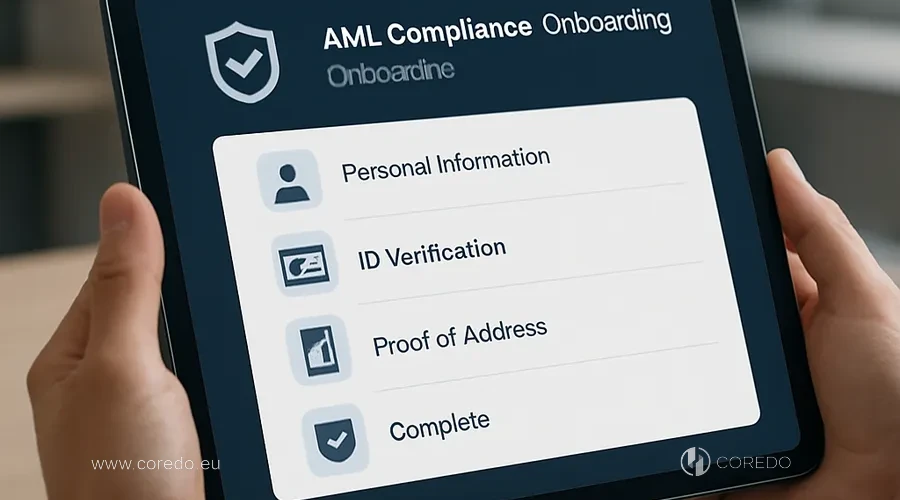
AML compliance is evolving toward digital onboarding in 2025–2026, integrating digital onboarding validation with automated monitoring systems.
Digital onboarding 2025: GNN in AML and FHE
GNN in AML systems (graph neural networks) analyze transaction networks, reducing false positives by 40%; GNN technologies for AML transaction monitoring are combined with FHE in joint analysis of AML risks by banks (homomorphic encryption) for privacy-preserving ML. How to integrate GNN and FHE into AML processes? COREDO implemented continual learning in AML for Singaporean fintechs, increasing profitability.
AML/CFT monitoring and automation
Continuous transaction monitoring using machine learning for anomalous transactions ensures financial control for CFT. Suspicious transactions are blocked automatically, minimizing AML reputational risks, as in our anti-corruption compliance projects.
How to conduct an AML audit and pass bank onboarding

Conduct an AML audit using a checklist to pass bank onboarding:
- Risk self-assessment (AML risk map, risk-based approach).
- Document collection (source of funds, PEP declaration, CDD questionnaire).
- External compliance audit with AML legal support.
- Digital onboarding (eIDAS in the EU, MAS Digital Onboarding Framework in Asia).
AML services for licensing speed up the process by 50%, reduce costs, the COREDO team integrated this for crypto licenses in Estonia.
Return on investment from AML audits for international companies
ROI from implementing AML services prior to onboarding reaches 25–40%: a compliance audit for sustainable banking relationships reduces client onboarding time and the share of returns for compliance reasons.
Scaling AML systems for international corporations includes the US IA AML Rule and GDPR. How to calculate the ROI of conducting an AML audit? See the metrics:
| Metric | Without AML audit | With AML audit |
|---|---|---|
| Onboarding time | 4 months | 3 weeks |
| Fines/blocks | 20–30% | <5% |
| ROI (annual) | – | +25–40% |
Which metrics evaluate AML compliance effectiveness? The stability of banking relationships, AML reporting, and the qualifications of responsible officers.
Key findings and recommendations
An AML audit is mandatory for PEPs, high-risk cases, in the EU (EU AMLA 2025) and in Asia (FATF updates 2025 for CIS businesses in Europe); without it, strategic risks such as account freezes and legal-risk exposure are inevitable. Is a compliance audit required for card issuance in the EU? Yes, taking AMLA into account.
Take action:
- Conduct the mandatory AML audit (1 week; AML audit prior to bank onboarding).
- Prepare source of funds/PEP documents (KYC compliance).
- Select an AML services partner for licensing in the EU/Asia/CIS.
- Implement GNN/FHE for continuous monitoring.
- Monitor FATF lists and external reviews.
How does legal support for AML services speed up onboarding and minimize reputational risks? Contact COREDO: we will provide full support for licensing, audits and sustainable banking relationships.