
COREDO – EU Legal & Compliance Services Expert legal consulting, financial licensing (EMI, PSP, CASP under MiCA), and AML/CFT compliance across the European Union. Headquartered in Prague, we provide seamless regulatory solutions in Germany, Poland, Lithuania, and all 27 EU member states.

Grigorii Lutcenko
02.03.2026 | 6 min read
Updated: 02.03.2026
Digital euro (CBDC euro): not an abstraction from presentations, but a real factor transforming the business models of banks, payment service providers (PSP), e‑money institutions and corporate treasuries. In this article I will lay out the impact of the digital euro on payment intermediaries and infrastructure, show practical approaches to integration, and also share COREDO’s cases on licensing, AML/KYC and building operationally resilient solutions.
The European Central Bank is carrying out the ECB digital euro project consistently, with pilots and research reports, and COREDO’s practice confirms: those who prepare in advance win. I rely on concrete deployment scenarios, regulatory requirements and architectural choices that payment companies and banks are already encountering in the Czech Republic, Slovakia, Cyprus, Estonia, the United Kingdom, Singapore and Dubai. The goal: to give you strategic and tactical guidance that will shorten the path from idea to industrial launch.
CBDC Deployment Models and Architecture

Before building an ROI, you need to align on the terminology. The retail digital euro (retail CBDC) is aimed at mass payments by individual and corporate users, while the wholesale (wholesale CBDC) targets interbank settlements and clearing of high‑value amounts. The ECB in its documents considers a two‑tier model of the digital euro (two‑tier CBDC model), where the central bank provides issuance and settlement finality (settlement finality), and distribution and customer services are provided through banks and PSPs.
The discussion around direct and intermediated CBDC models boils down to the balance between central bank control and market dynamics. The direct model gives users access to central bank accounts, but creates a risk of bank disintermediation upon CBDC introduction. The intermediated model reduces that risk by preserving the key role of commercial players in onboarding, KYC, and wallet UX. The COREDO team, in assessments for clients, considers hybrid options with differentiated access (tiered access) and limits that mitigate deposit outflows and support financial stability.
The registry architecture remains a matter of choice: permissioned ledgers and centralized registries simplify control and scalability, while a distributed ledger and CBDC expand possibilities for interoperability and programmability. In our techno‑economic assessments we compare TPS throughput and scalability, evaluate the feasibility of layer‑2 solutions and sharding for CBDC, and also model off‑chain settlement and atomic settlement to reduce costs during peak load.
EU regulation PSD2 MiCA GDPR AML/KYC
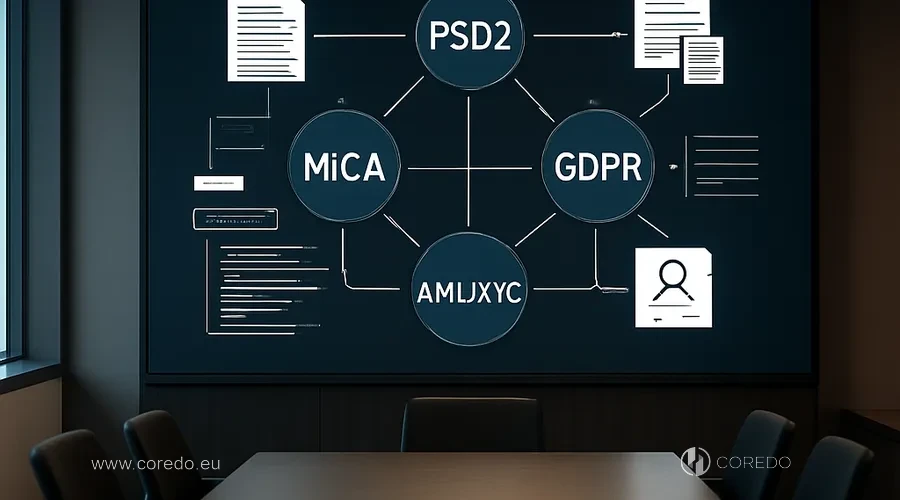
Regulatory requirements for CBDC in the EU are not built in a vacuum but on already familiar pillars. The impact of PSD2 on CBDC integration appears through requirements for open APIs, authentication and access management. At COREDO we prepared roadmaps for several PSPs for modernizing API gateways and wallet integration, taking into account API requirements for CBDC integration and the expected exchange formats compatible with ISO 20022 (impact on CBDC messages and enrichment of payment information).
MiCA and digital asset regulation in the EU do not replace rules for CBDC, but set compliance and market fairness standards that infrastructure providers cannot ignore. The legal status of digital currency in the EU will enshrine the status of the euro CBDC as legal tender, which affects taxation of digital payments and reporting, as well as pricing of transactions in the digital euro. For clients we prepare tax memoranda together with local advisers in Estonia, Cyprus and the Czech Republic so that corporations correctly reflect operations in management and statutory reporting.
GDPR and the digital euro: a separate topic. Privacy by design and data pseudonymization, CBDC transaction confidentiality and privacy modes, as well as possible use of zero‑knowledge proofs for transaction privacy, all of this must be combined with anti‑money‑laundering compliance (AML) for CBDC. I insist on a risk‑based approach: differentiated limits, multi‑level authentication and real‑time sanctions screening allow combining GDPR and AML requirements/KYC for the digital euro without degrading UX.
The travel rule in the context of digital currencies is already familiar to clients from the crypto market, and its logic can be easily scaled to CBDC taking into account wallet identification specifics. The solution developed at COREDO combines sanctions screening, transaction monitoring and beneficiary verification in a single circuit, which simplifies audits and reduces operational risks.
Eurosystem: TARGET2, TIPS, RTGS, SEPA
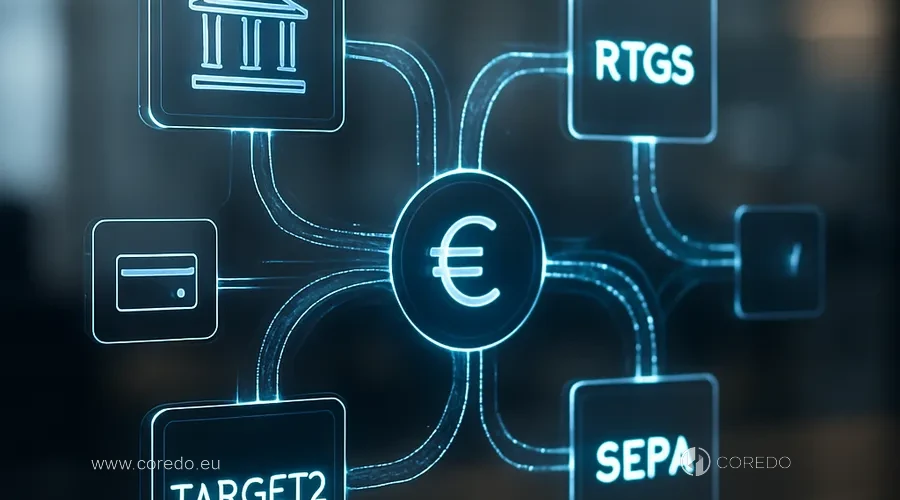
Integration of the digital euro into existing payment systems: a matter of practice, not slogans. TARGET2 and integration with central infrastructure set the standards for real‑time gross settlement (RTGS) and finality, while TIPS and real‑time settlements in the Eurosystem provide a benchmark for latency and availability. Our methodology maps TPS, SLA and RPO/RTO parameters to target business flows to determine where gross vs net settlement implications are appropriate and when it is advantageous to use netting within a PSP before sending to central infrastructure.
Interoperability between the digital euro and SEPA is a critical factor for rapid adoption in corporate processes. We ensure convergence of formats to ISO 20022 and support for enriched remittance data so that accounting and ERP systems receive exactly the data needed for automatic payment matching. For e‑money institutions and banks in Cyprus and Slovakia the COREDO team implemented integration with core systems via API gateways and event queues, preserving compatibility with existing AML monitors.
Cybersecurity for CBDC infrastructure requires special attention to cryptographic keys, HSMs and custody. Custody models and key storage for the digital euro must take into account multisig, hardware security modules and segregation of duties. In projects on sites in Singapore and Dubai we validated the design through independent pentests and stress tests, including failure scenarios and business recovery during CBDC outages, so that BCP and DRP are not just documents but working procedures.
Impact on banks, PSPs and the ecosystem
The impact of CBDC on banks and PSPs goes far beyond IT integration. The risk of bank disintermediation when introducing a CBDC is directly linked to deposit outflows and banking stability. Differentiated access and minimum balances, liquidity reservation and liquidity management through LMP instruments: operational mitigation mechanisms. I recommend that banks set wallet limits and incentivize customers to keep deposits by offering bundles with tokenized deposits and overdraft lines.
The effects of the digital euro on payment intermediaries’ margins will be material. Lower settlement costs and pressure on interchange fees increase the threat of card networks being displaced in certain scenarios. Merchant acquiring and the impact on acquiring will lead to a reassessment of MDR and chargeback fees, while the payment fee system may simplify due to direct settlement finality. At COREDO we build cost‑to‑serve analyses for PSPs and a PSP revenue model for CBDC implementation to anticipate margin compression and compensate for it with new products.
Which business models will PSPs retain after the CBDC launch? Onboarding services, KYC/KYB, risk scoring, fraud detection, data tokenization and value‑added services for merchants will retain value. Monetization strategies for CBDC for fintechs lie in programmability (programmable money): escrow orchestration, conditional payments, smart contracts for automated settlements, B2B subscriptions and micro‑payments for IoT. Partnerships between banks and fintechs around CBDC will become the norm: some provide licenses and access to liquidity, others — development speed and UX.
Gateways, settlements, and enterprise liquidity

How will the digital euro affect payment gateways? CBDC integration will reduce dependence on card networks in the online checkout, while API gateways and wallet integration will allow merchants to accept funds with final settlement in real time. This will change the operating cycle and require updates to reconciliation and payout processes.
The COREDO team is preparing transition checklists for merchants, including UX and adoption of corporate wallets, refund rules and disputes.
The impact of the digital euro on the transformation of corporate settlements will affect the treasury. The digital euro and interbank liquidity will accelerate cash turnover, enable management of liquidity corridors and market making in cross‑currency settlements via cross‑border CBDC corridors and settlements. Cross‑currency settlements and FX settlement will benefit from atomic PvP, and hedging instruments for companies under the digital euro will adapt to shorter clearing windows and new spot profiles.
Tokenization of deposits and the digital euro will coexist. Tokenized deposits and their impact on bank liquidity are already being tested in the EU and the UK, and our analysis shows: for B2B payments the pairing of tokenized deposits + CBDC provides flexibility in limits and SLAs. Custodial vs non‑custodial wallets for businesses will require a balanced choice: the former will simplify compliance and access recovery, the latter will increase control and reduce dependence on the provider.
Offline payments with the digital euro deserve special attention. They are critical for retail and transport, but add requirements for security and subsequent conflict resolution during synchronization. We implement double‑spend mitigation policies and local limits, as well as criteria for choosing a CBDC infrastructure provider, taking into account the frequency of point‑of‑sale scenarios and requirements for hardware wallets.
Pilots, programmability and scenarios
Pilots of the digital euro by the European Central Bank have already provided useful signals about CBDC infrastructure and scalability. Testing and pilot scenarios of the digital euro have shown that programmable money: it is not a “feature for the sake of a feature”, but a tool for automating the lifecycle of a transaction: holding deposits, confirming delivery, automatic calculation of penalties and bonuses. The use of smart contracts with the digital euro fits well in wholesale supply chains and insurance.
Interoperability of payment networks and token standards (token standards) are important for compatibility with corporate ERP and treasury platforms. In the COREDO projects in Singapore and Dubai we tested off-chain orchestration and on-chain confirmations to maintain compatibility with ISO 20022 and simplify auditing. Central bank pilot projects and use cases confirm: the market is ready for micropayments in IoT and automatic payments for resource usage, where CBDC addresses the ‘pain’ of transaction cost and delays.
The impact of the digital euro on the card payments ecosystem will be uneven. For high-risk merchant categories and cross-border scenarios cards will retain their role, but where value is in instant settlement finality and low cost, cards will give way to CBDC payments and SEPA Instant.
Pressure on interchange fees will inevitably increase demand for alternative rails.
AML/KYC compliance, sanctions and privacy
Anti-money laundering compliance (AML) for CBDC is about accuracy and speed. Real-time sanctions screening, fraud detection and transaction analytics in CBDC must operate with low latency so as not to break the UX. At COREDO we implement risk scoring that accounts for device context, behavioral biometrics and geoprofile, integrating the travel rule and beneficiary requirements for corporate wallets.
Compliance, sanctions and the digital euro imply not only filters but also managerial reporting. KPIs and KRIs for the transition to CBDC include the share of flagged transactions, average unblocking time, alert accuracy and escalation speed. Such a dashboard helps risk directors see not only the occurrence of incidents but also operational ‘bottlenecks’.
Privacy and GDPR requirements for the digital euro imply privacy by design and pseudonymization regimes. We use architectural patterns that separate identification and transaction processing, with optional use of zero-knowledge proofs where justified. This reduces regulatory risk and simplifies audits while remaining within lawful interests and the fight against financial crime.
BCP, DRP and cybersecurity
Operational resilience risks for PSPs in the context of CBDC are coming to the forefront. Operational resilience, BCP and DRP require scenario modeling: from performance degradation to the complete unavailability of some nodes. At COREDO we run war‑game sessions with technical and business teams to test failure scenarios and business recovery in case of CBDC outages, and we formalize the procedures in agreements with providers.
Cybersecurity for CBDC infrastructure is based on strict key management: cryptographic keys, HSM and custody, network segmentation, end‑to‑end encryption and hardware isolation of critical components. We insist on regular red‑team exercises, supply‑chain checks and independent audits to reduce the likelihood of compromise of critical secrets.
Liquidity management tools for PSPs are no less important. Liquidity management and LMP tools, minimum balances and liquidity reservation must comply with central bank rules and internal risk limits. For the CFO this means: daily repricing protocols, intra‑day limits, reporting on liquidity corridors and real‑time alerting.
ROI, fees and servicing costs
Planning ROI for payment intermediaries when transitioning to the digital euro begins with a cost-to-serve analysis. Transaction costs and operating expenses under the digital euro depend on the custody model, routing, required SLA and chosen providers. The COREDO team prepares unit economics by segment, models scenarios of declining interchange-dependent revenues and restructures fee structures for value-added services.
Transaction pricing in the digital euro must take into account settlement finality, the client’s risk profile, reporting requirements and additional services (scoring, payment guarantee, reconciliation). The impact of the digital euro on the payment fee system will manifest in greater transparency and a stratification of prices between “basic” processing and intelligent overlays.
Which business models will remain for PSPs? Those that can monetize risk management, programmability and analytics.
Hedging instruments for companies under the digital euro will be closer to day-to-day liquidity: short swaps, dynamic management of DSO/DPO and factoring based on smart contracts. In COREDO projects for holdings in the EU and Asia we tested automatic splitting of payments between suppliers and the treasuries of subsidiaries, reducing operational burden and decreasing accounting errors.
Plan: from architecture to pilot launch
How to prepare a payment intermediary for the digital euro? I use a four‑phase plan that has proven effective across different jurisdictions.
- Readiness assessment and architectural sketch: analysis of current APIs, AML/sanctions controls, custody options, performance (TPS throughput) and reliance on card networks. Defining target KPI/KRI and failure scenarios.
- Regulatory and licensing framework: checking compliance with PSD2, preparing for MiCA alignment, updating GDPR policy, describing AML/KYC for the digital euro and the travel rule, as well as setting up real‑time sanctions screening.
- Integration and security: designing API gateways and wallet integration, selecting a custody provider for digital currencies, HSM and key hierarchy, testing offline payments and privacy modes. Setting up monitoring, fraud analytics and logging in ISO 20022 format.
- Testing and pilots: regulatory sandboxes (sandbox) for CBDC solutions, testing and pilot scenarios for the digital euro with merchants and corporate wallets, stress tests BCP/DRP, preparation of reporting and a business case for scaling.
COREDO’s practice confirms: early dialogue with the regulator and participation in pilots reduces uncertainty and gives an edge in UX and compliance. We helped a PSP in Estonia and a bank in the Czech Republic align pilot scenarios with the supervisor and establish risk control checkpoints.
COREDO case studies – licensing and AML
Our experience at COREDO has shown that CBDC readiness accelerates when the basic elements are already in place. For an e‑money institution in Cyprus the team set up full‑stack AML/KYC for the digital euro taking into account the travel rule, implemented real‑time sanctions screening and integrated an API gateway for ISO 20022. This made it possible to move to a merchant pilot in eight months instead of the planned twelve.
In Slovakia we supported a PSP that was worried about margin compression. Together we recalculated the PSP’s revenue model under CBDC implementation, brought two new offers to market: guaranteed settlement for marketplaces and escrow on smart‑contracts for B2B. The effects of the digital euro on payment intermediaries’ margins were offset by increased turnover and reduced chargeback expenses.
In Singapore and Dubai we worked with custody providers for digital currencies, building custody models and key storage for the digital euro, access regulations and recovery procedures. The client received an independent report on operational resilience covering BCP, DRP and KRI, as well as the results of red‑team exercises and pentests. This package simplified communication with corporate merchants and insurers.
Finally, a case in the UK and Estonia: a payment gateway was preparing for reduced interchange and intensified its focus on programmable money. We implemented smart contracts for automated settlements with suppliers, established rules for tax accounting and reporting, and set up an integration with tokenized deposits at a partner bank. This accelerated capital turnover and reduced the cost of processing payments.
Plan 12–24 months for banks, PSPs, corporates.
The strategy looks pragmatic. Banks need to test a two‑tier digital euro model with limits and non‑reducing balances, integrate LMP tools and update client wallets taking into account privacy modes and offline scenarios. At the same time I recommend conducting stress‑tests of deposit outflows and developing an offering for tokenized deposits for corporate clients.
PSPs should rebuild the pricing grid with a focus on value‑added services: fraud analytics, payment guarantees, reconciliation platforms, conditional payouts and programmable B2B scenarios. Partnerships with banks and fintechs around CBDC and participation in regulatory sandboxes will provide quick access to pilots and reduce integration risks.
Corporate treasuries need to prepare a CBDC usage policy: limits, hedging rules, ERP updates for ISO 20022, accelerated collection scenarios and optimization of DSO/DPO. The impact of the digital euro on corporate liquidity can become a source of competitive advantage if treasury processes and reporting are adapted in advance.
Why should you start preparing now?
The CBDC euro is ceasing to be an experiment and is becoming the framework within which banks, PSPs and corporations will do business in the EU.
The digital euro’s impact on payment intermediaries, the card payments ecosystem and corporate settlements affects not only technology but also margin, product strategy and compliance. I see not a threat here, but an opportunity to relaunch high value‑added services, from programmable payouts to intelligent liquidity.
COREDO grew at the intersection of company registration, licensing and AML consulting, and it is precisely this combination that helps clients turn regulatory changes into sustainable business cases. If your team plans to integrate the digital euro, you’ll need a precise architecture, a clear roadmap and partners who take responsibility for the outcome. The COREDO team is ready to walk the path with you from readiness assessment to pilot and scaling, maintaining process transparency and control over risks.