
COREDO – EU Legal & Compliance Services Expert legal consulting, financial licensing (EMI, PSP, CASP under MiCA), and AML/CFT compliance across the European Union. Headquartered in Prague, we provide seamless regulatory solutions in Germany, Poland, Lithuania, and all 27 EU member states.

Pavel Kos
03.03.2026 | 6 min read
Updated: 03.03.2026
I see every day how the financial technology market is maturing. Regulators are raising the bar for cybersecurity, partners are tightening due diligence, and customers expect impeccable data handling. Since 2016, the COREDO team has supported international fintech projects – from company registration and obtaining licenses to AML consulting and technology compliance, in the EU, the United Kingdom, the Czech Republic, Slovakia, Cyprus and Estonia, as well as in Singapore and Dubai. On this path, cyber insurance has become not just “good practice”, but a management tool that reduces the volatility of operational losses and speeds recovery after incidents.
In this article I have compiled proven practices that I use myself and that COREDO relies on in projects with payment institutions, e-wallets, crypto services, forex brokers and neobank platforms. The text is intended as a practical guide: from understanding the necessity of cyber insurance for fintech and choosing optimal limits to negotiations with the underwriter and integrating coverage into BCP/DR plans. I deliberately avoid generalities and describe tools that actually help secure better terms and protect the balance sheet.
Why fintech needs cyber insurance
financial licenses in Europe and Asia are increasingly tied to expectations of mature cyber resilience. PSD2 and operational resilience requirements for payment operators effectively elevate cyber risks to first‑tier business risks. GDPR adds obligations for personal data protection and breach reporting, while NIS2 broadens the scope of covered entities and raises the bar for security measures for operators of digital infrastructure. At this point, cyber insurance becomes part of a risk transfer strategy that complements ISO/IEC 27001, SOC 2 Type II and internal controls.
COREDO’s practice confirms: partner banks, processing centers and large trading platforms increasingly include the presence of a cyber insurance policy among the mandatory conditions for joining their ecosystem. This is especially noticeable for payment aggregators, electronic money providers and API providers in open banking. Cyber risk insurance for financial companies is no longer seen as ‘the IT department’s insurance’; it is a corporate tool for operational resilience and compliance.
When fintech needs cyber insurance
There is not yet a direct, universal legal mandate, but requirements are emerging indirectly:
- Payment institutions and electronic wallets in the EU, under PSD2 and supervision by competent authorities, are required to confirm incident response plans and financial resilience, where cyber insurance often serves as a component for covering residual risks;
- supervisors in Singapore (MAS), Australia (APRA) and Hong Kong (HKMA) publish benchmarks where having a policy improves the assessment of operational resilience and the maturity of risk governance;
- partner banks, card issuers and global acquirers include a cyber policy as a condition of cooperation and limit types of coverage — for example, a sub‑limit on ransomware payments or a mandatory first‑party block with business interruption.
The answer to the question “Is a cyber policy mandatory for an electronic wallet and a payment institution?” in COREDO’s practice is: formally not always, but de facto it is harder to pass partner Due Diligence and meet operational resilience requirements without a policy, especially in a cross‑border model.
Structure of cyber policy coverage
Cyber insurance for fintech should cover both own losses (first‑party) and liabilities to third parties (third‑party liability):
- First‑party coverage for data breaches: forensic investigation costs, breach notification expenses, system restoration, PR support (brand rehabilitation), customer remediation and client compensation, a policy for business interruption due to a cyberattack (including contingent business interruption (CBI) coverage in case of a failure at a key supplier);
- ransomware insurance and extortion: payment for negotiator services, system restoration, potential ransom payments, taking into account a sub‑limit on ransomware payments and special terms;
- third‑party liability cyber: protection against claims from customers and partners, class action defense and cost of litigation, regulatory fines and compliance costs where they are insurable under the law of the relevant jurisdiction.
For payment services, insurance for data breaches and API compromise is especially important, including fraud exposure and transactional risk. The solution developed by COREDO for a number of payment aggregators includes a clear linkage of incident vendor SLAs to policy terms to speed up settlement.
How to assess ROI, cost‑benefit and risks

How much should a cyber policy cost and how to justify the purchase to the board of directors? Our experience at COREDO has shown the usefulness of quantitative models:
- FAIR model for quantitative assessment of cyber risks helps break down scenarios by frequency and severity, and also build a loss exceedance curve for cyber CAT events;
- VaR and CVaR for cyber risks provide a consistent language for communication with the CFO and CRO, including when determining the breakeven analysis of purchasing a cyber policy;
- Monte Carlo simulation and scenario analysis allow accounting for aggregation risk: the probability of a large correlated loss across multiple jurisdictions, for example in the event of compromise of a key third‑party vendor.
When I discuss «how to calculate ROI from cyber insurance for fintech», I rely on three steps: calibrate the frequency and severity of incidents using industry data (data on incident frequency and severity in the payments sector), model the consequences taking into account RTO/RPO and actual MTTR, then compare the expected loss amount with the premium and coverage structure (limits, deductible and retention in the cyber policy, coinsurance). Such a cost‑benefit analysis provides a clear decision point.
Underwriters’ metrics
Good terms depend on data. Underwriters look at metrics MTTD/MTTR, logging completeness (SIEM), maturity of EDR/MDR, coverage of critical vectors in MITRE ATT&CK, frequency and results of pen testing and bug bounty. For negotiations with an underwriter I use a set of security KPIs: percentage of MFA coverage, share of privileged accounts under PAM, regularity of tabletop exercises, the presence of SOC 2 Type II or ISO/IEC 27001.
Metrics to negotiate better premiums, a real tool to reduce the premium through cyber hygiene discounts and premium credits.
How to read policy wording without surprises

Legal “small print” in cyber policies decides everything. The policy must match the business model, architecture and geography of losses. The COREDO team regularly conducts policy wording analysis, identifying ambiguity issues and closing carve‑outs that are critical for fintechs.
Setting the limit, sub-limit and franchise
- Aggregate limit determines the total payout for the period, while sub‑limit and sharing clause manage limits for individual blocks — for example, for ransomware payments or forensic vendors;
- retention, deductible and franchise in cyber policies form the “lower” part of the loss that the company covers itself; proper retention settings reduce the premium but require an adequate reserve;
- coinsurance allocates the share of loss between the insured and the insurer and helps balance interests at high limits.
I address the question “how to choose the franchise and limits for an international fintech” through scenario stress‑testing: we forecast the worst credible loss taking into account CBI and provider outages, compare it with the board’s risk appetite and the group’s solvency, then allocate limits and sub‑limits to the most likely loss blocks.
Exclusions and contentious areas
- War exclusion and state‑sponsored attacks: for fintechs the wording that separates “cyberterrorism” and state‑sponsored attacks is critical, because attribution is difficult and disputes are frequent;
- silent cyber and retroactive exclusion: ensure that the retroactive exclusion clause (retroactive date) does not exclude events whose roots predate the discovery of the incident;
- third‑party vendor: seek clarity on “what the cyber policy covers in the event of an attack via a third‑party vendor”, including supply chain compromise and vendor due diligence obligations;
- continuous underwriting and security controls as a condition precedent: some insurers impose an obligation to maintain controls at a specified level; this requires discipline and transparent monitoring.
Parametric solutions
Parametric cyber insurance offers fast payouts on clear triggers, for example, a critical API malfunction or the duration of downtime. Such solutions accelerate liquidity but do not cover complex legal claims.
In a number of projects COREDO evaluated captives and alternative ART solutions: a captive structure to cover fintech cyber risks can be advantageous with a large and predictable exposure and the availability of retrocession. When does it make sense to go into a captive or retrocession? When market limits are insufficient, premiums have risen sharply, and the group has mature risk management and capital to retain part of the risk.
Compliance and the cost of cyber insurance
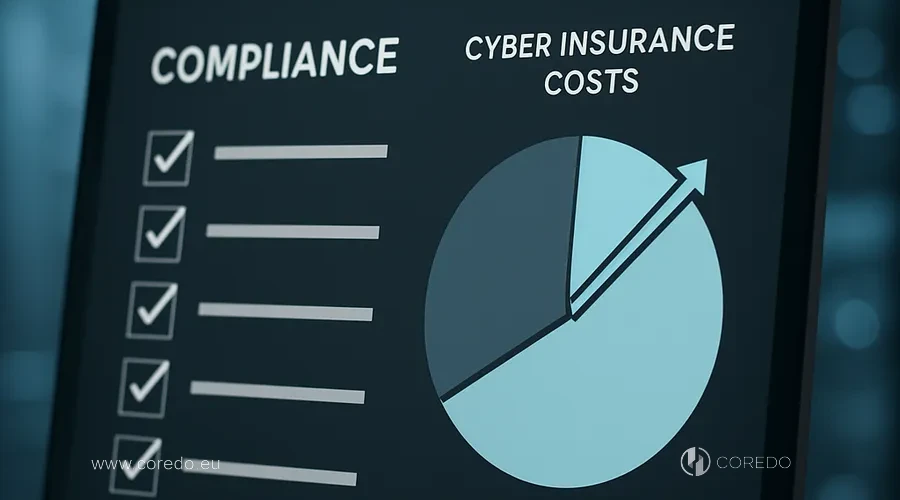
SOC 2 Type II and ISO/IEC 27001 certifications reduce information asymmetry for the underwriter and usually lead to better premiums. The presence of mature SIEM, EDR and MDR systems, as well as centralized logging and a response retainer, are arguments for discounts. I have seen MDR and EDR implementations bring tangible premium credits, especially when combined with regular tabletop exercises and a formalized incident response plan.
In open banking API security: the dominant risk vector. Good API governance, segmentation, minimization of privileges (least privilege), secret management and strict SLAs with partners form a better security posture assessment. For payment services, fraud loss mitigation, chargeback coverage and AML/KYC processes are also important, since AML/KYC data leaks increase third-party liability.
What insurers require from fintechs
- MFA everywhere, including admin access and remote connections, PAM for critical systems;
- offline immutable backups and regular recovery tests;
- EDR/MDR on all workstations and servers, event correlation in SIEM;
- network segmentation, zero trust principles, vulnerability management;
- a formalized incident response plan, incident response retainers and a panel of forensic experts under the policy;
- regular pen testing, bug bounty, vendor due diligence with clear SLAs for notifications.
Cyber insurance terms and regulatory requirements converge on the need for corporate resilience (cyber resilience) and high-quality board-level reporting. The CRO’s role in cyber strategy is becoming foundational.
Organizing the client’s purchase project

When an entrepreneur asks “does a startup need cyber insurance”, I look at the value chain: if the startup already processes payments, stores personal data or builds partner APIs, then a cyber policy is a rational step. The COREDO team has implemented dozens of such projects and established a transparent process.
Due diligence and legal arrangements
We start with underwriting questionnaires and security posture scoring to understand the baseline. Next comes policy due diligence: choice of law, jurisdiction and dispute resolution in the policy, issues of data localization and cross‑border claims, requirements for notification of data breaches in different jurisdictions, claims handling timeline and the insurer’s obligations to appoint forensic vendors. Such elaboration reduces the risk of unwarranted denials and speeds up settlement.
Negotiations with the underwriter
At the negotiation stage I bring MTTD/MTTR metrics, results of stress testing and scenario analysis, an improvement plan with concrete deadlines. If it’s necessary to include extortion and ransomware coverage in the base policy or increase the sub‑limit on ransomware payments, we write conditions regarding backups, segmentation and ransom negotiation procedures. An important part — how to account for reputational losses and customer compensation: we include brand rehabilitation, customer remediation and PR expenses with clear triggers.
Integrating BCP/DR into practice
Cyber insurance doesn’t work in a vacuum. I ensure that coverage is embedded into BCP/DR plans, and that the incident plan is regularly tested through tabletop exercises.
Preparing an incident response plan to present to the insurer means describing roles, RTO/RPO, the contact matrix, escalation procedures, and also mapping the insurer’s forensic and incident management vendors from their panel to internal procedures.
COREDO Case Studies: neobank and crypto services
В ЕС команда COREDO сопровождала регистрацию и Licensing платежного агрегатора, который интегрировался с крупными банками и маркетплейсами. Партнеры запросили полис киберстрахования для платежного агрегатора с first‑party покрытием, CBI и sub‑limit на fraud‑инциденты через компрометацию API. Мы провели quantitative risk assessment по FAIR, обосновали aggregate limit, настроили retention и добились скидки за внедрение MDR. Через полгода у клиента прошла атака на third‑party vendor; полис покрыл forensic, уведомление клиентов и PR, а также часть бизнес‑простоя: урок о важности CBI подтвердился на практике.
В Сингапуре мне довелось вести neobank, проходивший надзор MAS. Встал вопрос: насколько выгодна captive‑структура для покрытия киберрисков финтеха? Мы сравнили рынок и captive‑сценарий, смоделировали CVaR при cyber CAT, оценили стоимость капитала и перспективу ретроцессии. Решение: гибрид: рыночный полис с параметрическим блоком на быстрые выплаты по простоям API и удержание части риска через увеличенную франшизу. Премия оказалась ниже бенчмарка благодаря SOC 2 Type II и строгой API governance.
В Дубае мы поддержали криптосервис при получении лицензии и построении AML‑контуров. Клиенту нужен был акцент на ransomware‑страхование и покрытие extortion. После tabletop‑упражнений с участием панельных переговорщиков страховщика удалось согласовать расширенный sub‑limit на ransom и четкие условия выплат. Отдельно закрепили покрытие затрат на forensic и уведомление клиентов в нескольких юрисдикциях, учитывая трансграничную базу пользователей и требования GDPR.
Frequently Asked Questions
- Is a cyber policy mandatory when working with Open Banking and PSD2? Formally: no, but partners and regulators expect mature operational resilience; a policy helps pass due diligence and close residual risks.
- Are there premium discounts for implementing MDR and EDR? Yes, with proven effectiveness and SIEM integration many insurers give premium credits.
- What coverage is important for API‑compromise and fraud attacks? First‑party for investigation and restoration, third‑party liability, fraud/chargeback sub‑limits and CBI for supplier outages.
- How do SOC 2 / ISO 27001 affect the cost of cyber insurance? They lower the premium and expand available limits due to transparency of processes and controls.
- What is critical among exclusions (war, state‑sponsored)? Wording on attribution and criteria for “hostilities”; it’s important to avoid broad carve‑outs.
- How does the retroactive date work? The policy covers events after the specified date; ensure that investigations do not point to roots of the incident before the retroactive date.
- How long does settlement take with major insurers? With a good IR plan and vendor panel, from several weeks for operational expenses to months for complex third‑party claims.
- Is an independent security audit required for favorable terms? Often yes; an external assessment helps to better pass underwriting questionnaires.
- How to prepare an incident response plan for an insurer? Describe roles, MTTD/MTTR objectives, RTO/RPO, communications, escalations, contacts of the vendor panel and the frequency of tabletop tests.
- When does it make sense to consider a captive or retrocession? When there are large limits, high premium and mature risk management, and the group is ready to retain part of the risk.
- How to account for reputational losses? Include brand rehabilitation and customer remediation as explicit sections of the policy with measurable triggers.
Consider branches of an international fintech
A cross‑border structure complicates claims settlement. In the policy terms, agree in advance the choice of law and jurisdiction, as well as the rules on cross‑border claims issues. It’s important to understand how to assess aggregated losses across multiple jurisdictions and how one event vs series of related events ties to the aggregate limit.
For GDPR, consider the possibility of covering compliance costs and legal defense; the insurability of fines depends on local law. Different countries have different deadlines and formats for breach notifications, so “how to prepare data breach notifications” should be described quarterly and synchronized with the insurer’s panel lawyers.
How to calculate deductibles and limits
I use a three-level methodology. First we build scenario analysis and stress testing, including a worst‑case for ransomware with double extortion and a supply chain compromise. Then we assess VaR/CVaR and build a loss exceedance curve to set the limits corridor. Finally, we align retention with liquidity and the reserving plan so that the balance between premium and “self-insurance” is sustainable in any of the key jurisdictions.
For international groups, it is useful to consider coinsurance and separate sub‑limits for critical blocks: ransomware, forensic, business interruption and third‑party liability.
Market trends: budget and strategy
The market is showing premium growth and a tighter underwriting policy – market trends that are also confirmed by EIOPA’s observations. Reinsurers are strengthening control over insurer aggregation and concentration risk, and Solvency II affects the availability of catastrophe limits. In Asia, supervision by MAS/APRA/HKMA is pushing fintechs toward mature board-level reporting and the role of the CRO. Against the backdrop of increasing cyber catastrophes, interest in parametric cyber insurance is rising: rapid payouts close cash gaps during downtime.
At the same time, regulators and the market expect transparency: security controls as a condition precedent, continuous underwriting and mandatory risk profile updates are becoming the norm.
Cyber insurance: more than just a policy
Cyber insurance for fintech is not about “buying a piece of paper”, but about building a balance between risk transfer strategies and investments in security. When a policy is integrated into BCP/DR, backed by SOC 2/ISO 27001, when MTTD/MTTR metrics and vendor controls are transparent, the cyber policy becomes a mechanism for protecting revenue and capital. In COREDO’s real-world cases this helps obtain licenses, pass partner due diligence and withstand regulatory pressure without operational disruptions.
If you are planning to register a company in a new jurisdiction, obtaining a financial license or preparing an AML/KYC program – embed cyber insurance into your risk architecture from the very beginning. The COREDO team knows how to connect the legal, financial and technical parts into a single whole: from choosing the jurisdiction and license to configuring the cyber policy, negotiating with underwriters and integrating coverage into processes. This approach builds trust with partners and clients and, more importantly, gives the business resilience to the shocks that inevitably arrive in the dynamics of the fintech market.