
COREDO – EU Legal & Compliance Services Expert legal consulting, financial licensing (EMI, PSP, CASP under MiCA), and AML/CFT compliance across the European Union. Headquartered in Prague, we provide seamless regulatory solutions in Germany, Poland, Lithuania, and all 27 EU member states.

Pavel Kos
16.03.2026 | 6 min read
Updated: 16.03.2026
I founded COREDO in 2016 with a simple idea: international business should grow faster than its bureaucracy. Since then the COREDO team has implemented hundreds of projects for company registration in the EU, the United Kingdom, Singapore and Dubai, obtaining financial licenses and building mature AML programs. Today I want to explain how a bank’s counterparty check works in Europe and what a business must do to “pass” KYB/KYC, sanctions screening and counterparties’ due diligence right away – without surprises, delays and reputational risks.
This is not theory. Our experience at COREDO has shown that understanding the logic of banks’ counterparty checks and competent preparation of documents reduces the time to onboard a counterparty at an EU bank by 30–60%, and the number of false positive triggers in AML systems by 2–3 times. Below I share specific steps, practices and cases that worked for our clients in the Czech Republic, Estonia, Cyprus, Slovakia, the United Kingdom, Singapore and Dubai.
Why businesses should check counterparties
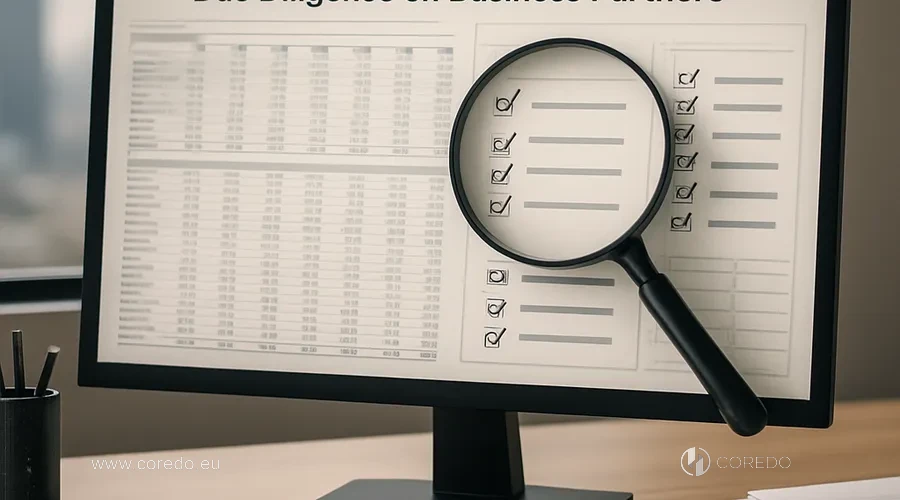
Entrepreneurs and chief financial officers want predictability: to open accounts quickly, carry out cross-border payments, enable acquiring, and not “stumble” over AML/KYC requirements. Bank counterparty checks are inevitable: financial institutions are required to know the client, its beneficiaries, sources of funds and the geography of operations. If a company understands the process and prepares evidence in advance, onboarding goes through the “green corridor”.
Counterparty checks in the EU are not only KYC for legal entities, but also the screening of a legal entity as part of the supply chain. The bank looks at the counterparties of your counterparties, sanction risks, PEPs and related parties, adverse media and reputational factors. I regularly tell clients: AML counterparty checks are about risk management, not about “tick-boxes”. The right strategy saves weeks of approvals and reduces the cost of compliance.
Regulation of AMLD 4/5/6, FATF and GDPR
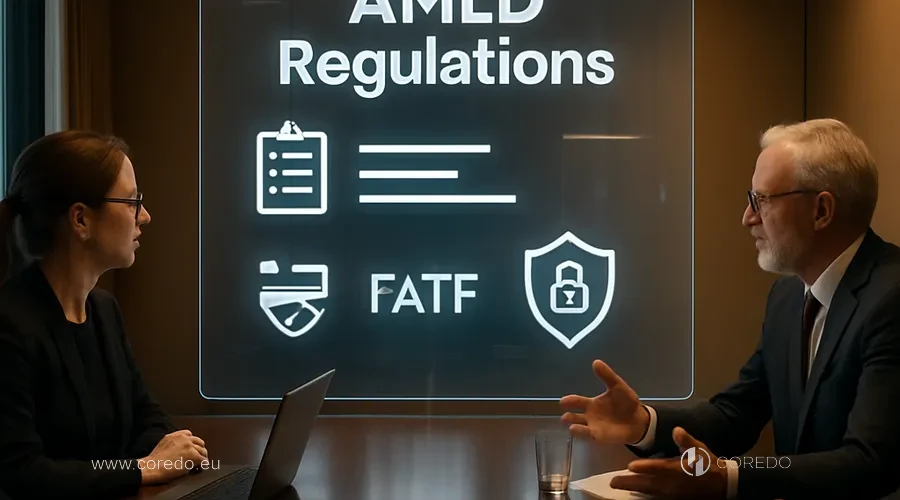
European banks rely on the EU AML Directives (AMLD4/5/6), the recommendations of FATF and national laws. These rules set mandatory Customer Due Diligence (CDD) procedures, the requirement to identify the ultimate beneficial owner (UBO), rules for sanctions screening and triggers for Enhanced Due Diligence (EDD). In addition, the GDPR affects banks’ counterparty checks: the legal bases for processing KYC data, the principles of data minimization and retention policy are important.
COREDO’s practice confirms that banks in the EU carefully observe file retention periods, maintain an audit trail and are prepared for regulatory inspections. In suspicious transactions the SAR (Suspicious Activity Report) process is triggered and the bank interacts with the FIU and EU regulators. This is a normal part of the ecosystem, so we always design internal policies to ensure they are compatible with FIU requirements and the ability to quickly provide materials.
Counterparty checks by banks: KYB and EDD

The procedures banks use to check counterparties, range from basic KYB to more in-depth EDD and largely determine the outcome of onboarding. In the following subsections we will look at how these stages are implemented in practice in EU banks and which documents and checks are required at different stages.
Onboarding and counterparty verification in the EU
Onboarding counterparties to an EU bank begins with profiling: jurisdiction of registration, industry, payment geography, expected volumes, currencies and channels. The bank conducts due diligence on counterparties using a risk-based approach: it assesses country ratings, sanctions lists, corporate structure and sources of funds. At this stage it is important to provide ownership diagrams, statutory documents, contracts, invoices and explanations of the business model in advance.
The COREDO team often builds a pre-onboarding “evidence folder”: contractual base, proof of address, description of operational processes, profiles of key partners. This reduces the time to onboard a counterparty and the number of clarifying requests. On average, when the file is complete and logically structured, the bank completes the initial CDD in 5–10 business days, even for a multi-jurisdictional business profile.
KYC and KYB for legal entities in Europe
KYC for legal entities in the banking context is manifested as KYB (Know Your Business). Bank KYB in Europe includes verification of registration, licenses (if applicable), governing bodies, taxpayer status and business reputation. The bank verifies the validity of documents, cross-checks data with registers, assesses corporate transparency and the company’s ability to maintain compliance.
To speed up the process we use standardized KYB checklists, eIDAS-signed documents, OCR and automatic document recognition, as well as SaaS KYC/KYB providers and API integration. The solution developed at COREDO allows collecting and verifying the package in 48–72 hours, including multi-level structures and cross-border ownership.
How EU banks verify UBOs
Identification of the ultimate beneficial owner is a key element. EU banks verify UBOs through EU beneficial ownership registers, commercial databases and public company registers. If the ownership chain is complex, we prepare an analysis of ownership chains and corporate structures with graphical diagrams and supporting extracts. This saves compliance officers hours and reduces the risk of escalation to EDD.
When direct register data is absent, entity resolution and graph analysis methods are used to establish links between shareholders, directors and related parties. Such verification of the ultimate owner of an EU company, together with internal explanatory memorandums, helps the bank quickly resolve compliance issues.
Sanctions screening of counterparties, PEPs
Sanctions screening of counterparties is conducted against EU, OFAC, UN (UN sanctions) and national authorities’ lists. The bank also checks PEPs and related parties, analyses watchlist consolidation and conducts adverse media screening. We pre-test clients against sanctions and restrictive lists using sanctions monitoring tools to understand the likelihood of matches.
How does automated sanctions screening work in a bank? The system updates lists daily, uses name matching and fuzzy matching rules, normalizes data and checks transactions and the counterparty on every event. When a hit occurs it goes into case management, where an officer checks the context, country risk and business rationale. Our task is to reduce false positives in AML systems by correctly transliterating names, adding identifiers and updating data.
Enhanced Due Diligence: When and How
What is Enhanced Due Diligence for counterparties? It is an in-depth review for high-risk profiles: complex multi-level structures, exposure to sanctioned jurisdictions, cash transactions, crypto assets or non-bank payment channels. EDD includes interviews with management, confirmation of source of wealth (SOW) and source of funds (SOF), independent references, extended adverse media and, if necessary, external investigations.
In COREDO practice EDD is often triggered by forex licenses, crypto services and PSPs. We prepare the EDD package in advance: auditors’ letters, bank references, certified corporate documents and risk remediation roadmaps. This approach reduces the duration of EDD from months to weeks.
COREDO cases in the EU, Asia and the CIS

COREDO practices are drawn from real cases of working in the EU, Asia and the CIS and show how to adapt processes to local requirements and reduce operational risks. Next, concrete examples of accelerating on-boarding: registration and KYB in Estonia and the Czech Republic and practical solutions that reduce timelines and risks.
Accelerating onboarding in Estonia and the Czech Republic
One of the projects: a tech company with clients in Germany and the Netherlands. We registered a legal entity in Estonia and a subsidiary in the Czech Republic, assembled a KYB package including the articles of association, a risk assessment and a CDD policy. The bank carried out a banking counterparty check, requested a UBO check and documents for key suppliers. Thanks to pre-prepared counterparty profiles and payment schemes time to onboard was reduced to 7 days.
The COREDO team also tuned Know Your Customer procedures for client businesses and implemented periodic review. Result: consistent passing of annual checks, no escalations and the ability to quickly open accounts for new projects in the EU.
Crypto licensing and blockchain forensics
For a crypto company we arranged a license in Estonia and structured operations through Dubai. The bank required AML counterparty checks, sanctions screening and a description of wallet controls. We implemented blockchain forensics, linked the reports with the bank’s TMS and explained signature rules for transaction monitoring.
The COREDO solution included risk-score models for counterparties, threshold and escalation rules, and tools for verifying bank details and IBANs for fiat settlements. The onboarding was completed without EDD escalation, and the false positive rate fell below 10% already in the first month.
FIUs and payment institutions in the UK and Cyprus
Working with a payment institution in the United Kingdom and a licensable entity in Cyprus, we built an SAR process and interaction with national FIUs, including playbooks for compliance and incident management. Case management practices were combined with an audit trail, which simplified regulatory inspections and internal audits.
The key effect is transparency: the bank and the regulator can see how Customer Due Diligence works, how suspicious activity reports are formed and on what grounds decisions on “de‑risking” or client rejection are made. This increases trust and reduces the burden on compliance operations centers.
Forex broker: reducing onboarding time
The forex broker needed to reduce counterparty onboarding time and optimize the cost of verifying a single counterparty for the partner bank. We implemented an ML model for entity resolution, improved the quality score of KYC data providers and moved from batch to a hybrid batch vs real-time screening mode for critical transactions.
In 3 months time to onboard was reduced from 15 to 6 days, and cost per onboarding decreased by 22%. At the same time we implemented practices to reduce client friction during KYC: transparent checklists for clients, preliminary guidance and eIDAS verification of directors.
Refusal of operations due to EU sanctions
Not all projects end in onboarding. In one of the cases, sanctions counterparty screening revealed a connection to an entity subject to EU sectoral restrictions. We prepared a justified refusal, notified the bank and the client about the risks, and proposed an alternative supply scheme through jurisdictions without a sanctions context and with safe partners. Such an honest approach protects the business from regulatory fines and reputational damage.
Errors in counterparty checks

Common mistakes in counterparty screening: outdated UBO data, incomplete ownership chains, ignoring related parties, and insufficient adverse media screening. These miscalculations increase the likelihood of EDD and delays. We eliminate them by using a centralized document repository, regular data validation, and automatic reminders to update the KYC‑package.
Another risk is underestimating compliance in cross-border operations. You cannot rely on a single data source; it’s important to perform watchlist consolidation and check the counterparty across several list aggregators. At COREDO we also assess reputational risk: history of legal disputes, industry incidents, links to PEPs through the second and third line.
Technologies and tools for AML checks
For effective AML checks, a combination of modern technologies and reliable tools is critical, enabling quick detection of suspicious counterparties and transactions. In the sections below we will examine sanctions monitoring and the principles of automated screening: the key mechanisms that ensure timeliness and accuracy of risk control.
Sanctions monitoring and screening
Modern sanctions-monitoring tools include a pipeline for list updates, name normalization, contextual matching of country/date of birth, and risk levels. Automated sanctions screening in a bank relies on rules with weighting factors and escalation thresholds, as well as real‑time checks during payments. Properly chosen thresholds reduce compliance-team overload and maintain sensitivity.
Entity matching and graph analysis
Banks and fintechs use ML, NLP and graph databases for entity resolution: merging entities by indirect indicators, accounting for typos and transliterations. We apply fuzzy logic and name-matching rules, as well as graph analysis to uncover hidden connections between UBOs and directors. This is especially important when checking PEPs and related parties, where a direct indicator may be absent.
Reducing false positives in TMS using machine learning
Transaction Monitoring Systems (TMS) are built on signature-based rules and anti‑money‑laundering algorithms, supplemented by ML models. In several cases we moved clients from fully batch monitoring to a hybrid solution: critical transactions in real‑time, low-risk ones in batch. This approach reduces the false positive rate without losing control and helps scale the screening process as the business grows.
SaaS KYC/KYB providers and API integration
We use SaaS KYC/KYB providers and API integrations to speed up CDD. How to integrate a KYC API into a bank’s process? We start by assessing the data quality of KYC providers, testing coverage for the required jurisdictions, checking GDPR compliance, and building a microservice architecture with queues and retry mechanisms. OCR and automated document recognition reduce manual work, and an eIDAS-compliant signature simplifies director verification.
Scaling microservices and the cloud
Migration of legacy AML systems to cloud solutions is a trend of the 2020s. We design microservices for AML platforms, separating sanctions screening, adverse media, UBO resolution and TMS. Such separation increases resilience and simplifies scaling as the client base grows, and also supports flexible choice of data providers without vendor lock‑in.
Compliance metrics and ROI
Understanding key metrics and correctly calculating ROI can turn compliance from an unjustified expense into a manageable investment. Assessing the economics of compliance requires focusing on specific KPIs, onboarding time, false positive rate and cost per onboarding – to identify and prioritize optimization points.
Onboarding KPIs: time, FP rate, cost
Managing compliance without metrics is impossible. Basic KPIs: time to onboard as an AML team’s KPI, false positive rate, cost per onboarding, share of cases in EDD and case closure time. We also track the share of automated KYB passes, SLA for client responses and conversion by onboarding channels.
ROI of implementing automated KYC
The ROI of implementing automated KYC for a bank is reflected in reduced FTE and accelerated onboarding. We build compliance operations centers (COMPLIANCE HUB) with separation of the 1st and 2nd lines of defense, automate repeat checks and use centralized playbooks. Annual savings are achieved through reduced manual operations, license optimization and decreased burden on legal teams.
Thresholds and escalation in case management
effectiveness of AML programs heavily depends on threshold values and escalation rules. We recommend a risk matrix with clear cut-offs, where geography, industry, volumes and payment channel types are considered separately. A good case management system for investigations records decisions, provides an audit trail and helps pass regulatory reviews without manual stress-testing.
Post-onboarding procedures
Onboarding is only the beginning. Post-onboarding periodic review and monitoring practices include profile re-verification, document updates, monitoring for new sanctions and regular adverse media screening. We set the review frequency proportional to risk and build triggers for changes in UBO, geography, or unusual transaction patterns.
The SAR process must be formalized: criteria for suspiciousness, report preparation deadlines, and channels for interacting with the FIU. At COREDO we prepare playbooks with examples so that officers act consistently and can quickly gather due diligence evidence. It is also important to comply with the retention policy and the principles of data minimization under the GDPR, so as not to retain unnecessary personal data.
Counterparty checks for transactions
Cross-border payments add layers of risk: correspondent banking, SWIFT screening, differences in sanctions regimes, multi-currency and multi-jurisdictional factors. Counterparty checks for cross-border transactions include assessment of payment channels, IBAN verification, screening of sender and recipient countries, and corporate transparency of partners in the chain.
In COREDO projects we take into account international reciprocity and information exchange, analyze commercial and reputational risks from unscrupulous counterparties and prepare MOUs with data providers in advance. This approach reduces the likelihood of payment stoppages and unexpected requests about sources of funds.
How to set up counterparty checks
I recommend a step-by-step plan that scales across the EU, Asia, and the CIS:
- Risk map and segmentation: client profiling and counterparties, risk-score models and thresholds.
- Policies and procedures: CDD/EDD, sanctions screening, periodic review, SAR, incident management and playbooks.
- Technology: selection of KYC/KYB SaaS, integration of KYC API, OCR, eIDAS, TMS, case management, audit trail.
- Data: vendor quality assessment, watchlist consolidation, adverse media, public UBO registers.
- Training: regular compliance training, regulatory inspection simulations, internal audits.
- Operating model: centralization of compliance functions, COMPLIANCE HUB, clear separation of lines of defense and KPIs.
COREDO’s practice confirms: when responsibility is allocated transparently and business units are involved in KYC/KYB, the number of exceptional cases decreases and regulators perceive the company as a predictable partner.
Turnkey solution from COREDO
COREDO builds a “turnkey” process: from registering legal entities in the EU, the UK, Singapore and Dubai to obtaining financial licenses (crypto, payment, forex, banking) and setting up an AML program. We combine legal expertise and technology consulting: we select SaaS providers, implement AML platforms, design microservice architecture and prepare documentation for AMLD and FATF.
In a number of projects we take on MLRO ad interim functions, establish interaction with banks and the FIU, prepare clients for onboarding and support them in cases of complex escalation. For companies with active growth we create a scalable verification procedure that takes into account scalability issues, multi-jurisdictional and multi-currency risks, as well as requirements for storing due diligence evidence.
Conclusions
Bank counterparty checks are a systemic effort at the intersection of law, technology and operational management. When a company understands how banks vet counterparties, how CDD differs from EDD, how sanctions screening and beneficiary checks (UBO) are organised, onboarding time shortens, transactions go through without delays, and compliance becomes a competitive advantage.
I am convinced: business wins where documents are accurate, processes are transparent, and technology helps rather than hinders.  Over the years the COREDO team has built a set of tools that removes friction between banks and entrepreneurs, ensures compliance with the AMLD and FATF recommendations, takes GDPR into account and is ready for regulatory inspections. If you are planning to register a company in the EU or Asia, preparing to obtain a licence, scaling payment infrastructure, or building an AML/KYC program, we have practical solutions proven in Estonia and the Czech Republic, in Cyprus and the United Kingdom, in Singapore and Dubai. This is one of those cases where the right partner saves months and protects your business where the stakes are: reputation and access to finance.