
COREDO – EU Legal & Compliance Services Expert legal consulting, financial licensing (EMI, PSP, CASP under MiCA), and AML/CFT compliance across the European Union. Headquartered in Prague, we provide seamless regulatory solutions in Germany, Poland, Lithuania, and all 27 EU member states.

Pavel Kos
17.03.2026 | 6 min read
Updated: 17.03.2026
Since 2016 I have been developing COREDO as a consulting partner that takes on complex legal and financial tasks in the EU, the United Kingdom, the Czech Republic, Slovakia, Cyprus, Estonia, Singapore and Dubai. During this time the COREDO team has completed hundreds of projects for company formation, obtaining financial licenses, AML consulting and supporting KYC/UBO checks for banks. Today I have gathered in one text what truly saves entrepreneurs time and money: how to confidently respond to banks’ requests about the ultimate beneficial owner (UBO), how to build documentary evidence of ownership and control, which wordings work and how to set up processes so that accounts pass compliance quickly and without being blocked.
In the article I provide a structured guide with sample responses and documentary checklists, plus I share practical case studies. The solution developed by COREDO for clients with an international structure is built on a sequential approach: “structure: control: economic benefit”. This approach fits equally well with the requirements of banks in the EU and Asia and helps to pass both standard KYC and Enhanced Due Diligence (EDD).
Ultimate Beneficial Owner (UBO): the bank’s logic

UBO, an individual who ultimately owns a company or controls it through shareholdings, contractual mechanisms or other factors of influence. Basic guidance is provided by the recommendations of FATF and the requirements of the EU AMLD: the threshold for significant ownership is usually 25%+ of shares/votes, but banks apply a Risk-Based Approach and sometimes lower the threshold to 10–15% in higher-risk situations.
The bank looks beyond formal shareholdings. Control can be exercised through a trust instrument, options, shareholders’ agreements, voting arrangements, the right to appoint/remove directors, as well as through a chain of powers of attorney and authorities. COREDO’s practice confirms: correct disclosure of beneficial owners, taking into account actual control, reduces the likelihood of additional inquiries and speeds up account opening.
When the bank requires disclosure of the beneficiary
The request arises in four key situations:
- at the account opening stage and during initial KYC for a corporate client;
- for international payments that raise compliance concerns or correspond to high-risk profiles;
- during correspondent banking and de-risking checks when the bank reassesses the risks of the client portfolio;
- during events affecting risk: change of UBO, restructuring, emergence of a PEP, adverse-media signals, sanctions flags.
In these cases the bank activates EDD: requests an expanded ownership structure, documents confirming beneficial ownership, explanations on source of funds and source of wealth, as well as updated UBO declarations.
Beneficiary data for account opening
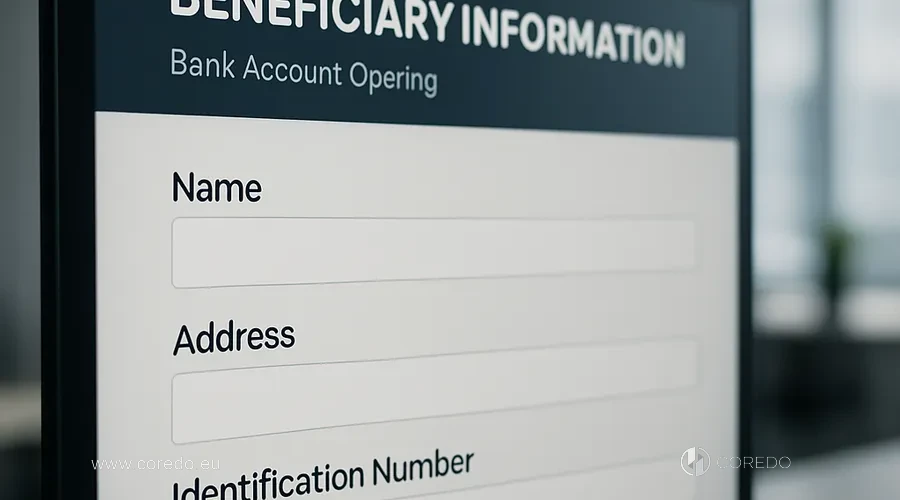
My experience shows that the standard set of information requested by banks varies in form but is the same in substance:
- personal details of the UBO: full name, date and place of birth, citizenship, tax residency, residential address;
- description of ownership share and/or control mechanism (percentages, voting rights, contractual relationships);
- PEP status and confirmation of absence/presence of political exposure;
- source of funds (the source of funds for specific transactions/company capital) and source of wealth (origin of the UBO’s wealth);
- supporting identity and address documents (passport, ID, utility bill), tax identification number;
- structure confirmations: registry extracts, shareholder agreements, trustee declarations, minutes and resolutions.
I always note an important detail: handling of personal data in these processes is governed by the GDPR and local laws. A clear information note for the beneficiary and secure channels for transmitting documents simplify interaction with the bank.
Beneficial ownership documents

The set proves three things: structure, control and economic benefit.
- Extracts from commercial registers and the beneficial ownership register (where available): disclose participants in the chain.
- Articles of association, shareholder registers, share certificates, cap table: show formal ownership.
- Shareholder agreements, options, voting agreements: confirm contractual control.
- Trust deed, letter of wishes, trustee/settlor/beneficiary statements: record the trust’s parameters.
- Board resolutions and minutes: demonstrate the appointment of directors and managers.
- Notarial certification, apostille and certified translations: increase confidence in documents, especially for Asian banks and cross-jurisdictional chains.
- eKYC and digital verification of beneficiaries: video identification, qualified signatures, ID authenticity checks.
Requests for supporting KYC documents by banks in the EU and Asia regularly include requirements for an apostille and translation. I build in time for these steps in advance so the client doesn’t lose momentum in opening the account.
Banks’ questions about the beneficiary

The bank poses questions via UBO questionnaires and letters. Typical templates include:
- who the beneficiary is and how shares/votes are distributed within the corporate group;
- who effectively controls the company when there are nominee shareholders/nominee directors;
- explain the ownership chain up to the individual, specifying intermediate companies and countries of incorporation;
- PEP screening: whether there is PEP status or close ties;
- source of funds vs source of wealth: describe the origin of capital and the funds for the transaction/deposit;
- whether there are sanctions risks, screening results and adverse media signals;
- describe the role of managers and directors, their authorities and contractual relationships.
The COREDO team builds responses using the “structure: control, economic benefit” constructor, adding links to documents. This style reduces the likelihood of follow-up requests.
Response to the bank’s inquiry about the beneficiary
I handle each situation according to a clear procedure:
- Mapping the ownership chain: I build a diagram from the company to the UBO, including SPVs and trusts.
- Classification of control: share, contractual, trust-based, via powers of attorney and authorizations.
- Gathering evidence: registers, agreements, trustee letters, resolutions, notarized confirmations.
- Preparing the UBO explanation: text with three blocks – structure, control, economic benefit.
- sanctions screening and PEP, adverse media monitoring, assessment of material risk indicators.
- Final UBO package: questionnaire, UBO declaration, sample letter to the bank, supporting documents, certified translations and apostille.
The solution developed at COREDO always takes into account correspondent banking requirements: I include additional explanations in letters if transactions will pass through sensitive corridors or have non-routine payment purposes.
Letter to the Bank Regarding Ownership Structure
It’s convenient to use the following logical structure for the letter:
- Introduction: purpose of the letter and identification of the company.
- Structure: a brief diagram in words indicating jurisdictions and ownership stakes.
- Control: description of contractual rights, trust relations, powers of directors.
- Economic benefit: who receives dividends/economic benefits, in what proportions and under what conditions.
- Source of funds/wealth: a concise justification and references to documents.
- Attachments: list of documents, certifications, translations, links to public registers.
Example wording for the introduction: “By this letter I confirm the ownership structure and control over [Company Name, registration number, country]. The ultimate beneficial owner (UBO): [Full name, date of birth, nationality], owns 60% through [SPV1, country], and also exercises contractual control over the remaining 40% under the Shareholders’ Agreement dated [date].”
Phrasing of responses to the bank
- “The UBO is identified on the basis of aggregate control and economic benefit in accordance with FATF/EU AMLD”.
- “Contractual control is confirmed by clause [X] of the Shareholders’ Agreement providing the right to appoint the majority of directors”.
- “Beneficial owner disclosure is supported by registry extracts from [country], notarized copies and apostilles dated [date]”.
- “Source of funds: income from the sale of a stake in [company], evidenced by the contract and statements; source of wealth: cumulative income from business activity for [period], evidenced by tax calculations”.
- “PEP status: none/present; attached is a PEP declaration and an explanation of risk management measures”.
Holdings, SPV and contractual control
A complex structure requires clear yet concise explanations and an impeccable evidential base. Our experience at COREDO has shown that the bank responds positively to a combination of a diagram and precise references to documents.
Wording for nominee shareholders
– «Nominee shareholder owns shares on behalf of the UBO under a trust declaration dated [date]; beneficiary, [Full name], rights are confirmed by [trust declaration/nominee agreement]».
– «Nominee director performs administrative functions; control is exercised by [Full name of UBO] through the right to approve strategic decisions on the list [A, B, C]».
Trust relationships and trusts
– «Trust deed dated [date], trustee – [name], settlor, [Full name], beneficiary: [Full name], term and conditions of benefit distribution: [description]; attached are the trustee statement and the letter confirming beneficiary status».
Responses when contractual relationships establish control
– «Control is secured by a call/put option dated [date], strike and exercise conditions – [description]; the agreement grants the right to consolidate the controlling stake upon events [triggers]».
– «A voting agreement dated [date] ensures control by [Full name] over [X%] of votes on matters [list]».
How to explain powers of attorney and authorities
– «Signing and banking powers are delegated by a power of attorney dated [date], issued by [entity], with/without the right of substitution; actual control is maintained through the right to revoke the power of attorney».
How to answer questions about a holding structure
– «The holding includes [number] companies in [countries]; control is consolidated at the [HoldCo, country] level, the ultimate UBO is [Full name]; economic benefit is distributed through dividends and management fees according to group policy».
Source of funds vs source of wealth: how
The bank clearly distinguishes these concepts. Source of funds, the source of a specific payment or capital (sale of a stake, dividends, fee, loan). Source of wealth, the origin of the UBO’s overall wealth (years of income, investments, exits, inheritance).
In my explanation I indicate:
- a brief history of the capital: supported by contracts, invoices, tax documents, statements;
- key transactions: share purchase agreements, M&A, confirmations of receipts;
- independent confirmations: audit reports, asset valuations, legal memoranda if necessary.
PEP screening and sanctions
PEP – politically exposed person or close associate. With such a status the bank will apply EDD: additional questions, requests for detailed sources of wealth, enhanced adverse-media monitoring.
I prepare precise wordings in advance:
- “PEP status has been present since [date] as [role], risks are mitigated by a transparent income structure and independent confirmations; a list of assets and tax confirmations is attached.”
- “Sanctions screening shows no matches; we conduct regular monitoring, the group’s sanctions policy is attached.”
For correspondent banking I add a statement on the compliance policy of the group companies and describe the risk-based approach procedure: criteria, material risk indicators (MRI), escalation thresholds and control of negative signals.
Beneficial ownership disclosure in the EU and Asia
In the EU, the AMLD directives and beneficial ownership registers are in force, in the United Kingdom – the Persons with Significant Control register. In Singapore the requirement to maintain an internal UBO register and to produce it on request remains; in Dubai local DIFC/ADGM regulations and federal rules on economic presence and owner disclosure apply.
I take into account differences in formalizations: in some places a public extract from the register is required, while in others a certified internal register is sufficient. In any case the bank relies on international AML standards and KYC, as well as on CRS/FATCA for tax transparency.
Legal entity registration: UBO requirements
– EU (Cyprus, Estonia, Czechia, Slovakia): registration often requires submission of UBO data to the registry, notifications upon changes, presence of a local address and directors in certain countries.
– United Kingdom: PSC disclosure, director duties to disclose information about owners, annual confirmation.
– Singapore: internal UBO registrar, local director, strict KYC for foreign beneficiaries, emphasis on source of wealth.
– Dubai (including free zones): UBO declarations upon incorporation and renewal, emphasis on substance and the reality of operations.
The COREDO team takes local regulations into account at the structure selection stage: holding, SPV, branch, and their impact on UBO disclosure and tax liabilities in cross-border operations.
COREDO cases and solutions
- Payment company for the EU. An EMI license applicant faced a bank request about beneficiaries due to a layered structure with two SPVs. COREDO’s solution: an ownership diagram, shareholders’ agreements with key control provisions, a letter in the format “structure, control: economic benefit”, apostille of the document sets. The bank approved the account without EDD.
- Crypto provider in Estonia. The client received a UBO request with clarification on source of wealth and adverse media monitoring. The COREDO team prepared a KYC package, added reports on proceeds from previously sold startups, a link to an independent valuation of the shares and a legal memorandum. Account opened, Licensing proceeded as planned.
- A holding group in Singapore and the Czech Republic. The structure was complicated by a nominee shareholder. COREDO’s practice confirmed the beneficiary’s right via a trust declaration and a voting agreement; prepared a UBO declaration and an explanation for the Asian bank with certified translations. The bank minimized additional questions.
- Investment project in Dubai. The correspondent bank requested a formalized package on sanctions risks and PEP screening. Solution: the group’s compliance policy, a description of the RBA process, adverse media reports and a list of MRI. The correspondent confirmed servicing.
KYC Packages: Explanation for Beneficiaries
I structure the process around data centralization:
- Group UBO matrix and updates when changes occur;
- questionnaire templates, sample UBO declaration, sample responses for EU/Asia banks;
- data room for documents with access control and download logging;
- notarization, apostille and translation of documents according to a pre-agreed schedule;
- online eKYC and digital verification of beneficiaries with ID authentication;
- integration with public UBO registers and adverse media services;
- KYC outsourcing and centralization of UBO data for all banks in the group.
ROI metrics for automating beneficiary verification look convincing: reduction in response times by 30–50%, fewer repeat requests, more predictable account opening timelines. Cost optimization on due diligence is especially noticeable for scalable groups with multiple banks.
Minimize the risk of account blocking
I recommend implementing training for managers on responding to banks’ inquiries about beneficiaries. Internal guides on letter-preparation techniques, document checklists, and escalation procedures reduce the risk of delays. It’s sensible to initiate a compliance escalation when:
- the structure changes and an international payment is planned;
- a PEP status appears or negative media signals arise;
- the bank requests EDD or the correspondent bank implements de-risking procedures.
Scenarios for the “structure: control, economic benefit” template cover 80% of questions. The rest are nuances of the specific jurisdiction and bank, where the COREDO team adds local arguments.
Issues in M&A, real estate, and audits
M&A deals, acquisitions of real estate and audit reviews often trigger additional UBO requests.
I include:
- analysis of ownership chains using public databases;
- confirmations of structural changes, reorganizations, changes of UBO;
- documents: extracts from registers, shareholder agreements, board resolutions, legal memoranda.
The bank looks at the adequacy of the provided evidence of ownership and the impact on solvency and the timeliness of transactions. Timely updating of UBO data increases trust and speeds up settlements.
Errors when specifying the beneficiary
The mistakes are usually the same: an incomplete ownership chain, vague wording about contractual control, lack of evidence of source of wealth, and unapproved transfers. The director has duties to disclose information about the owners and must ensure that the data is current. Non-compliance can affect access to financing and loans, cause delays in operations, and raise questions from regulators.
When beneficiaries change or during reorganizations, I first update the UBO package, notify the bank and, if necessary, prepare formalized UBO attestations and signatures. Such a proactive step reduces the risk of being blocked.
Explanatory letters: techniques and samples
An effective letter is short and precise, but relies on supporting documents. I use the technique “brief summary, link to evidence: expected outcome”.
Sample structure of a UBO declaration
- Section 1. UBO personal data: full name, date of birth, citizenship, residency, address, tax identification number.
- Section 2. Ownership/control mechanism: percentage of ownership, voting rights, contractual instruments, trust arrangements.
- Section 3. Source of wealth: a brief history of the wealth, supporting documents.
- Section 4. PEP/sanctions/screening: status, measures taken, compliance policy.
- Section 5. Signatures and date, declaration of the accuracy of the information.
Sample explanations for AML and compliance
- “Structure, control – economic benefit” with a list of attachments.
- “Payment scenario”: purpose, counterparty, geography, compliance with sanctions and compliance policy.
- “Group policy”: RBA, MRI, adverse media monitoring, frequency of UBO data review.
Responses for international payments
– “The payment is related to an investment transaction [description], beneficial owners are disclosed in the appendix, sanctions and PEP risks have been assessed, screening results show no matches; confirmations of source of funds are in the appendix [list]”.
– “The correspondent bank requested clarification of the UBO: I enclose the structure, contractual bases of control, the sanctions policy and adverse media reports; we expect confirmation of payment processing under the standard SLA”.
Automation and digital verification
Online eKYC and digital verification of beneficiaries are becoming standard.
I implement tools for the automatic collection of UBO data, integration of UBO registers with a company’s internal systems, and centralized KYC management for multi-jurisdictional groups. This speeds up UBO disclosure and reduces human errors.
A separate direction is the use of blockchain identifiers to confirm ownership of digital assets and to transparently trace transactions. Such evidence is useful for crypto providers and fintech, especially during EDD. A mathematical model of beneficiary risk assessment together with material risk indicators helps compliance teams quickly prioritize and escalate cases to lawyers.
Responses to common situations
- Wording for PEP: «PEP status recorded since [date]; sources of wealth confirmed by tax and audit documents; risk measures include independent oversight and periodic review».
- Wording for nominee and trusts: «Nominee/Trust relationships confirmed by [documents]; UBO – [Full name], control and right to economic benefit secured in sections [X/Y]; trustee confirmation attached».
- Responses for sanction risks and screening: «Screening against [lists] dated [date] with no matches; sanctions policy and audit log are attached; automated monitoring is active».
- Responses for beneficiary changes and reorganizations: «Changes effective from [date]; updated shareholders register and UBO questionnaire attached; control structure and dividend policy reviewed and recorded in board resolutions».
- How to minimize account blocking risks when disclosing UBO: «I provide the full ownership chain, certified transfers and apostilles; added explanation on source of funds/wealth and counterparty confirmations».
Minimizing disclosed information
I always strike a balance: the bank receives everything required by AML/KYC standards and internal policy, but without excessive information. The following help:
- accurate mapping of the bank’s requirements before submitting the package;
- links to public registers instead of sending unnecessary files;
- legal memoranda on narrow issues of beneficiary disclosure;
- contractual notices marked confidential and secure transmission channels.
AML requests from banks and regulators
The regular cycle is as follows:
- incoming request, registration in the tracker, assignment of a responsible person;
- collection of the UBO package: legal verification: translation and apostille;
- submission of a letter with a UBO explanation – responses to clarifications: final confirmation by the bank;
- updating internal UBO data and training the team based on the case results.
COREDO uses this cycle in support of licenses, crypto, payment services, forex and, where applicable, Banking licenses. This uniform standard reduces discrepancies across EU and Asian markets.
What to write to the bank: who the beneficiary is
Brief and to the point:
- «UBO, [Full name, date of birth, citizenship], owns/controls [X%] through [jurisdictions and companies]; control confirmed by [documents]».
- «Economic benefit belongs to [Full name] in the amount of [X%], distribution: via dividends/management fee according to group policy dated [date]».
- «Source of funds – [description], source of wealth – [description]; supporting documents attached».
Questions about beneficial owners in M&A
– “The M&A transaction will change shareholdings and voting rights as of [date]; the updated chart and UBO declaration are attached; post-transaction control mechanism, [description]; sanctions and PEP checks remain in place”.
This wording gives the bank clarity and reduces the need for follow-up requests.
Conclusions
A transparent and professional response to a bank query about the beneficiary is not about “unnecessary bureaucracy”. It’s about business speed, access to financing and the resilience of international operations.
I design the process so that every word in the letter has documentary support, and every diagram explains the structure, control and economic benefit without unnecessary details.
COREDO helps entrepreneurs and financial directors follow this path with confidence: from company registration in the EU, Singapore and Dubai to obtaining financial licenses and implementing sustainable AML/KYC practices. If you see complex bank questionnaires, UBO declarations and EDD ahead, involve a consultant at an early stage. This is the fastest way to turn compliance requirements into a manageable process that supports the growth of your business rather than slowing it down.