
COREDO – EU Legal & Compliance Services Expert legal consulting, financial licensing (EMI, PSP, CASP under MiCA), and AML/CFT compliance across the European Union. Headquartered in Prague, we provide seamless regulatory solutions in Germany, Poland, Lithuania, and all 27 EU member states.

Pavel Kos
19.03.2026 | 6 min read
Updated: 19.03.2026
I founded COREDO in 2016 to relieve entrepreneurs of anxiety around international payments and licensing requirements. Over the years the COREDO team has delivered projects in the EU, the Czech Republic, Slovakia, Estonia, the United Kingdom, Cyprus, Singapore and Dubai, helping clients register companies, obtain financial licences and implement sustainable AML processes. COREDO’s experience confirms: it is not the banks’ “strictness” itself that causes problems, but an unstructured model of payment flows, ignoring bank limits and delayed communication with compliance. In this article I will break down how to build an anti‑AML strategy, payment limit management and an infrastructure that minimises account blocks and scales turnover safely.
International Payments Risk Map
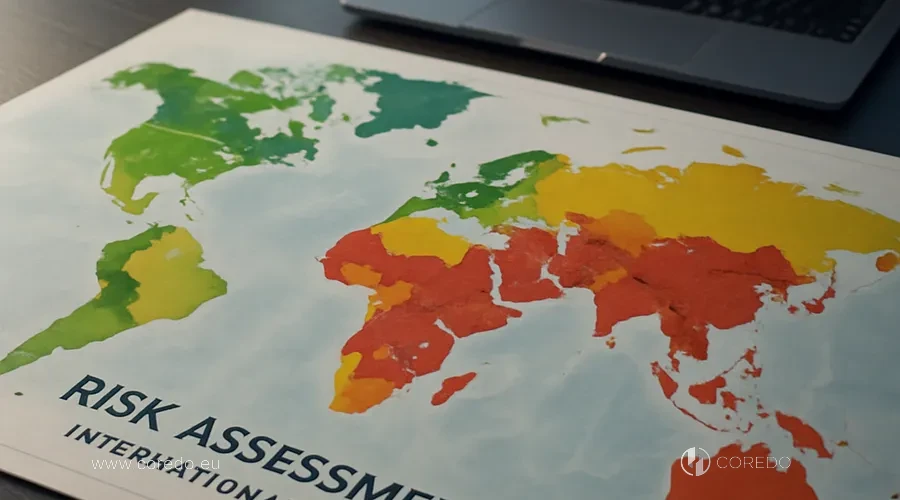
Any blocking of corporate payments does not start with a single «suspicious» transaction, but with a mismatch between the overall pattern of the business and the expectations of the bank and its correspondents. Banks reconcile the model of payment flows with the client’s risk profile, MCC limits and industry restrictions, taking into account the routing modes of payments through SWIFT and SEPA. PSD2 regulation and payment limits set a high bar for transparency, and ISO 20022 standards change the message structure, allowing compliance to detect anomalies more precisely.
In e‑commerce the situation is complicated by acquirer limits, chargeback ratio, velocity monitoring and restrictions by merchant category code (MCC). Correspondent banks add their own restrictions on correspondent accounts and international limits on outgoing/incoming payments.
Our experience at COREDO has shown: when a company designs its payment architecture from the start taking into account correspondent banking risk and the influence of PSD2 on payment routes, the number of KYC/KYB requests and SAR cases is reduced manyfold.
Payment flow modeling and limit setting

I start by building a detailed cash flow model taking into account bank limits and seasonality. Payment destination maps will be required, allocation by currencies and jurisdictions, as well as a velocity profile — frequencies and amounts. Next, a risk-based approach to limits (RBA) is applied: for each flow we define transaction limits per company, currency limits and conversions, dynamic threshold rules (dynamic thresholds) and SLAs for processing.
The algorithm for calculating payment flow limits is practical:
- segment counterparties by countries, currencies, MCC and channel (SWIFT/SEPA/acquiring);
- set base limits and nonlinear threshold rules (for example, an increase of X% no more than Y times per period);
- add modeling of transactional velocities (velocity) and allowable peak loads;
- define fallback routes and payment orchestration;
- set quotas on multi-currency correspondent accounts and allocate them via virtual IBANs.
This approach supports planning payment flows in advance and preventing bank blocks. I build reserves for blocked funds as an element of liquidity: calculating a “buffer” in turnover days in case of a temporary freeze at one of the banks. This reduces the cost of frozen funds for the business and helps withstand unexpected legal holds and freezing orders.
Anti-AML standards for business

The company’s anti‑money laundering policy is based on international principles: FATF recommendations and requirements, EU AML directives (AMLD5, AMLD6), Wolfsberg Group principles and the standards of the Basel Committee on Banking Supervision. At COREDO we translate them from “paper” into operational procedures: proper client verification (KYC), KYB (Know Your Business) procedures, beneficial owner and UBO-structure checks, PEP screening and monitoring, as well as sanctions lists (UN, OFAC, EU) with sanctions automation and filtering.
The key to trust is provable transparency. Therefore we embed requirements for transaction transparency, regulatory notifications and fines into the risk matrix, and we also implement SWIFT sanctions monitoring and sanctions scoring of counterparties. In the case of suspicious transactions it is important to know how to file a SAR/STR with the FIU and how to conduct case management for investigations. The solution developed by COREDO includes dossier templates, an audit trail and access control (segregation of duties), so any inspector can see who made the decision and when.
AML integration: fewer false positives

The reality is: rule‑based rules catch recurring scenarios, while machine learning for AML finds anomalies and previously unknown patterns. I advocate for a hybrid: rule‑based and ML detection should complement each other. We combine sanctions scoring, velocity monitoring systems, transaction anomaly analysis, and contextual features (geography, device, user behavior). To reduce false positives and optimize flags we introduce nonlinear thresholds, “hot” allowlists of permitted routes, and auto‑enrichment of data via external registries.
Technically this requires an API‑oriented payments architecture, end‑to‑end encryption of payment data, 2FA and device identification, and for remote verification: e‑KYC with video‑KYC and liveness. I insist on a centralized risk view: a compliance dashboard and risk visualization with KPI and KRI for payment security.
Such a dashboard combines monitoring of suspicious transactions (SAR), case management, RCA (root cause analysis) of blocks, and metrics of losses from blocked funds, helping managers make data‑driven decisions.
Payment infrastructure and orchestration

Payment orchestration allows evenly distributing load and navigating different limit regimes without breaking the rules. Payment orchestration platforms, routing logic and fallback routes save the day during peak periods. I build a payment orchestrator to bypass limits, taking into account international payments and bank-level limits, multi-currency correspondent accounts and virtual IBANs to spread risks.
In e-commerce the focus shifts to acquiring and acquirer limits, merchant onboarding and risk screening, as well as limit parameters for marketplaces. Here it’s important to prevent transaction laundering, control structuring (smurfing), maintain an acceptable chargeback ratio and comply with MCC restrictions. In COREDO projects we enforce transaction speed controls, geography filters and 3-D Secure rules, and also create a routing policy that dynamically selects a provider, taking into account payment liquidity and bank limits.
Liquidity and modeling of account blocks
Payment liquidity and banks’ limits work like communicating vessels. I use cash pooling to concentrate excess liquidity and pre-allocate limits for high-priority transactions.
Stress‑testing methods for payment lines and scenario modeling of blocks show how many days a business will survive if a single correspondent account is closed or if limits on correspondent accounts are reduced. These exercises are not theoretical; they reduce the real risk of downtime.
A clear playbook is needed in the event of a bank block:
- the sequence of steps for communication, document provision, route switching, and recording recovery KPIs;
- we supplement the playbook with a calculation of the cost of frozen funds to the business and the ROI from reducing blocks.
This approach supports risk pricing: the manager can see that the budget for prevention is cheaper than remediation and the accelerated restoration of access after an incident.
Document workflow for bank requests
How to prepare the document workflow for a bank so the process is fast and predictable? I suggest a checklist: contractual framework, invoices, proof of source of funds, pricing logic, description of the business model and ultimate beneficial owners, plus a compliance-check log before large transfers. Data retention and regulatory requirements dictate retention periods, and legal hold procedures protect against loss of the evidentiary base.
Separation of duties (segregation of duties), access control and audit trail build trust. Regulatory notifications and fines are not an abstraction, so I define internal company roles, response times and escalation.
When the bank sees a structured package, account freezes are replaced by targeted requests, and KYC shifts into regular updates without stress.
SWIFT SEPA ISO 20022 sanctions risks
Payment processing modes via SWIFT/SEPA require different approaches to data and validation. SEPA rules and limits assume rapid processing within the EU, but impose strict requirements on account details and the payment purpose. SWIFT combined with ISO 20022 adds fields that banks use to build transaction anomaly analysis and sanctions filtering. I incorporate sanctions monitoring, interaction with correspondent banks and correspondent bank Due Diligence as an ongoing process, not a reactive measure.
Managing correspondent risks means regular review of sanctions lists, test payments, monitoring of failures, as well as an action plan in case of account freezes. Virtual accounts and virtual IBANs help isolate risk by channels and geographies. Such control allows scaling the flow without breaching OFAC/EU/UN requirements and reduces the likelihood of a SAR from the bank.
Limits for marketplaces and e-commerce
For marketplaces, the level of dispute management, the speed of returns, and the predictability of acquirer cascades are important.
Limit management for e‑commerce includes:
- limits by MCC and customer geography;
- modeling velocity by cart and by device;
- control of structuring and transactional fraud, including fraud rings and ‘triangulation’;
- rules on chargeback ratio and the impact on limits.
The COREDO team implemented dynamic thresholds and a sandbox for testing payment scenarios before the holidays for a large retailer. This reduced false positives by 27% and allowed them to get through peak days without a decrease in authorization. After implementing a compliance dashboard, the business owner saw KRI for vulnerable routes and the ROI of measures to prevent transaction laundering in a single view.
Scaling payment flows
How to scale payment flows safely? I start with a sandbox and testing payment scenarios: country clusters, currencies, risk-scoring and fallback logic. Next, compliance checks before large transfers and pre-validation of payment details according to ISO 20022. A review of payment routes before an IPO/exit addresses investors’ and banks’ questions about the resilience of the model, and best practices for international expansion formalize the onboarding process for new providers and correspondents.
Risk pricing and the ROI from reducing payment blocks become part of the financial model. We compare the cost of investigations, lost revenue and remediation with the prevention budget. KPI and KRI for payment security are included in the quarterly report, and metrics on losses from blocks on funds help make decisions about reallocating limits and reserves.
Licensing and Legal Framework
Licensing of PSP and e‑money providers, as well as complex licences (crypto, forex, payment services) requires early consideration. In the EU and the UK, PSD2 affects payment routing and imposes requirements on SCA, access to accounts and API interfaces. In Singapore, licences under the Payment Services Act add layers of control, and in Dubai and Cyprus regulators closely review the AML framework and governance.
At COREDO we combine overseas company registration, preparation of AML policies, development of AML procedures for international branches and configuration of payment orchestration. This approach increases bank approvals when opening accounts because the company’s regulatory and operational logic align. We manage AML outsourcing and third‑party risk through due diligence and regular audits of providers, so that no external partner drags the business into sanctions‑risk areas.
COREDO case studies: recovery and scale
Case 1. An EU fintech faced a series of blocks after expanding into the Middle East. Analysis revealed bottlenecks: lack of dynamic limiting, weak sanctions scoring, and a single correspondent account for “clean” and “grey” countries from the bank’s perspective. The COREDO team implemented a payment orchestrator, virtual IBANs to distribute risk, and sanctions automation. Result – remediation and accelerated restoration of access in 12 business days, a 40% reduction in SAR incidents over a quarter.
Case 2. A global marketplace was preparing for a funding round. We conducted a comprehensive audit of the payment infrastructure and the company’s anti‑money‑laundering policy, implemented velocity control, separation of duties, and case management. Additionally, we performed correspondent bank due diligence and shifted part of the turnover to the SEPA channel with pre‑validation. Investors received a review of routes, a stress‑test of limits, and an ROI calculation from preventing account blocks.
Case 3. A crypto provider licensed in Estonia experienced freezes on fiat currency transfers. The solution developed at COREDO included integration of ML models for anomaly detection, e‑KYC with liveness, SWIFT sanctions monitoring, and creation of a playbook for bank blocks. The business restored payment continuity through alternative correspondents and clear communication with banks on SAR/STR procedures and KYB updates.
How to avoid payment blocks
- Build a cash flow model taking into account bank limits, currencies, MCCs and seasonality. Implement dynamic limit management and nonlinear threshold rules.
- Implement an anti-AML strategy: KYC/KYB, beneficial owner verification, PEP screening, sanctions lists (UN, OFAC, EU), SAR/STR procedures and case management.
- Build an API-oriented architecture: rule-based and ML detection, velocity monitoring, end-to-end encryption, 2FA and device identification, e-KYC.
- Deploy payment orchestration: routing logic, fallback routes, virtual IBANs, payment liquidity control and bank limit management.
- Prepare documentation for the bank: invoices, contracts, source of funds, model description, and a log of compliance checks before large transfers.
- Conduct stress-testing and scenario modeling of blocks. Build reserves and an action plan for account freezes, including communications and route switching.
- For e-commerce, set limiting parameters for marketplaces, monitor structuring and transaction laundering, and reduce the chargeback ratio.
- Before international expansion, use a sandbox, route review, pre-validation of ISO 20022, as well as correspondent bank due diligence.
Risk management for the executive
Banking limits are not an obstacle but the framework within which turnover grows safely. When the payments model accounts for international limits on outgoing/incoming payments, correspondent account restrictions and PSD2’s impact on routing, account blocks become a rare exception. Compliance checks before large transfers and transparent documentation relieve pressure on the bank and speed up processing.
At COREDO I require the team to have equally strong legal and operational expertise. Company registration and obtaining a license are only the beginning. Real resilience comes from a functioning anti-AML strategy, payment orchestration, anomaly monitoring and regular stress-testing. That’s why clients choose comprehensive support: from PSP and e-money licensing to SWIFT/SEPA routing and developing ML detection.
Conclusions
The international payments business beats uncertainty with discipline. A model of payment flows, risk‑oriented limits, sanctions monitoring and well‑thought‑out document workflow create a system in which preventing bank account freezes becomes the norm. I see this daily: when management adopts the strategy “planning payment flows in advance”, the budget for remediation and stoppages is released in favor of product, market and partnership development.
COREDO has grown on projects where we were expected not to give “advice” but to deliver results: licenses, open accounts, resilient payment routes and readiness for any request from a bank or regulator. If you need a partner who will combine the legal framework, AML engineering and payment architecture into a single clear model, my team is ready to take responsibility for the path – from idea to scaling without unnecessary risks.