
COREDO – EU Legal & Compliance Services Expert legal consulting, financial licensing (EMI, PSP, CASP under MiCA), and AML/CFT compliance across the European Union. Headquartered in Prague, we provide seamless regulatory solutions in Germany, Poland, Lithuania, and all 27 EU member states.

Gregory Lutsenko
31.01.2026 | 6 min read
Updated: 31.01.2026
I have been building COREDO since 2016 and have seen how international acquiring has transformed from an auxiliary function into a strategic asset. Properly structured payments drive higher conversion, reduce total cost of ownership, lower fraud risks and accelerate expansion into new markets. The COREDO team has implemented dozens of projects in the EU, the UK, Singapore, Dubai, the Czech Republic, Slovakia, Estonia and Cyprus; COREDO's experience confirms: successful international projects rely on precise legal architecture, a mature AML/KYC process and an engineering approach to payment routing.
In this article I have compiled practical strategies that we regularly implement. The text is intended as a practical map: from choosing a provider and a legal model to improving approval rate and managing chargebacks. I draw on industry standards (PSD2, SCA, EMV 3‑D Secure, PCI DSS, GDPR), as well as on the comprehensive support experience COREDO has provided to companies across industries: from subscriptions and digital to marketplaces and fintech.
Architecture of International Acquiring

First, about the foundation. International acquiring is not a single contract, but a bundle of legal, technical and financial solutions. I suggest looking at the architecture through four layers: the merchant role, the connection model, transaction economics and routing.
- Merchant role. Options are merchant of record (MoR) and an in-house merchant model. MoR takes on billing, taxes and risk, accelerating launch but increasing MDR and reducing flexibility. An in-house model gives control over pricing, settlement and data, but requires mature AML/KYC and PCI DSS compliance.
- Connection model. Comparing PSP and bank acquiring shows: PSP is faster to integrate, provides payment orchestration, smart routing and fallback providers, as well as a payment gateway in one window. Bank acquiring offers direct rates and tight underwriting ties, but will require additional integration and self-orchestration.
- Roles and scaling. PayFac (payment facilitator) speeds up onboarding of sub-merchants and suits marketplaces; an ISO aggregator builds a portfolio on relationships with acquirers. BIN sponsoring and multi-BIN strategies open the way to local schemes and increase approval rates of international payments through local-present routes.
- Transaction economics. Merchant discount rate (MDR) consists of interchange, scheme fees and the provider's margin. Interchange-plus vs blended pricing is an important choice: interchange-plus is transparent for optimization, blended is convenient at the start. Interchange optimization and managing MCC and business categorization reduce fees. MCC downgrades increase costs; I recommend keeping an up-to-date MCC profile and monitoring downgrades.
The cost of acquiring in international projects depends on on-us vs off-us logic, acquirer's locality, vertical risk, rolling reserves and settlement timing. The COREDO team deployed a model with net settlement and batch processing, and then migrated to real-time settlement for a high-turnover marketplace — we aligned authorization and finance through smart routing and settlement optimization.
PSD2, SCA, PCI DSS and GDPR: compliance
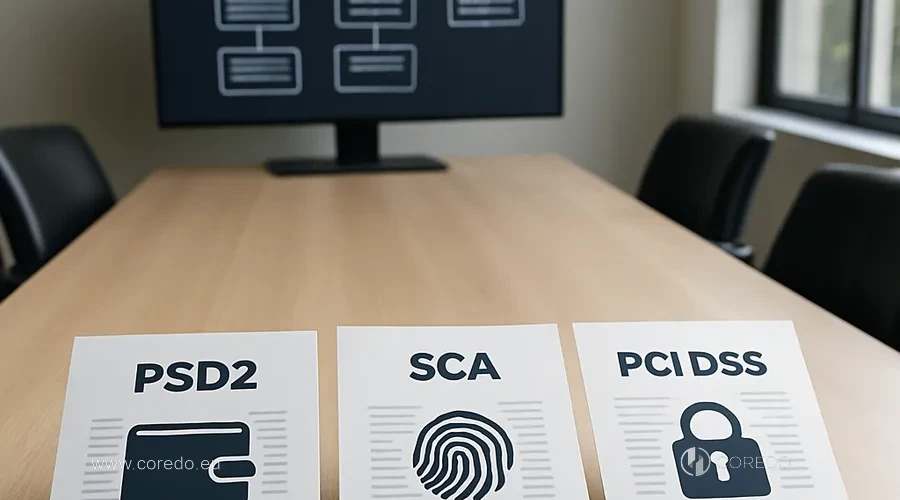
The impact of PSD2 on international acquiring is most noticeable through SCA and ecommerce exemptions. 3-D Secure 2.0 and decline reduction go hand in hand with the liability shift under EMV 3-D Secure, while a frictionless flow is more important for conversion. I apply dynamic 3DS: low-risk transactions proceed without friction, while high-risk ones require a challenge. Trusted beneficiary, transaction risk analysis (TRA), low-value, corporate and recurring exemptions, when configured correctly, provide a steady increase in the approval rate.
Compliance and regulatory requirements GDPR and PCI DSS determine data processing and the level of integration. PCI SAQ and SDK integration requirements depend on the type of checkout: gateway hosted page vs embedded checkout. A hosted page simplifies PCI obligations, while embedded requires enhanced measures (token vault, encryption, segregated environments). GDPR's impact on the processing of payment data requires justification of all data flows and transparency of consent.
AML and KYC when connecting acquiring services abroad are the point where projects most often lose momentum. Best practice for merchant onboarding for international clients includes a KYB checklist, emphasis on UBO, source of funds, turnover benchmarking, merchant risk scoring and portfolio segmentation. Sanctions screening and PEP checks during onboarding are supplemented by managed escalation on sanctions hits, and enhanced Due Diligence (EDD) for high-risk merchants structures elevated checks.
Reducing Declines and Increasing Approval Rates

I set acquiring KPIs - approval rate, decline rate, chargeback ratio - at the P&L level. Improving the approval rate of international payments begins with correctly interpreting issuer response codes. We separate soft-decline codes and retry authorization tactics from hard-decline reasons and escalation methods: the former are handled via retry logic for soft declines with a backoff strategy and soft-decline retry windows, the latter are sent to an alternative rail or we request a different payment method.
Payment routing optimization (smart routing) provides the fastest uplift. We apply:
- bin-based routing and fallback algorithms tailored to specific issuers;
- time-of-day and geo-based routing rules for regional peaks;
- split routing and fallback providers to maintain uptime;
- working with local acquirers in Asia and Europe for local presentment and to reduce cross-border frictions.
Payment orchestration platforms and their role here cannot be overstated: they speed up A/B testing of the checkout flow and measurement of lift, provide flexible decision trees and real-time decisioning. Our experience at COREDO has shown that authorization rate uplift and measurement methods via controlled experiments, plus issuer-specific logic, deliver a stable 2–4 percentage points of growth without compromising security.
DS 2.0: tokenization and security

Tokenization and payment security are the foundation of CNP. Token vault and management of stored credentials are important for subscriptions and repeat payments. Stored credential compliance and card scheme rules require an initial CIT with SCA and subsequent MITs with correct indicators. Using tokens and stored credentials for subscriptions increases conversion and reduces the risk of leaks.
3-D Secure 2.0 and reduction of declines are achieved through dynamic 3DS and frictionless flow. Liability shift protects the merchant in disputed transactions. At the same time it is important to configure SCA and exemptions for ecommerce and to consider the trusted beneficiary. Device fingerprinting and behavioral biometrics together with the device trust score set individual risk thresholds; at the same time device fingerprint persistence and privacy restrictions in the EU require a delicate implementation within the framework of GDPR.
I am not a supporter of excessive friction. Bot mitigation techniques and the CAPTCHA trade-off should be applied selectively, relying on behavioral analytics and velocity checks. The right balance reduces false declines without loss of security, and fraud rules and white/black lists for merchants speed up decision-making for legitimate customers.
Fraud, chargebacks, and dispute representment
Tools for reducing fraud risks in international payments are built on rule-based and ML approaches. Fraud scoring models: rule-based vs ML complement each other. Ensemble models combined with real-time transaction monitoring rules provide consistent filtering and speed. Velocity profile analysis and anomalous activity help catch BIN attacks and card scanning before they translate into chargebacks.
Managing chargebacks and dispute representment is a discipline with clear SLAs. I highlight:
- chargeback threshold monitoring and SLAs for incidents;
- representment process and documentation (invoices, T&Cs, proof of delivery, 3DS data, customer communications);
- representment win rate and optimization of cases by reason (fraud, not as described, processing errors);
- chargeback prevention services and third-party vendors with integration into orchestration.
Authorization hold and capture windows affect cash flow gaps and disputes. Rolling reserve and funds retention terms should be agreed taking into account the vertical and historical metrics. An incident response playbook for mass failures (incident response): isolation of the problematic provider, forced fallback, communication with issuer relations, and targeted changes to risk rules — I recommend keeping such a plan up to date.
From KPIs to cash in the account
Consolidation of reconciliations and settlement optimization save time and money. Reconciliation automation and webhook integrations close gaps between authorization, capture, refund, and chargeback. Reconciliation exceptions and matching rules are needed for non-standard scenarios, including partial refunds and multi-capture.
Settlement timing and net settlement models determine liquidity; batch processing vs real-time settlement - a choice between predictability and speed. Currency issues and FX margin in cross-border acquiring require transparency: FX markup and dynamic pricing are better fixed in the SLA; cross-border tax and VAT implications should be addressed in the legal framework. Managing reconciliation of multi-currency settlements and authorization rate uplift should be done from a single panel, to calculate ROI metrics in decline-reduction projects and to see acquirer fees breakdown and optimization opportunities.
Approval rate benchmarking by industry helps set realistic targets, while portfolio management and merchant risk segmentation show where to expect quick wins. The COREDO team developed reporting templates in which acquiring KPIs: approval rate, decline rate, chargeback ratio, representment win rate, and dispute SLAs are collected automatically. This reduces manual errors and speeds up decision-making.
Merchant acquiring for legal entities: onboarding
The best practice for merchant onboarding for international clients is speed without compromises in AML/KYC. Merchant onboarding KYC/KYB checklist includes corporate documents, beneficial owners, business model rationale, sources of funds, sanctions policy, user geography and turnover forecasts. Acquirer underwriting and turnover requirements matter up front: I recommend preparing the sales pipeline and approval rate data from pilot markets.
Sanctions screening and managed escalation on hits reduce delays. EDD for high-risk merchants structures additional requests, and merchant risk scoring and portfolio segmentation help explain internal control to the regulator and the bank. Legal entity structuring for cross-border sales sets up MoR/own-merchant roles, taxation (including VAT in the EU) and allocation of risks between legal entities.
BIN sponsoring and multi-bin strategies are useful when a local footprint is needed for specific countries. Managing MCC and business categorization is critical at the application stage: the correct MCC reduces interchange and lowers the risk of downgrades. The COREDO team structured such setups in the EU and Asia, building ISO aggregator relationships with acquirers when a direct contract was economically suboptimal at launch.
How to evaluate a provider and an architecture
How to choose a payment provider for an international project? I look at seven parameters:
- Approval rate for target BINs/markets and analysis of issuer response codes.
- Capabilities: smart routing, split routing, bin-based routing and fallback providers.
- Roles: PSP vs bank acquiring; presence of PayFac, ISO aggregator, BIN sponsoring.
- Settlement modes: batch vs real-time, net settlement, payout speed.
- Compliance: PCI DSS level, PCI SAQ options, GDPR compliance, sanctions screening.
- Acquiring costs and MDR calculation: interchange plus vs blended, acquirer fees breakdown, FX markup, rolling reserve.
- Roadmap: payment orchestration platforms, open banking and alternatives to card payments (for example, SEPA Instant in Europe).
The role of payment gateways in reducing declines lies in stable integration (ISO 8583 and modern messaging formats), advanced routing and analytics. Gateway hosted page vs embedded checkout affects UX and PCI. Assessment of the acquiring bank's reliability for international settlements includes uptime, quality of connectivity with issuers, time-to-approve changes in risk rules and support for merchant support SLA and dispute timelines.
COREDO Cases: what works
Case 1. Subscription service in the EU with stored credentials. Initial approval rate: 78%. The solution developed at COREDO included dynamic 3DS, stored credential compliance, bin-based routing and retry logic for soft declines. Authorization rate uplift was 6.2 percentage points, we kept the chargeback ratio below 0.5%, and the representment win rate rose to 72% thanks to standardized document templates and improved customer communication.
Case 2. Digital content marketplace in Asia. Problem — fraud spikes and BIN attacks. We implemented ensemble models with real-time decisioning, velocity checks, behavioral analytics, device fingerprinting and geo-based routing. The fraud-mitigation tools for international payments reduced the false positive vs false negative imbalance, the approval rate increased by 3.5 percentage points, and hard-decline reasons shifted toward alternative payment paths (including local methods and open banking).
Case 3. B2B SaaS with multi-currency billing in the UK and Singapore. Pain points — reconciliation and FX. We set up reconciliation automation and webhook integrations, consolidation, settlement optimization and matching rules for partial refunds. Currency issues and FX margin in cross-border acquiring became transparent, and we implemented a hybrid of batch processing vs real-time settlement: instant settlement for key clients and batches for the long tail. This sped up cash visibility and increased ROI in projects to reduce declines.
Launch and scaling plan
I propose a step-by-step plan of action:
- Diagnosis. Analysis of issuer response codes, segmentation by BIN/countries, benchmarking, acquiring KPIs and portfolio risk profile.
- Architecture. Selection of PSP and/or bank acquiring, payment orchestration platforms, fallback providers, BIN sponsoring. Structuring MoR/own-merchant, MCC, VAT and AML/KYC.
- Integration and security. PCI SAQ, SDK requirements, token vault, stored credential compliance, 3DS 2.0 with dynamic 3DS. Setting up real-time transaction monitoring rules, fraud rules and whitelists/blacklists.
- Routing and retries. Smart routing, bin-based routing, time-of-day/geo-based rules, split routing. Retry logic mechanics for soft decline, backoff strategies, soft decline codes and re-authorization tactics.
- UX and A/B. Personalization of the payment flow to increase conversion, UX optimizations for mobile checkout, gateway hosted page vs embedded checkout, A/B tests of payment scenarios and lift measurement.
- Operations and finance. Reconciliation automation, settlement timing and net settlement models, batch vs real-time settlement. Managing reconciliation of multi-currency settlements, FX and tax aspects.
- Fraud and disputes. Bot mitigation, device trust score, velocity profile analysis. Chargeback representment process and documentation, SLA and threshold monitoring, preventions and third-party vendors.
- Escalations and incidents. Incident response playbook for mass failures: fallback, communications with acquirers/issuers, adjustments to risk rules, post-analytics and authorization rate uplift measurements.
- Scaling. Payment facilitator (PayFac) models for scaling the portfolio, ISO aggregator and relationship with acquirers, local acquirers in Asia and Europe, open banking and SEPA Instant. Strategies for scaling acquiring as volume grows, taking into account acquirer underwriting and turnover requirements.
COREDO's practice confirms: discipline at every step yields a synergistic result. Even small improvements in routing, SCA exemptions and retry logic together produce a significant increase in conversion and MDR savings.
Private matters — handled personally
- How to reduce the risk of payment failures and lower declines in cross-border transactions? Local routing, issuer-specific rules, dynamic 3DS, correct ISO 8583 fields, SMART AVS/CVV policies and precise retry windows.
- How to reduce false declines without sacrificing security? Calibration of ML model thresholds, adding contextual signals (device fingerprinting, geolocation checks and IP-risk controls), whitelisting trusted customers and trusted beneficiaries.
- What to consider in pricing? Interchange optimization, MCC, acquirer fees breakdown, interchange-plus vs blended pricing models, FX markup, rolling reserve and conditions for holding funds.
- How to increase checkout conversion through acquiring optimization? Personalization of the payment flow, dynamic method selection (card/SEPA Instant/open banking), embedded/hosted hybrid, stored tokens and frictionless 3DS 2.0.
- How to manage incident response? Real-time monitoring of the approval rate, triggers for anomalous decline spikes, automatic fallback and notifications, communication channels with acquirers and issuers, post-mortem with analysis of issuer response codes.
COREDO checklist: international acquiring
- Legal structure: legal entity structuring, MoR vs own merchant, VAT and cross-border tax.
- Compliance: PSD2/SCA, PCI DSS/PCI SAQ, GDPR, sanctions screening, PEP, EDD.
- Integration: provider selection, PSP and bank acquiring, PayFac/ISO aggregator, BIN sponsoring.
- Economics: MDR structure and components, interchange optimization, FX and settlement timing.
- Risks: fraud scoring models, ensemble models, real-time monitoring, velocity checks, bot mitigation techniques.
- Orchestration: smart routing, bin-based/time-of-day/geo-based routing, split routing, fallback providers.
- UX: mobile-first, hosted vs embedded, stored credentials and card scheme rules, dynamic 3DS.
- Operations: reconciliation automation, webhook integrations, matching rules, settlement optimization.
- Disputes: chargeback prevention, representment documentation templates, merchant support SLA and dispute timelines.
- Metrics: acquiring KPIs, authorization rate uplift, approval rate benchmarking, ROI.
Conclusions
International acquiring is a field where strategy, law, and engineering meet in one place. The right choice of provider, a well-thought-out legal structure, strict AML/KYC, advanced routing, and proper data handling produce an effect that is immediately visible in the P&L. I see businesses in the EU, Asia, and the CIS accelerating growth when they transform payments from infrastructure into a conversion driver.
The solution developed by COREDO always begins with diagnostics and clear KPIs. The COREDO team implements international acquiring as an ecosystem: from licensing and AML consulting to payment orchestration, anti-fraud and reconciliation automation. If you are planning to launch or scale cross-border sales and want to increase the approval rate, optimize MDR and build reliable compliance - let's discuss the roadmap and design an architecture that will withstand any scale.