
COREDO – EU Legal & Compliance Services Expert legal consulting, financial licensing (EMI, PSP, CASP under MiCA), and AML/CFT compliance across the European Union. Headquartered in Prague, we provide seamless regulatory solutions in Germany, Poland, Lithuania, and all 27 EU member states.

Alena Mach
15.01.2026 | 6 min read
Updated: 15.01.2026
When founders of fintech‑projects, bank spin‑offs or corporate treasurers turn to us at COREDO, the first question today sounds like this: "Is it even possible to build a viable stablecoin model in Europe after MiCA, and how can it be done legally and profitably?"
From years of working on company registrations in the EU, the UK, Singapore and the CIS, as well as licensing crypto and payment services, I see: MiCA does not kill stablecoins, it kills weak models. Stablecoin regulation in the EU is becoming stricter, but this very fact opens a window of opportunity for those ready to build a transparent structure, reserves and compliance at the level of a financial institution.
Below is a systematic breakdown of how MiCA and related regimes are changing the market, which stablecoin models remain viable, and how we at COREDO structure such projects "turnkey": from the legal entity and license to the AML framework and tax reporting.
MiCA: EMT or ART for stablecoins
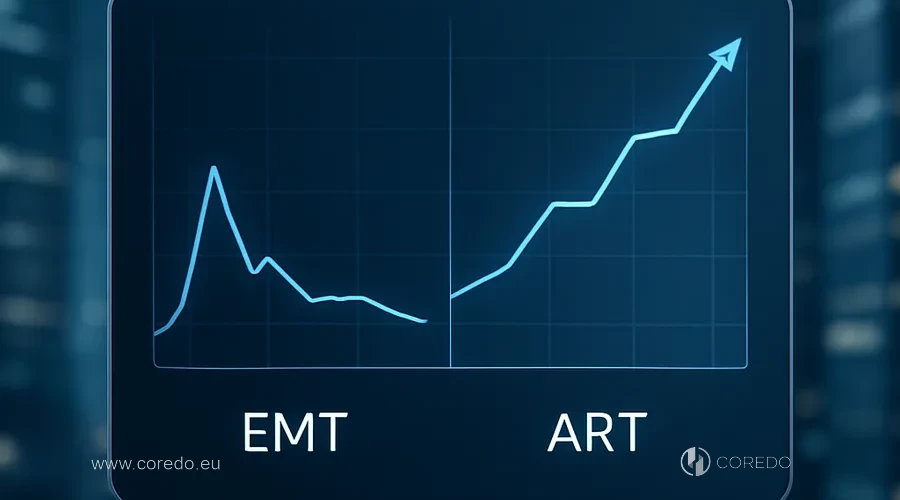
MiCA divides stablecoins into two basic classes:
- e‑money tokens (EMT): essentially tokenized electronic money, 1:1 pegged to a single fiat currency, most often the euro.
- asset‑referenced tokens (ART) - tokens pegged to a basket of currencies and/or other assets (for example, a multi-currency stablecoin or a token backed by a mix of fiat+bonds+gold).
This fork is a strategic decision, not merely a legal label. It determines:
- regulatory regime;
- reserve requirements;
- possibilities for use in payments;
- supervision (ordinary or “enhanced” for significant tokens).
In recent projects the COREDO team first modeled the financial and operational architecture of the stablecoin, and only then determined what would be more advantageous for the client: EMT for a payments focus or ART for more flexible treasury/investment logic.
When it makes more sense to use EMT
EMT is closer to classic electronic money. For business this means:
- the token is fully fiat‑backed (usually by the euro), without a multi-asset basket;
- the ability to position the product as a payment and settlement instrument rather than a speculative asset;
- strict requirements for the issuer: the status of an electronic money institution or a credit institution, full MiCA compliance and an e‑money regime.
For projects that target stablecoin use cases in payments, e‑commerce, B2B settlements and corporate treasuries, EMT most often becomes the default model.
When ART provides more flexibility
ART allow:
- issuing multi-currency tokens (for example, pegged to a basket of EUR+USD+CHF);
- including several types of assets in the reserve (cash, government securities, sometimes highly liquid commercial instruments);
- building more complex treasury and investment scenarios.
At the same time MiCA requires that the governance model, disclosure and reserve discipline correspond to the level of systemically significant financial products, especially if the stablecoin seeks the status of a significant token with enhanced EBA supervision.
MiCA and algorithmic tokens: what's prohibited
MiCA makes its priorities very clear:
- a ban on algorithmic stablecoins in the EU in their familiar market form;
- the de facto exit from the European market of partially backed models where reserves do not cover 100% of liabilities;
- a tougher stance toward schemes where price stability is maintained only by an algorithm and market mechanisms, without transparent reserves.
In practice this means:
- projects with algorithmic stablecoins either cease to be 'stablecoins' under MiCA, or take such a token outside the EU;
- exchanges and payment platforms will delist non-compliant tokens for European customers: otherwise they themselves risk being classified as CASPs;
- any model where the reserve is "something approximately liquid" without strict limits on quality and duration will not pass MiCA scrutiny.
When a fintech client came to us with the idea of a 'semi-algorithmic' stablecoin for Europe, the COREDO team's task was not to 'shoehorn' the project into the text of the regulation, but to honestly show: either you rebuild the product toward EMT/ART with full backing, or you work with segments outside the EU. This is one of those cases where reliability and long-term viability are more important than quick launches.
Stablecoin reserves under MiCA: architecture and audit

MiCA and the future supranational practice in the EU effectively enshrine the concept of high-quality reserve assets:
- cash held in accounts with reputable banks;
- short-term government bonds (HQLA);
- strict limits on duration, concentration, and credit risk.
From a business perspective the key question is not “what can be placed in the reserve”, but how to structure the reserve portfolio so that:
- obtain Licensing and regulatory supervision;
- withstand stress scenarios (withdrawal of 30–40% of assets over a short period);
- maintain acceptable project economics.
From recent cases: the solution developed by COREDO for one of the euro-stablecoin issuers included:
- legal structuring of the reserve through a separate SPV in the EU;
- segregation of reserves between bank accounts and an HQLA portfolio with strict limits;
- implementation of independent reserve audits with regular publication of reports for users and the regulator;
- documented stress-testing procedures and a liquidity plan in case of peak redemptions.
For clients this is critical for two reasons:
-
MiCA stablecoins with high-quality reserves will have a competitive advantage over 'grey-zone' tokens that European CASPs will sooner or later limit access to.
-
Large corporate users and financial institutions will look specifically at:
- the reserve structure,
- liquidity management procedures,
- independent audit.
Redemption rights under MiCA: holder rights and issuer economics

MiCA enshrines a key principle: a stablecoin holder has the right to redeem the token for fiat (or the underlying asset) at par, within a reasonable time frame and on clear terms.
In COREDO's practice this translates into a number of mandatory architectural elements:
- clear redemption procedures: who, where, in what format submits the request;
- predefined execution timeframes and fees;
- delineation of rights: retail users, professional participants, large corporate clients.
A point that many underestimate: MiCA's ban on paying interest on stablecoins breaks the familiar marketing model of a "yield-bearing token deposit".
To maintain the product's appeal, COREDO's team in real-world projects proposes alternative mechanisms:
- programmable discounts on fees;
- priority access to liquidity and limits;
- integration of the stablecoin into DeFi infrastructure (there, yield is generated at the protocol level, not in the token itself, which is important for MiCA).
CASP, MiCA and passporting in the EU
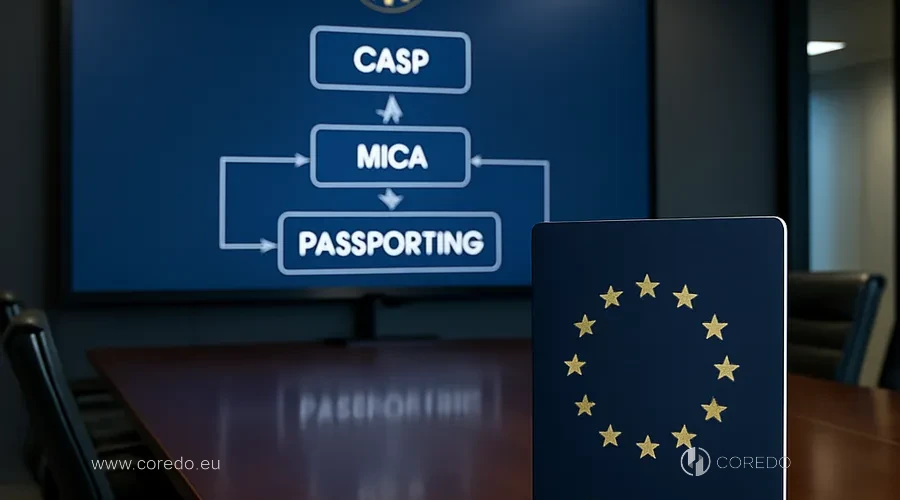
Any issuer or platform working with stablecoins in Europe encounters the concept of crypto‑asset service providers (CASP).
CASP under MiCA are:
- exchanges and brokers;
- custodians;
- payment and wallet providers;
- token issuance and placement platforms.
Key idea: by obtaining a CASP license in one EU jurisdiction, you gain passporting for services across the Union. This significantly increases the value of choosing the right country for registration and licensing.
The COREDO team in such projects typically handles several tasks:
- selecting an EU jurisdiction taking into account the required license (EMT/ART, CASP, e‑money, etc.), local regulator practice and the tax environment;
- designing a CASP compliance strategy in the EU: AML/KYC, the Travel Rule for cryptoassets, operational resilience, IT governance;
- support in preparing the white paper, internal policies, and contractual framework with users and partners.
For an entrepreneur, this means that a proper start in one EU country, with professional legal support, is extrapolated to the entire Union market — without the need to go through regulators in each country "from scratch".
AML/KYC and the Travel Rule: practical compliance
MiCA is embedded in the broader trend of tightening AML/CFT. In the EU this trend is being reinforced by:
- The Travel Rule for crypto-assets, the obligation to transmit sender and recipient data for transfers, even when they occur in stablecoins;
- a harmonized AML approach at the EU level;
- increasing attention to cross-border stablecoin compliance.
Our experience at COREDO has shown that sustainable projects build an AML framework like a bank's, even if legally they are "just" a fintech.
What this means in practice:
- KYC/EDD processes for different types of clients (retail, corporate, financial institutions);
- transaction monitoring using risk scoring and scenario analysis;
- integration with sanctions and PEP-screening providers;
- AML policies that take into account not only EU requirements but also related regimes (for example, stablecoin regulation in Singapore or Hong Kong, if the project operates globally).
In one project with an Asian fintech entering Europe with a stablecoin and a payments platform, the COREDO team built a single AML framework aligned with:
- MiCA and the European AML framework;
- the local regulator in Singapore;
- the forthcoming DAC8 requirements on the exchange of tax information for crypto-assets.
DAC8 and reporting on stablecoins
MiCA is not the only regulatory layer. On the horizon is DAC8, which introduces tax reporting for transactions in crypto-assets, including stablecoins.
For businesses and CASPs this means:
- the obligation to collect and transmit to tax authorities data on clients' transactions;
- being brought within the scope of the automatic exchange of information (AEOI) for digital assets;
- the need to set up processes and IT‑infrastructure in advance, rather than 'catching up' with the regulator at the last moment.
In real projects we are already incorporating into the platform architecture:
- segmentation of clients based on their tax residency;
- the ability to generate reports in line with DAC8 standards;
- notifications and explanations for corporate clients so that their treasuries and chief financial officers understand how stablecoin operations will be reflected in reporting.
MiCA and liquidity management
If you look at MiCA not from the issuer's perspective but from the corporate user's, the key questions are different:
- whether MiCA-compliant regulated stablecoins can be used for daily settlements with counterparties in the EU;
- how stablecoins affect liquidity management and treasury strategies;
- what to choose for international settlements: CBDC, stablecoins, or traditional bank payments.
In a large corporate case, the COREDO team assisted the treasury of a European group:
- to develop a policy for using stablecoins in cross-border settlements with counterparties in Asia;
- to identify a pool of MiCA-compliant euro stablecoins with adequate reserves and compliance;
- to integrate these instruments into cash-management systems and counterparty risk limits.
Result for the business:
- reduced cost and time of international payments;
- at the same time, MiCA compliance, the AML regime, and future DAC8 reporting.
MiCA and regulation in Singapore, Hong Kong, the UK and the US
For projects that are global from the outset, MiCA is only one of the regimes. On the horizon:
- stablecoin regulation in Singapore - a balanced regime with an emphasis on payments and enterprise solutions;
- stablecoin regulation in Hong Kong and the emerging Hong Kong stablecoin licensing regime;
- the UK's approach, where stablecoins fall within the perimeter of financial regulation but with its own specifics;
- the debate in the US around GENIUS Act stablecoins and competing bills.
In complex COREDO projects for clients from Asia and the CIS we often build a multi-jurisdictional strategy:
- EMT/ART under MiCA - for access to the EU and eurozone markets;
- a license and architecture for Singapore: for Asian payments and corporate clients;
- possible integration with Hong Kong or UK regimes as a scaling option.
Key takeaway: MiCA is becoming a reference point that other jurisdictions tend to align with one way or another, especially regarding:
- reserves and transparency;
- consumer protection;
- systemic stablecoins and oversight by central authorities.
How we structure stablecoin projects at COREDO
For a stablecoin project to have a chance at a long life under MiCA and related regimes, it must be built from the outset as a licensable financial business, not as a technical experiment.
A typical roadmap that the COREDO team builds with clients looks like this:
-
Strategic session and model selection
- EMT or ART;
- payment, trading, or corporate-treasury focus;
- target jurisdictions: EU (specific countries), United Kingdom, Singapore, Dubai, etc.
-
Legal structuring and choice of jurisdiction
- registration of a legal entity in the EU, United Kingdom, Singapore, or another relevant jurisdiction;
- analysis of whether the issuer will combine roles: e-money, CASP, payment platform;
- preparation for licensing (financial licenses, crypto licenses, e-money).
-
Reserves and liquidity management
- reserve policy: composition, HQLA limits, allocation;
- daily, weekly, and stress liquidity management procedures;
- preparation for independent reserve audits and regular reporting.
-
MiCA compliance and governance
- development of a governance framework for the stablecoin issuer: governing bodies, controls, risk committees;
- preparation of the white paper in accordance with MiCA;
- implementation of operational and IT procedures for CASP.
-
AML/KYC and Travel Rule
- development of AML policies taking into account MiCA, the EU's general AML directives, and the local law of the chosen jurisdiction;
- selection and integration of technological solutions for KYC, transaction monitoring, and the Travel Rule;
- training the client's team and regular AML updates.
-
Tax and reporting architecture (including DAC8)
- analysis of tax implications in key jurisdictions;
- designing processes to meet DAC8 and AEOI requirements for crypto assets;
- integration with corporate accounting and treasury systems.
-
Scaling and cross-border strategy
- preparation for passporting CASP services across the EU;
- assessing expansion to Singapore, Hong Kong, Dubai, or the United Kingdom;
- adapting documentation and compliance to new regimes.
What an entrepreneur and a CFO should take into account
From daily work with clients I see several practical takeaways that save months and the equivalent of hundreds of thousands:
- Design the stablecoin from the start for MiCA, even if the initial launch focuses on another region. Reworking the architecture afterwards in Europe is costly.
- Treat reserves and MiCA compliance as part of the unit economics, not just a regulatory burden: access to European platforms and large corporate clients depends on it.
- Embed AML and DAC8 readiness from the outset: many business models collapse not because of the token idea, but because of inadequate compliance and reporting.
- See MiCA as an opportunity for differentiation: regulated stablecoins with transparent reserves and a clear legal framework will outperform "grey" alternatives, especially in the B2B and enterprise segments.
At COREDO we have been supporting international business since 2016 — from company registration in the EU, Asia and the CIS to obtaining financial licenses and building AML frameworks. During this time I have seen the crypto market go through several cycles and regulators move from an experimental approach to a systemic one.
MiCA, stablecoin regulation in Singapore and Hong Kong, initiatives like the GENIUS Act in the US: this is not noise, but a new foundation for those building a long-term fintech business.
If you, as a founder, CEO or chief financial officer, view stablecoins as a tool for global payments, liquidity management or developing a fintech platform, it's important not just to "be on trend with EU crypto regulation", but to design the product from the outset as a regulated financial service.
And here, sound legal, financial and AML support stops being a "consulting expense" and becomes part of the architecture of your competitive advantage.