
COREDO – EU Legal & Compliance Services Expert legal consulting, financial licensing (EMI, PSP, CASP under MiCA), and AML/CFT compliance across the European Union. Headquartered in Prague, we provide seamless regulatory solutions in Germany, Poland, Lithuania, and all 27 EU member states.

Pavel Kos
09.12.2025 | 6 min read
Updated: 09.12.2025
When the COREDO team began actively supporting fintech clients in Switzerland, one figure surprised me: according to the Swiss Financial Market Supervisory Authority (FINMA), more than half of licensing applications are returned for revision precisely because of weak compliance procedures and poorly thought‑out risk management. Against this background, Switzerland retains its status as one of the strictest and at the same time most attractive financial centres in Europe.
Entrepreneurs and finance directors I speak with almost always pose the same dilemma: a FINMA licence provides access to major banks, institutional clients and scaling in the EU and Asia, but the path to it seems opaque, expensive and time‑consuming.
Are you ready to structure your business to withstand scrutiny by the Swiss regulator under the 2025 standards, from AML and KYC in Switzerland to requirements for the management team and IT infrastructure?
In this article I explain how, in practice, to obtain a license from FINMA in Switzerland:
- which FINMA requirements are truly "red lines";
- how to design the legal structure and capital;
- which compliance procedures FINMA expects to see in 2025;
- how to set up the process so as not to "burn" the budget and timelines.
If a Swiss licence for you is not an abstract reputational asset but a tool for growth and increasing multiples, I recommend reading the article in full: you will get a practical roadmap and a checklist that the COREDO team has repeatedly tested on real projects.
What is a FINMA licence and why is it needed?
Swiss Financial Market Supervisory Authority (FINMA): an independent regulator overseeing banks, insurers, asset managers, fintech providers and crypto companies in Switzerland. It is FINMA that issues key licences and monitors compliance with the Financial Market Supervision Act (FINMASA) and sector‑specific regulatory acts.
By "FINMA licence" people in practice mean a whole range of regimes:
- a bank licence or a securities dealer licence;
- a licence for a payments institute or electronic money institution (EMI);
- an asset manager licence;
- licenses for virtual asset service providers (VASP licence);
- authorization to operate a DLT trading facility for distributed ledger infrastructures.
For international business this is not just formal FINMA Licensing. A licence in Switzerland:
- opens doors to Swiss and European banks, large corporate clients and funds;
- facilitates scaling the business in the EU and Asia due to the high degree of trust in Swiss supervision;
- reduces regulatory risks when subsequently entering other markets (Liechtenstein, Germany, Singapore), where a Swiss background is perceived as a mark of quality.
COREDO's practice shows: companies that have obtained a FINMA licence and built mature compliance materially increase their valuation multiple ahead of fundraising rounds or M&A deals.
Key FINMA requirements for a license in Switzerland

Key FINMA requirements for obtaining a license in Switzerland cover not only financial metrics, but also how you build your business at the level of structure and governance. To obtain a license, the regulator primarily assesses the corporate and legal structure of the company, its transparency, presence in Switzerland and compliance with local legislation.
corporate structure and legal framework
First step: registration of a legal entity in Switzerland with the correct ownership and governance structure. In most cases clients choose the form of a joint-stock company (AG) or a limited liability company (GmbH) depending on the type of license and capital requirements.
Key points FINMA looks at:
- The legal structure of the company in Switzerland must be transparent: identifiable beneficiaries, absence of convoluted offshore chains, justified use of holding levels.
- A genuine management center, the board and key functions (risk, compliance, MLRO) must be actively involved in the activities of the Swiss entity, not be “nominal”.
FINMA requirements for the management team include:
- proven experience in the financial sector, risk management and compliance;
- an impeccable professional reputation, confirmed by background checks and the absence of sanctions or significant past violations;
- sufficient presence in Switzerland (often, a resident director and local key functions).
In one COREDO project a client — a fintech payment services provider — had to completely reformat the board of directors: we replaced two “decorative” directors with specialists experienced in a Swiss bank and an international payment system. This became a key factor in FINMA approving the application.
Financial requirements and capitalization
The minimum capital for a FINMA license depends on the type of activity and the scale of operations:
- for payment institutions and EMI, from several hundred thousand CHF;
- for an asset manager license: from hundreds of thousands to millions CHF;
- for banks and large brokers: significantly higher, taking into account risk buffers.
FINMA assesses not only formal compliance with the threshold but also financial resilience and capitalization:
- sufficient capital taking into account stress scenarios;
- availability of reserves for operational, market and compliance risks;
- a sustainable business model supported by a realistic financial plan.
Key requirements for financial reporting under FINMA standards:
- preparation of reports according to International Financial Reporting Standards (IFRS) or Swiss GAAP, depending on the type of license and group structure;
- annual audit by an independent auditor recognized by FINMA;
- ability to provide interim reports and reports on special requests from the regulator.
For illustration — an approximate table:
| License type | Minimum capital (CHF) | Financial reporting features | Reporting deadlines |
|---|---|---|---|
| payment license (EMI) | from 300 000 | Audit under IFRS or Swiss GAAP, emphasis on liquidity and risks | Annually, plus reports on request |
| VASP license | depends on the volume of operations | Reports focusing on virtual asset management and AML risks | At FINMA's request and annually |
| DLT trading facility | individually | Details of IT infrastructure, cyber risks and compliance | Regular audits and inspections |
In one COREDO project the client had to strengthen capitalization by 25% during the application review: FINMA, based on the updated business plan, requested additional buffers for market and operational risks.
Compliance, AML and KYC requirements
A separate section — AML and KYC in Switzerland. The regulator expects not a formal set of policies, but a genuinely functioning system:
- detailed anti-money laundering (AML) and counter-terrorist financing policies;
- clearly described Know Your Customer (KYC) procedures, including identification, verification and ongoing customer monitoring;
- a well-developed Source of Funds check and, if necessary, Source of Wealth, especially for high‑risk clients.
implementation of AML/KYC procedures for FINMA includes:
- a risk‑based approach with classification of clients and transactions by risk categories;
- use of transaction monitoring technology systems (rules‑based and/or ML solutions);
- clear separation of first, second and, if necessary, third line of defense.
FINMA compliance procedures for 2025 are built taking into account FINMASA and FINMA's current guidance:
- appointment of a responsible MLRO and compliance officer;
- regular staff training;
- a documented system of internal control and incident escalation;
- readiness to provide the regulator with a full trace of actions on AML/KYC cases.
In one crypto project the COREDO team implemented AML/KYC in the crypto business taking into account the VASP model: we integrated on‑chain analytics, three levels of transaction monitoring and strict Source of Funds checks for clients from high‑risk jurisdictions. This enabled passing a detailed AML‑Due Diligence by FINMA and partner banks.
How to obtain a FINMA license in Switzerland?

procedure for obtaining a FINMA license in Switzerland requires careful preparation of documents, a sound business model and strict adherence to regulatory requirements for finance and compliance. Below we outline the key stages of submitting and reviewing an application that every company planning to operate legally under FINMA supervision goes through.
Stages of submitting an application and its review
In practice, the procedure for obtaining a FINMA license is divided into several stages:
- Diagnosis and architecture (1–2 months)
At this step at COREDO we carry out a GAP analysis:- alignment of the business model with the licensed activity;
- readiness of corporate governance;
- maturity of compliance and IT systems.
Result, a roadmap and the structure of the document package.
- Package preparation (2–4 months)
Includes:- a detailed business plan with financial models and a description of risk management in the financial sector;
- compliance, AML/KYC, operational and IT risk management policies;
- a description of the IT infrastructure for licensing (architecture, security, backup, cyber incident plans);
- shareholder register and group structure.
- Submission of the application
At this step the formal process of preparing an application for obtaining a license FINMA in Switzerland begins:- set of FINMA forms;
- certified incorporation documents;
- information about responsible persons and the management team;
- description of processes and systems.
- FINMA application review (usually 4–6 months)
At this stage the regulator:- analyses the documents;
- sends requests for clarifications;
- may initiate an audit and on‑site FINMA inspection to verify that the declared processes correspond to reality.
- Conditional license and implementation phase (3–4 months)
Often FINMA issues a conditional license subject to a number of additional conditions: fine‑tuning IT systems, strengthening compliance, hiring additional specialists. In such cases the COREDO team guides the client through the checklist for fulfilling the conditions and communications with the regulator. - Final licensing and launch
After confirmation that all conditions have been met a full license is issued and the company begins operations at full capacity.
As a result, the time to review a FINMA application and fully implement the project typically ranges from 9–16 months, depending on the type of license, the client's readiness and the number of question rounds from the regulator.
Documents required for the application
Which documents are needed to submit an application to FINMA depends on the business model, but the basic set includes:
- incorporation and registration documents;
- detailed business plan and financial forecasts;
- internal policies on compliance, AML/KYC, risk management and IT security;
- descriptions of key business processes and the governance structure;
- dossiers on board members, the executive team and key control functions;
- contracts with key providers (outsourcing, IT, cloud, etc.).
licensing specifics DLT trading facility FINMA:
- a detailed description of the DLT architecture, consensus mechanisms, key management;
- assessment of cyber risks and an incident response plan;
- a demonstration of how the DLT platform protects investors and market integrity.
Conditions for obtaining a FINMA VASP license for companies working with virtual assets:
- clear separation of custody, exchange and other functions;
- advanced AML procedures taking into account on‑chain risks;
- demonstrable measures to protect client assets (custody model, segregated accounts, insurance).
In COREDO projects we prepare documents so that they simultaneously satisfy FINMA requirements and future bank due diligence — this significantly reduces the time to open accounts after licensing.
Features of licensing fintech and virtual assets

For fintech players, the question of how to obtain a FINMA license in Switzerland inevitably boils down to three areas: governance, IT, and risks.
FINMA requirements for fintech companies include:
- well-considered corporate governance in fintech: roles and responsibilities of the board of directors, risk and audit committees;
- a mature risk management system in the financial sector — credit, market, operational, compliance and IT risks;
- provable reliability of the IT infrastructure for licensing: redundancy, change management, cybersecurity, independent testing.
For crypto businesses and virtual asset providers:
- A FINMA VASP license requires strict segregation of client and own funds, a transparent fee structure and asset custody arrangements;
- AML/KYC implementation in crypto business must take into account anonymous and mixing services, DeFi risks and cross-border flows.
When licensing a DLT trading facility, FINMA pays particular attention to:
- market infrastructure (matching engine, clearing, settlement);
- protection against market manipulation;
- business continuity and disaster recovery.
In one of COREDO's projects for a DLT platform, we had to refine the architecture to ensure the independence of the AML-monitoring and risk-management modules from the core: this was exactly what the regulator emphasized.
FINMA Risk Management and Compliance

In practice, risk management during FINMA licensing is not a one-off exercise to obtain a license, but a transition to ongoing regulatory supervision. FINMA expects to see:
- a formalized risk appetite and limits;
- regular reports on key risk indicators;
- an independent risk management function.
Implementing transaction monitoring technologies is a mandatory element:
- systems must be able to detect anomalies and suspicious activity scenarios;
- configurable rule logic and a documented process for handling alerts are required;
- the result — a transparent history of actions for each case, available for review.
On-site FINMA audits and inspections usually include:
- checking that actual processes comply with those described in the documents;
- selective review of client files and AML case files;
- assessment of the effectiveness of internal controls.
The consequences of failing to comply with FINMA requirements are not only regulatory risks and fines. Possible outcomes include:
- restrictions on operations;
- requirements to strengthen capital;
- replacement of management or key functions;
- in extreme cases — revocation of the license.
In practice, COREDO is often engaged after FINMA's first orders to fix the control system and reduce the likelihood of escalation of enforcement actions.
How to obtain a FINMA license: timelines and ROI
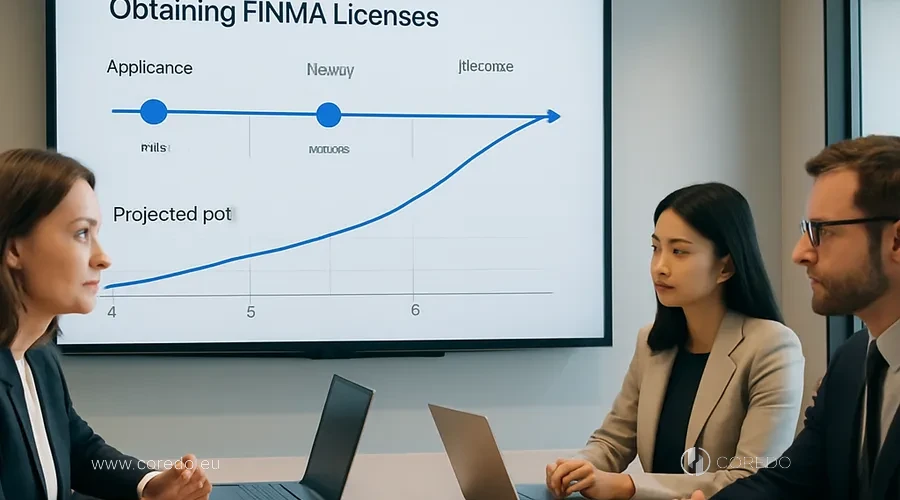
From COREDO's project experience, the timeframes for FINMA's review of fintech and VASP cases on average are:
- 2–6 months for preparation;
- 4–8 months for review and revisions;
- 3–4 months to meet conditions and launch.
In total, 9 to 16 months, if the initial strategy and team meet the regulator's expectations.
Benefits of obtaining a conditional FINMA license:
- a clear list of required revisions instead of a rejection;
- the ability to build partnerships and processes for an almost approved model;
- increased trust from investors and banks, even before full licensing.
ROI assessment for licensing financial services in Switzerland should take into account:
- revenue growth due to access to new markets and customer segments;
- lower cost of capital due to increased confidence in the regulatory jurisdiction;
- intangible effects: resilience to regulatory shocks and readiness for M&A deals.
For one of our clients, the FINMA license triggered business scaling in the EU and Asia: after being admitted to the Swiss market it became easier to open branches and gain recognition from European and Asian regulators. The company's valuation multiple more than doubled in the subsequent round.
Recommendations and conclusions for entrepreneurs and executives
In conclusion - a condensed checklist I usually discuss with founders and the CFO.
Checklist for obtaining a FINMA license
- Clearly determine the type of FINMA license and verify that the business model complies with it.
- Design the company's legal structure in Switzerland with a transparent beneficial ownership chain.
- Assess and, if necessary, recapitalize the business to meet the minimum capital required for a FINMA license, with a buffer.
- Form a management team that meets FINMA requirements regarding experience, reputation, and presence in Switzerland.
- Build comprehensive FINMA 2025 compliance procedures, including AML/KYC, risk management and internal control.
- Prepare a financial model and financial reporting according to FINMA standards (IFRS or Swiss GAAP).
How to form the management team and compliance function
- Include specialists with real experience in the banking, payments, or investment sector on the board of directors and in top management.
- Define independent compliance, risk, and, where necessary, internal audit functions.
- Ensure key roles are not combined in ways that create conflicts of interest.
How to ensure AML and KYC compliance
- Implement risk-based AML/KYC adapted to your type of activity and client geography.
- Set up source-of-funds verification and continuous transaction monitoring.
- Provide regular staff training and testing of procedures under stress scenarios.
How to minimize risks and accelerate licensing
- Start with a preliminary GAP analysis of FINMASA requirements and relevant regulations.
- Don't skimp on document quality: FINMA quickly spots templated and "dead" policies.
- Plan the project at least a year ahead, synchronizing it with growth and capital-raising plans.
COREDO's experience confirms: projects that treat licensing as part of corporate governance strategy and long-term growth reach a FINMA license more calmly, faster, and with better financial results.