
COREDO – EU Legal & Compliance Services Expert legal consulting, financial licensing (EMI, PSP, CASP under MiCA), and AML/CFT compliance across the European Union. Headquartered in Prague, we provide seamless regulatory solutions in Germany, Poland, Lithuania, and all 27 EU member states.

Nikita Veremeev
16.11.2026 | 6 min read
Updated: 16.11.2026
If you are reading this, you are probably the founder, CFO or compliance officer of an EU company fielding requests to pay in cryptocurrency, or holding reserves in bitcoin and stablecoins. The question usually is not "what is cryptocurrency", but what can legally be done with it, and who needs a CASP licence. This guide covers payments, holding, when MiCA requires a licence, AML, accounting, tax and bank onboarding. As of November 2026.
- Since 30 December 2024, Regulation (EU) 2023/1114 (MiCA) and Regulation (EU) 2023/1113 on transfers of crypto-assets have applied directly in all EU member states.
- A CASP licence requires capital of between EUR 50,000 and EUR 150,000, depending on the class of services — Art. 67 and Annex IV MiCA.
- The national transitional regime for companies that operated under the old rules before 30 December 2024 ends no later than 1 July 2026 — Art. 143(3) MiCA.
- The EUR 1,000 threshold: for a crypto-asset transfer above EUR 1,000 to a self-hosted address, the provider must additionally verify who owns or controls it — Art. 16(2) of Regulation (EU) 2023/1113.
- A Czech individual's income from selling crypto-assets is tax-exempt up to CZK 100,000 per tax period, or if the asset was held for more than 3 years — §4 of Act No. 586/1992 Coll., as amended by Act No. 32/2025 Coll.
- The standard corporate income tax rate in the Czech Republic is 21% of the tax base.
- From 10 July 2027, the general CDD threshold under Regulation (EU) 2024/1624 (AMLR) for a one-off transaction is EUR 10,000, but CASPs are subject to a specific, lower threshold of EUR 1,000 — Art. 19(1)(b) and 19(3)(a) AMLR.
What an EU company is already entitled to do with crypto-assets today

An EU company has four scenarios for crypto-assets: customer payments, holding them on the balance sheet, services to third parties (needing a CASP licence), or use only within its own group. MiCA draws the line by one formal criterion, not intent.
Regulation (EU) 2023/1114 (MiCA), Art. 3(1)(15), defines a "crypto-asset service provider" (CASP) as a person whose occupation or business is the provision of one or more crypto-asset services to clients on a professional basis; Art. 3(1)(39) clarifies that a "client" is a person to whom a CASP provides such a service. Holding crypto-assets for yourself does not make a company a CASP.
Do we need a licence just to hold bitcoin on the balance sheet? No — Art. 2(2)(a) MiCA excludes from the scope of the Regulation the provision of crypto-asset services exclusively to a parent company and its subsidiaries, and holding an asset for yourself is not a "service" under Art. 3(1)(16). A licence is needed once the company starts executing clients' orders or holding their crypto-assets.
Rule of thumb: a business paying through a licensed partner, or holding a reserve at a regulated exchange, stays that CASP's client — see "When Is a Crypto Project Without a Licence Legal". The risk appears once it offers to exchange or transfer crypto-assets to its own customers.
Accepting cryptocurrency payments: how to structure it legally

Accepting crypto payment is not "connecting a wallet" — it is four legal decisions before the first payment.
- Choose the payment model (1–2 weeks). A licensed CASP partner converts the asset into EUR (see "Crypto Acquiring: How to Set Up a Legal Flow Without Schemes"), or the company converts it itself — no MiCA licence needed, but full AML checks then fall on the company.
- Payer screening (2–4 weeks). Sanctions lists, address provenance, mixing signs; a CASP partner covers part of this, but responsibility stays with the recipient.
- Fix the contract and price (1 week). The price is set in EUR, crypto only the settlement method; the offer must state the rate and when it is fixed, or a dispute has nothing to settle.
- Set up the accounting entry (1 week). Receipt is recognised at the rate on the date received; any later value change before conversion to fiat is a separate transaction, not retroactive.
Practical tip: even through a CASP partner, get a statement fixing the conversion rate at the deal moment — the document that protects the company in a tax audit.
If a company offers customers "pay us in crypto, we'll forward it on", it becomes a crypto-transfer-service provider under Art. 3(1)(16)(j) MiCA, requiring CASP authorisation under Art. 59.
Example: a Czech B2B SaaS company (40 staff) began accepting annual-subscription payments in USDC from EU and UAE clients. A licensed Czech CASP partner accepts payment, converts it into EUR within one business day, and forwards the sum; the company never holds crypto more than a few hours and does not become a CASP. The offer fixes the EUR price, crypto only the payment method.
Holding crypto-assets: self-hosted wallet, exchange or custodian
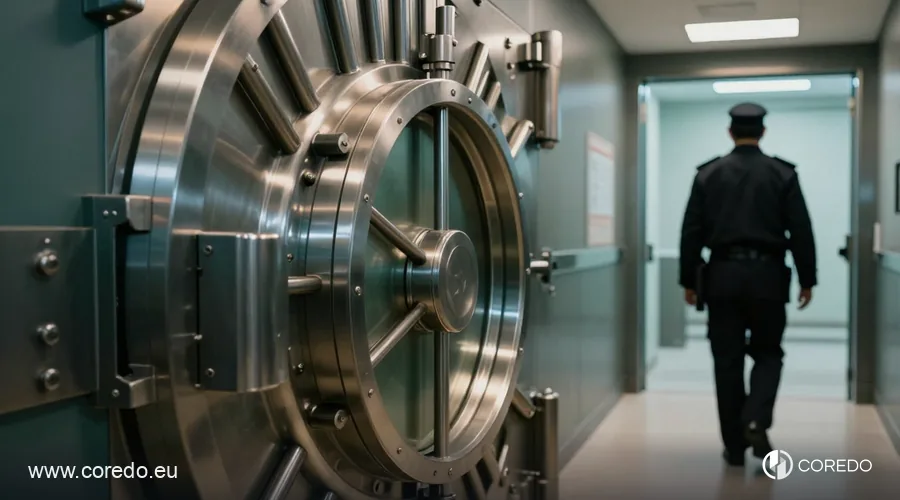
If a company holds part of its reserves in crypto-assets, it has three storage options, each distributing risk differently.
- A self-hosted wallet. Full control over the keys, but full responsibility for losing them; needs an internal key-management policy (who, how, how many signatures).
- An account at a regulated exchange or CASP. MiCA, Art. 75(7)–(9), requires a CASP to segregate clients' crypto-assets from its own property and to be liable for their loss from an incident, up to their market value at the time of loss — a protection for the CASP's client, not a safeguard provided by the state.
- A custodial service from a separate provider. A standalone custody agreement, often insured; check that the custodian is itself authorised as a CASP under Art. 59 MiCA.
- Due-diligence documents on the provider. ESMA register number, segregation policy, reserves report, insurance cover, jurisdiction, regulator and incident contacts.
Default for an operating company (not a financial business): hold crypto-assets with an authorised CASP under a clear segregation policy, not a self-hosted wallet — managing private keys needs skills ordinary businesses usually lack.
MiCA: when a CASP licence is required, and when it is not

The line between "using crypto for myself" and "providing a crypto-asset service" is defined by the list of 10 types of activity in Art. 3(1)(16) MiCA, not by turnover or asset type — see the classification in "Classification of Crypto-Assets under MiCA".
| Situation | Is a CASP licence required? | Basis |
|---|---|---|
| A company accepts crypto payment through a CASP partner | No | The company is a client of the CASP, Art. 3(1)(39) |
| A company holds crypto-assets on its balance sheet as a reserve | No | Not a service under Art. 3(1)(16) |
| A company provides crypto-asset services only within its group | No | Exclusion under Art. 2(2)(a) |
| A company holds keys or transfers crypto on clients' instructions | Yes | Custody/transfer, Art. 3(1)(16)(a),(j) |
| A company operates an exchange or trading platform | Yes | Art. 3(1)(16)(b), Class 3 capital |
Does occasionally exchanging crypto for fiat need a licence too? Yes — exchanging crypto for funds or other crypto-assets are separate services under Art. 3(1)(16)(c)–(d) MiCA; frequency is irrelevant, only that the service goes to a client. See reverse solicitation under MiCA.
If licensable, next comes choosing a CASP class and preparing capital and authorisation; class and staff requirements: "Licensing of CASPs: Capital and Personnel".
| CASP class | Minimum capital | Services covered |
|---|---|---|
| Class 1 | EUR 50,000 | Execution, placing, transfer, receipt/transmission of orders, advice, portfolio management |
| Class 2 | EUR 125,000 | Everything in Class 1, plus custody and exchange for fiat/other crypto-assets |
| Class 3 | EUR 150,000 | Everything in Class 2, plus operating a trading platform |
CASP licensing: capital, timelines, procedure

A CASP application goes to the competent authority of the country of registration; MiCA, Art. 62(2), sets a single list of more than ten blocks of information — from the programme of operations to the client-asset segregation policy. Czech process and timelines: "Crypto Licence in the Czech Republic in 2026: Process and Timelines".
- Document package (4–8 weeks). Programme of operations, articles of association, capital and its origin, internal control, ICT security and the segregation policy — Art. 62(2) MiCA.
- Good repute (2–4 weeks). Checking repute and qualification of managers and qualifying-holding holders — Art. 62(2)(g)–(h).
- Entity registration, Art. 59(2) (2 months). The place of effective management and at least one EU-resident director must already be in place before filing, not appear afterwards.
- Regulator review (3–6 months). Typical for the Czech Republic, Estonia and Lithuania once the full package is accepted.
- Passporting (no wait). Once authorised in one country, a CASP gains the right to provide services in other EU countries through the passporting mechanism under Art. 65 MiCA, without a second licence.
| Country | Document preparation | Regulator review |
|---|---|---|
| Czech Republic | 1 wk + 2–4 wks + 2 months | 3–6 months |
| Estonia | 1 wk + 2 wks + 2 months | 3–6 months |
| Lithuania | 1 wk + 2 wks + 2 months | 3–6 months |
| Slovakia | 1 wk + 2–4 wks + 2 months | 3–6 months |
| Poland | 2–4 wks + 1–2 months | 4–6 months |
The transitional regime is not an open-ended alternative, and its length depends on the country. Art. 143(3) MiCA's overall deadline is 1 July 2026, or earlier if authorisation is granted or refused sooner. The Czech Republic set a transitional period of 18 months, but only companies that filed a CASP authorisation application by 31 July 2025 could use it (ESMA's list under Art. 143(3)); anyone who missed that date has no transitional regime left — only full CASP authorisation from scratch.
Build in a 1–2 month buffer for the regulator's information requests; MiCA allows these, suspending review meanwhile.
AML obligations: KYC, the Travel Rule and reporting

A CASP is itself an AML/CFT obliged entity with full due-diligence and reporting duties; a CASP's client relies on the provider's checks, but still needs the rules, since they decide what data the company will be asked for.
Regulation (EU) 2023/1113 on transfers of crypto-assets (the Travel Rule), applicable since 30 December 2024, requires the sending CASP to accompany a transfer with information on the originator and the beneficiary — name, address or account number, and for individuals also a document number or date of birth (Art. 14(1)–(2)) — regardless of the transfer amount; no threshold exempts smaller transfers. See "Travel Rule: How to Prepare".
What is the point of the EUR 1,000 threshold? Above it, for a self-hosted address, the CASP must verify the address is genuinely owned or controlled by the originator or beneficiary — Art. 14(5) and 16(2) of Regulation (EU) 2023/1113; enhanced verification for addresses outside regulated platforms, not where the Travel Rule switches on.
A separate, lower CDD threshold applies to CASP transactions. AMLR, Art. 19(1)(b), sets the general threshold at EUR 10,000; Art. 19(3)(a) sets CASPs a threshold of EUR 1,000, with minimal identification required below that under Art. 20(1)(a). Until 10 July 2027, this threshold under national law transposing Directive (EU) 2015/849 is EUR 15,000 (Art. 11) — the new CASP regime is 15 times stricter.
| Parameter | Today (Directive (EU) 2015/849) | From 10 July 2027 (AMLR) |
|---|---|---|
| CDD threshold for an ordinary financial institution | EUR 15,000 | EUR 10,000 |
| CDD threshold specifically for a CASP | not set separately | EUR 1,000 |
| Application | through each country's national law | directly, without national law, in all EU countries |
Practical tip: if transfers above EUR 1,000 often arrive from self-hosted wallets, check in advance what address data the CASP partner will request.
Supervision is changing too: Regulation (EU) 2024/1620 on the Anti-Money Laundering Authority (AMLA) applies from 1 July 2025 (Art. 108; certain articles from 26 June 2024), gradually taking supervision from national regulators — a cross-border CASP should watch the FAÚ, ČNB and now AMLA.
Accounting for crypto-assets: practice in the Czech Republic

The Czech Accounting Act No. 563/1991 Coll. has no separate balance-sheet line for "crypto-assets" under MiCA — a company must set out in its policy how it classifies and measures them, applied consistently, not changed deal by deal.
The overlap between accounting and AML rules in the Czech Republic: "AML for Accountants in the Czech Republic".
For tax purposes, Czech law refers to the MiCA definition: a "crypto-asset" is a digital representation of a value or right that can be transferred and stored electronically using distributed ledger or similar technology; clarified by the Coordination Committee of the Chamber of Tax Advisers and the Financial Administration on 29 April 2026.
In practice, a crypto-asset is recognised at its value on the date of receipt (the EUR/CZK rate that day); any revaluation before sale needs a documented method the company can show an auditor.
Act No. 32/2025 Coll., in force since 15 February 2025, provides: an individual's income from disposing of a crypto-asset is tax-exempt if it does not exceed CZK 100,000 for the tax period, or if held over 3 years — by analogy with the securities exemption.
For a company (a legal person), this exemption does not exist — crypto-asset income enters the ordinary corporate tax base; the §4 relief in Act No. 586/1992 Coll. was written for individuals, not corporate accounting.
Taxation of crypto-asset transactions

For an EU company, crypto-asset transactions fall under two tax regimes — corporate income tax and VAT — easily confused.
A company's income from selling or exchanging crypto enters the general tax base at the standard rate — 21% in the Czech Republic; no reduced regime applies to corporate holders.
The CZK 40,000,000 limit under §4 of Act No. 586/1992 Coll. (aggregated for exempt income from securities and from holding a crypto-asset for more than 3 years) applies only to individuals; applying it to a company's own corporate income is a direct error in its tax return.
VAT is separate. In Hedqvist (C-264/14, judgment of 22 October 2015), the Court of Justice of the EU ruled that exchanging traditional currency for bitcoin and back is the supply of a service for consideration within the meaning of Art. 2(1)(c) of Directive 2006/112/EC, but that such a service is exempt from VAT under Art. 135(1)(e) of the same Directive — by analogy with currency used as legal tender.
Does this exempt every crypto transaction from VAT? No — Hedqvist concerns only exchanging crypto for fiat; selling goods where crypto is merely the payment method is taxed normally, on the goods' price in EUR.
Bank onboarding: how not to lose your account
EU banks have no duty to open accounts for any business; de-risking — refusing or closing accounts over a customer's category, not real risk — is acknowledged at regulatory level, not a myth; see where blocks occur in "Crypto Business and Correspondent Banking: Where Do Blocks Occur".
In its opinion of 5 January 2022 (Art. 16a(1) and 29(1)(a) of Regulation (EU) No 1093/2010), the EBA acknowledged that unwarranted de-risking harms the fight against financial crime, competition and financial stability, and urged regulators to engage such banks.
PSD2 (Directive (EU) 2015/2366), Art. 36, gives payment institutions the right to access bank accounts on an objective, non-discriminatory and proportionate basis — but protects payment institutions, not crypto-asset service providers; a bank can still refuse a CASP an account under its own risk policy.
- Business model — where crypto-assets come from and go, and who the counterparties are.
- AML/KYC policy — how crypto-payment counterparties are checked, even if the company is not itself a CASP.
- CASP partner authorisation — its ESMA register number, if settlement runs through a licensed partner.
- Beneficial ownership — the full UBO chain, no unexplained companies.
- Transaction history — wallet or exchange statements for the period requested.
- Source of capital — especially if acquired long before the company was registered.
Practical tip: submit the bank application with the full compliance package from the start — incomplete documents cause more refusals than crypto itself; see typical questions in "Crypto Onboarding for Corporate Clients".
Common mistakes made by EU companies
- "We're not an exchange" is read as "no licence needed". Holding others' keys or transferring crypto on a client's instructions needs a CASP under MiCA, regardless of self-description.
- The MiCA transitional regime is treated as a permanent alternative. The right to operate without authorisation under Art. 143(3) ends no later than 1 July 2026, earlier in some countries.
- The individuals' §4 relief under Act No. 586/1992 Coll. is applied to company income. It is written for individuals, not legal persons.
- The Travel Rule's EUR 1,000 figure is read as its starting threshold. Originator and beneficiary data are required on every transfer regardless of amount; EUR 1,000 is the self-hosted-address threshold only.
- A bank application is filed without a ready AML package. This lengthens onboarding and raises refusal risk.
- The conversion rate is fixed "by feel". An auditor will not accept a valuation without a documented rate source.
How COREDO helps
At COREDO, since 2016 we have supported CASP licensing under MiCA, AMLR compliance and corporate solutions for EU crypto-asset companies.
On this topic, we help determine whether a company needs a CASP licence given its business configuration, prepare and file the authorisation application in the Czech Republic and other EU countries, build an AML policy and Travel Rule procedures, and prepare the compliance package for account onboarding for crypto companies.
For accounting and tax, we provide accounting services for companies with crypto transactions under Czech rules, and for AML, outsourced AML support where there is no in-house MLRO yet, or its skills are not enough for the new volume.
What to do next
- Identify your scenario — accepting payments, holding a reserve, or services to third parties — using the criteria in Section 4.
- Check whether a CASP licence is needed under MiCA, and if so, which class and capital fit your services (Sections 4–5).
- Set your accounting policy for crypto-assets before the first transaction, not after the auditor asks.
- Prepare the bank compliance package in advance if you plan regular crypto-asset operations.
- If you need an independent readiness check, discuss your configuration with our team: licence for crypto-asset activities.
Frequently Asked Questions
Does a company need a CASP licence just to accept crypto payments?
No, if payment runs through a licensed CASP partner, or the company does not itself serve third parties: under Art. 3(1)(15) and 3(1)(39) MiCA, the licence is needed by whoever provides the service, and here the recipient is the client, not the provider.
Can an EU company hold bitcoin on its balance sheet without a CASP licence?
Yes. Holding crypto for yourself is not among the 10 services in Art. 3(1)(16) MiCA and needs no Art. 59 authorisation; a licence is only needed for services to third parties.
What is the Travel Rule, and when does the EUR 1,000 threshold apply?
Regulation (EU) 2023/1113 requires originator and beneficiary data for every transfer regardless of amount; EUR 1,000 is only the threshold for extra verification of a self-hosted address under Art. 14(5) and 16(2).
Is exchanging crypto for euros subject to VAT?
No — under the CJEU's Hedqvist ruling (C-264/14), such exchange is VAT-exempt under Art. 135(1)(e) of Directive 2006/112/EC; paying for goods with crypto is a separate, taxable transaction on the goods' price.
How long does a CASP licence take in the Czech Republic?
In COREDO's practice: about 1 week for initial preparation, 2–4 weeks for documents and repute checks, 2 months for registration, then 3–6 months for regulator review.
Does a company pay tax when selling cryptocurrency in the Czech Republic?
The §4 exemption in Act No. 586/1992 Coll. (CZK 100,000 a year, or holding over 3 years) is only for individuals; a legal person's crypto-sale income enters the corporate tax base at 21%.
Why do banks refuse accounts to crypto companies?
Banks have no duty to open accounts for any customer; the EBA's 5 January 2022 opinion acknowledged unwarranted de-risking at EU level, and PSD2 (Art. 36) protects account access only for payment institutions, not crypto providers.
Sources
- Regulation (EU) 2023/1114 (MiCA) — definitions, exclusions, CASP authorisation requirements, capital by class, the transitional period.
- Regulation (EU) 2023/1113 (Travel Rule) — originator/beneficiary information, the EUR 1,000 threshold for self-hosted addresses, the date of application.
- Regulation (EU) 2024/1624 (AMLR) — the EUR 10,000 CDD threshold from 10 July 2027.
- Directive (EU) 2015/849 (current AMLD, consolidated text) — the current EUR 15,000 CDD threshold, Art. 11.
- Directive (EU) 2015/2366 (PSD2) — Art. 36, payment institutions' access to bank accounts.
- EBA, opinion on de-risking (5 January 2022) — acknowledgement of the problem of unwarranted refusal of banking services.
- Finanční správa ČR / Chamber of Tax Advisers, Coordination Committee 04/26 (29 April 2026) — the exemption of individuals' income from selling crypto-assets, §4 of Act No. 586/1992 Coll.
- Ministry of Finance of the Czech Republic, Info No. 106/99-MF-903/2024-74 (22 January 2025) — introduction of the holding-period and price tests for crypto-assets under Act No. 32/2025 Coll.
- Public Administration Portal of the Czech Republic — corporate income tax rate — standard rate of 21%.
- European Commission, VAT Committee Working paper No 892 on CJEU C-264/14 Hedqvist — the VAT exemption for exchanging cryptocurrency for fiat.
- ESMA, List of grandfathering periods under Article 143(3) MiCA — the Czech transitional period (18 months) and the application deadline of 31 July 2025.
- Regulation (EU) 2024/1620 (AMLA) — Art. 108, the date of application of the Regulation and the establishment of the AML Authority.