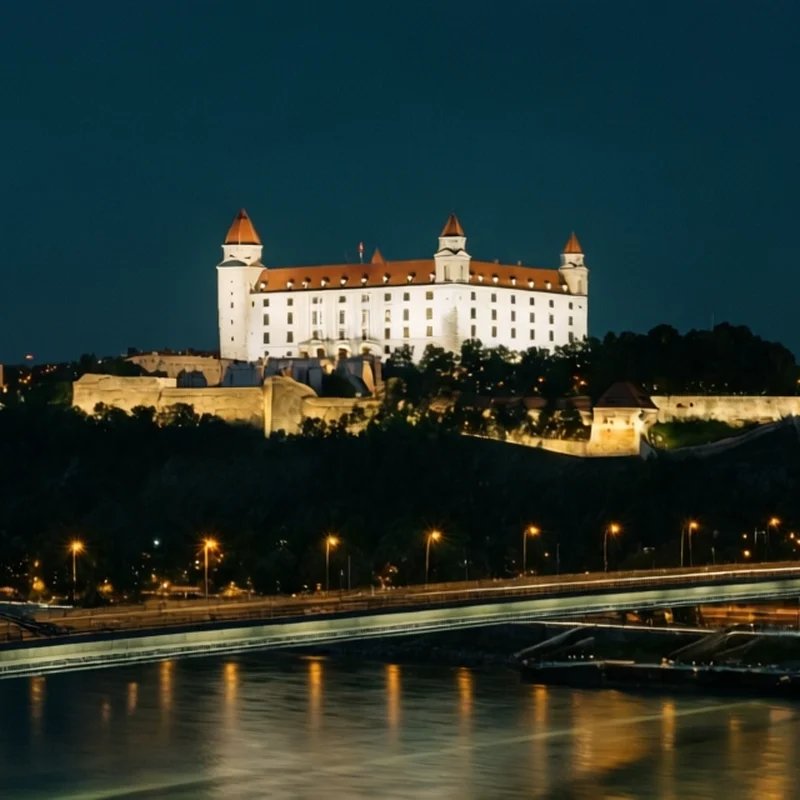
Company Formation in Slovakia

Why Register a Company in Slovakia

Slovakia is a stable jurisdiction in the heart of Europe with access to the EU market and the eurozone, a favourable business environment, and developed infrastructure.

The country offers foreign investors transparent regulation, the possibility of 100% foreign ownership, and a strategic location between the markets of Central and Eastern Europe. Slovakia attracts international business with competitive conditions for manufacturing, technology, and logistics.

Get a Consultation

Cost of the service
EUR 2,200

Types of Companies in Slovakia

Foreign entrepreneurs can register a company in Slovakia in one of the following legal forms.

S.R.O. (Spoločnosť s ručením obmedzeným)

limited liability company. The most popular form of doing business in Slovakia. Formation requires a minimum of one founder (natural or legal person), with a maximum of 50 participants. The minimum share capital is EUR 5,000, with the minimum contribution per participant being EUR 750. Before filing the registration application, at least 30% of each monetary contribution must be paid up, but the total amount of monetary and non-monetary contributions must be no less than EUR 2,500. If the s.r.o. is established by a single participant, the share capital must be paid in full before registration.

A.S. (Akciová spoločnosť)

joint-stock company. Suitable for large-scale projects and companies planning to raise investment through share issuance. The minimum share capital is EUR 25,000. Founders may include at least two natural persons or one legal person; the number of shareholders is unlimited. A joint-stock company is required to establish a supervisory board and a board of directors, ensuring the separation of management and oversight functions.

Partnership

Slovak legislation provides for the establishment of a general partnership (verejná obchodná spoločnosť, v.o.s.) or a limited partnership (komanditná spoločnosť, k.s.). Registration of a partnership requires a minimum of two partners.

Branch of a foreign company (organizačná zložka)

Companies operating in other jurisdictions can open a branch in Slovakia. A branch is not a separate legal entity and acts on behalf of the parent organisation. A head of the branch must be appointed; a citizen of an EU or OECD member state needs no Slovak residence permit for this.

Registration Procedure

Company registration in Slovakia is carried out in accordance with the Commercial Code (Obchodný zákonník, Zákon č. 513/1991 Zb., as amended). Since 17 August 2026, entries have been governed by the new Commercial Register Act (Zákon č. 29/2026 Z. z.). The process includes the following steps:

Power of attorney and company name

For remote registration, COREDO prepares and sends the powers of attorney, which are signed with notarial certification and apostille; the client suggests three possible company names.

01

Memorandum and articles

The memorandum of association and the company’s articles of association are prepared and notarially certified; the powers of attorney and certificates of non-conviction are translated.

02

Share capital

The share capital — at least EUR 5,000 — is contributed.

03

Trade licence

The trade licence (živnostenské oprávnenie) is obtained from the District Office (Okresný úrad).

04

Commercial Register

The documents are filed with the Commercial Register (Obchodný register) — at the registry court or with a notary acting as registrar — for company registration; COREDO communicates with the notary and the court.

05

Tax registration

Since 1 January 2023, the tax administrator has itself registered companies entered in the Commercial Register for income tax — within 30 days of receiving the register data (Financial Administration of the Slovak Republic, financnasprava.sk).

06

The application for registration is filed electronically — with the registry court or with a notary acting as registrar; only documents that cannot be filed electronically are submitted on paper.

Required Documents

The following documents are required for registration:

  • memorandum of association and articles of association (notarially certified);
  • identity documents of the founders and directors;
  • proof of a registered office in Slovakia (lease agreement or property owner’s consent);
  • resolution on the appointment of a director;
  • confirmation that the share capital contributions have been paid;
  • the tax administrator’s consent, if a founder is on the list of tax debtors.

The company director must provide a criminal record clearance certificate.

All documents in foreign languages must be translated into Slovak by a certified court translator. For documents issued outside the EU, an apostille or consular legalisation may be required.

Capital Requirements

Company type Min. share capital Details
S.R.O. (LLC) EUR 5,000 Min. contribution EUR 750; before registration — 30% of each contribution, total ≥EUR 2,500
A.S. (JSC) EUR 25,000 Suitable for large-scale investment projects
V.O.S. (general partnership) Not established Minimum 2 partners
Branch Not required Not a separate legal entity

Tax System in Slovakia

Slovakia offers a differentiated corporate income tax (CIT) system. Since 2025, the CIT rate is 10% for companies with taxable revenue up to EUR 100,000, and 21% for taxable revenue above EUR 100,000 and up to EUR 5,000,000. Since 2025, a rate of 24% also applies to companies with taxable revenue exceeding EUR 5,000,000.

The standard value-added tax (VAT) rate since 1 January 2025 is 23%, with reduced rates of 19% and 5% for certain categories of goods and services.

Dividends paid to legal entities out of profits generated since 2004 are not subject to Slovak income tax. Exceptions include a 35% withholding tax on dividends from profits since 2017 paid to residents of non-cooperative jurisdictions or where the beneficial owner cannot be evidenced. Slovakia also participates in more than 70 double taxation avoidance treaties, creating favourable conditions for international business structuring.

Opening a Bank Account

In practice, a company needs a payment account for its business transactions. Slovak law generally prohibits cash payments above EUR 5,000 (Act No. 394/2012 Z.z.). Under the financial transaction tax (Act No. 279/2024 Z.z.), a company using a payment service provider based outside Slovakia calculates and pays the tax itself. The Slovak banking system is well developed. To open a corporate account, an extract from the Commercial Register, the company’s founding documents, and documents of directors and beneficial owners are required.

Since Slovakia is a member of the eurozone, euro settlements with partners from other eurozone countries carry no currency risk. Banks conduct due diligence (KYC/AML) when opening an account, which may require additional documents regarding the ownership structure and sources of funds.

Compliance and AML Requirements

As a member of the European Union, Slovakia applies European standards in the area of anti-money laundering and counter-terrorist financing (AML/CFT). Companies are required to comply with the requirements for identifying beneficial owners, maintaining records of client transactions, and reporting suspicious transactions. Companies record data on their ultimate beneficial owners in the Commercial Register; this data does not appear in the public extract. Companies that do business with the public sector register instead in the publicly accessible Register of Public Sector Partners (Register partnerov verejného sektora). With the entry into force of the new EU AML Regulation (AMLR, Regulation (EU) 2024/1624), applicable from 10 July 2027, compliance requirements will be further tightened. The financial market regulator in Slovakia is the National Bank of Slovakia (Národná banka Slovenska, NBS).

Registration Timelines

If the application is complete and all conditions for registration are met, the registry court registers the company within two working days of receiving it. A notary acting as registrar has the same deadline, counted from receipt of the application or from the end of a period set for remedying defects. For serious operational reasons, the deadline may be extended by up to ten days. The overall period, including document collection, obtaining a trade licence (živnostenské oprávnenie), and notarial certification, is approximately one month. For remote registration, timelines may be extended depending on the time required for document dispatch and legalisation.

COREDO Service Fees

Service Fee
Company formation in Slovakia (full package) EUR 2,200 + VAT

The package includes: preparation and filing of founding documents, registration with the Commercial Register, registered office (Sídlo) for 1 year, and payment of state fees. The price of the package may vary depending on the specific case. The minimum share capital for an s.r.o. is EUR 5,000. For an individual cost estimate, contact our specialists — we will prepare a detailed commercial proposal tailored to your specific situation.

Our Experts

The COREDO team has been working since 2016 and possesses deep expertise in company formation across various European jurisdictions.


Nikita Veremeev
Nikita Veremeev
Founder & NED. Founded COREDO in November 2016 and personally oversees the strategic development of business across dozens of jurisdictions.
Pavel Kos
Pavel Kos
Head of Legal. Has been with COREDO since June 2017, responsible for legal support of corporate projects and company registration in European jurisdictions.
Alena Mach
Alena Mach
Executive Director
Daniil Saprykin
Daniil Saprykin
Head of Customer Success
Annet Abdurzakova
Annet Abdurzakova
Senior Customer Success Manager

Frequently Asked Questions

Can a foreign citizen register a company in Slovakia?

Yes, Slovakia permits 100% foreign ownership of companies. Foreign citizens may act as founders and directors, but a director who is not a citizen of an EU or OECD member state needs a Slovak residence permit.

What is the minimum share capital for an s.r.o. in Slovakia?

The minimum share capital for an s.r.o. is EUR 5,000, with the minimum contribution per participant being EUR 750. If the company is established by a single participant, the capital must be paid in full before registration.

What are the corporate tax rates in Slovakia?

Since 2025: 10% for companies with taxable revenue up to EUR 100,000 and 21% for taxable revenue above EUR 100,000 and up to EUR 5,000,000. Large companies with taxable revenue exceeding EUR 5,000,000 pay 24%.

How long does company registration take?

By law, the registry court or a notary acting as registrar registers the company within two working days once a complete application meets the conditions. Serious operational reasons can extend this by up to ten days. The overall period, including document collection, is approximately one month.

Is the founder's presence in Slovakia required for registration?

No, company registration in Slovakia is possible remotely. Founders may act through an authorised representative on the basis of a notarially certified power of attorney with apostille. All documents must be translated into Slovak by a certified translator.

What is the VAT rate in Slovakia?

Since 1 January 2025, the standard VAT rate in Slovakia is 23%. The reduced 5% rate applies, among other things, to basic foodstuffs, medicines, printed books and accommodation services. The 19% rate applies to certain items of Annexes 7 and 7a to the VAT Act, for example electricity.

Request a Consultation

COREDO specialists provide full support for the company registration process in Slovakia — from document preparation and obtaining a trade licence to registration with the Commercial Register and the tax administration. We have been working since 2016, helping entrepreneurs from dozens of countries successfully build business structures in Europe.


    By contacting us you agree to your details being used for the purposes of processing your application in accordance with our Privacy policy.

    COREDO – EU Legal & Compliance Services Expert legal consulting, financial licensing (EMI, PSP, CASP under MiCA), and AML/CFT compliance across the European Union. Headquartered in Prague, we provide seamless regulatory solutions in Germany, Poland, Lithuania, and all 27 EU member states.