
COREDO – EU Legal & Compliance Services Expert legal consulting, financial licensing (EMI, PSP, CASP under MiCA), and AML/CFT compliance across the European Union. Headquartered in Prague, we provide seamless regulatory solutions in Germany, Poland, Lithuania, and all 27 EU member states.

Gregory Lutsenko
23.11.2026 | 6 min read
Updated: 23.11.2026
Searching for “a company in Ireland” or comparing Ireland with Hong Kong and the BVI? The question is usually the same: what registration takes, costs and requires. This is a step-by-step guide for a founder, CFO or compliance manager running an EU-facing business: company form, the EEA-resident director rule, tax, reporting and common mistakes. As of November 2026. For the service itself, see turnkey company registration.
- Corporate tax in Ireland is 12.5% on trading profits and 25% on passive income and certain excepted activities (Revenue).
- For groups with global turnover of €750 million or more, a minimum effective rate of 15% has applied since 31 December 2023 under the Pillar Two rules.
- Online registration via the CRO (Form A1 on CORE) carries a €50 fee and takes around 10 working days, per the CRO’s own target.
- If no director is an EEA resident, section 137 of the Companies Act 2014 requires a €25,000 security bond or a Registrar’s certificate under section 140.
- Beneficial ownership details must be filed with the Register of Beneficial Ownership (RBO) within 5 months of incorporation.
- The mandatory VAT registration threshold is €85,000 for goods and €42,500 for services.
- The first Annual Return is filed 6 months after incorporation, and annually thereafter.
Why foreign founders choose Ireland for a company
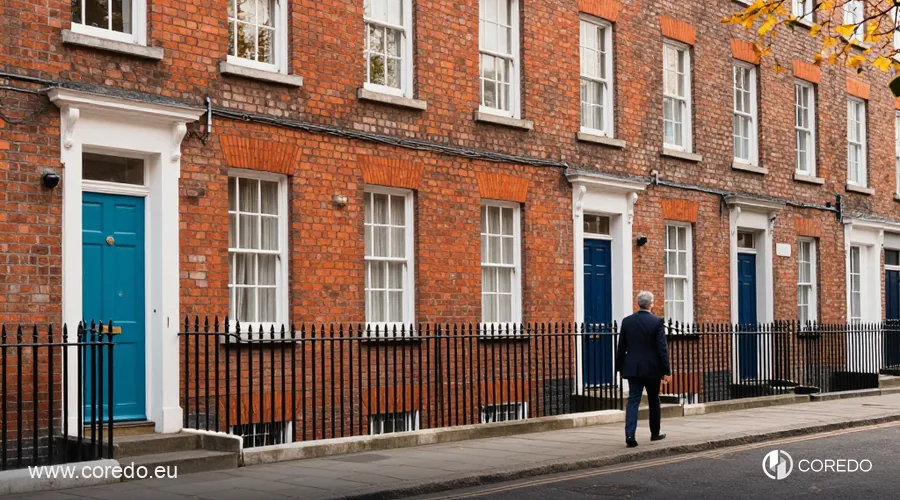
Ireland has been an EU member since 1973 and is the eurozone’s only English-speaking country since the UK left the EU. For a company, that means EU single-market access without separate registration per member state, English-language common-law courts, and a reputation for developed banking and audit infrastructure.
Corporate tax on trading profits is 12.5%. The rate has applied since 2003 and remains one of the lowest in the EU among countries with a full double-taxation treaty network, rather than offshore status.
For fintech, SaaS and trading companies serving EU and US clients, three things matter: a predictable tax rate, EU status, and an account with a eurozone bank or EMI without extra explanations. Ireland offers all three; the BVI or Hong Kong offer only some.
A practical note: with no clients or deals in Ireland itself, the company is usually chosen for EU bank access and the 12.5% rate, not the local market — then the resident-director and substance rules in sections 4 and 7 become critical.
LTD, DAC or PLC: how to choose the legal form

The Companies Act 2014 sets out several company forms, but in practice the choice is almost always between three of them.
Which form should you choose if there is no specific investor requirement? Nine times out of ten, the private company limited by shares (LTD): according to a 2015 estimate by the Department of Enterprise, this form accounted for around 90% of all companies registered.
An LTD has no objects clause: section 38 of the Companies Act 2014 gives it full capacity for any lawful activity. It is the only form that can run with one director — a DAC, PLC, CLG (no share capital) and unlimited company all need at least two.
| Form | Min. directors | Objects clause | Min. capital | When chosen |
|---|---|---|---|---|
| LTD | 1 | No (Companies Act 2014, s. 38) | 1 share per subscriber | Ordinary trading or holding business |
| DAC | 2 | Yes | 1 share per subscriber | Investor/bank requirement to fix the activity |
| PLC | 2 | Yes | €25,000 | Public capital raising, listing |
With no reason to fix an objects clause or need a second director, an LTD is almost always simpler and cheaper than a DAC or PLC. The Companies Act 2014 sets a minimum capital only for a PLC — €25,000; an LTD or DAC needs just one share per subscriber.
Step-by-step company registration with the CRO

Registration runs through the Companies Registration Office (CRO) and its CORE filing system. The sequence barely changes between companies — only the document-gathering time does.
- Checking and reserving the name (1 day). An Irish LTD’s name ends in “Limited” or “Teoranta” (section 26, Companies Act 2014); “Limited” is protected under section 27 and reserved for that form. Reserving it through CORE costs a €25 fee, held for 28 days.
- Appointing directors and a secretary (1–2 days). At least one director and a separate secretary are required; if no director is an EEA resident, a €25,000 security bond is needed under section 137.
- Preparing the constitution and the address (2–5 days). The company’s constitution and a physical Irish registered address (section 50, Companies Act 2014); per CRO guidance, a P.O. box does not qualify.
- Filing Form A1 on CORE (1 day). The filing fee for the constitutional documents is €50; if the name was reserved and filed within 28 days, €25 is deducted.
- CRO review and issue of the certificate (CRO target — around 10 working days). Filings are processed in order received; corrections re-enter the queue on resubmission.
- Initial registrations after the certificate issues (in the first weeks). Registering beneficial owners with the RBO (within 5 months), registering for Corporation Tax, and, where relevant, employer and VAT registration.
Example: a Lithuanian payment company sets up an Irish subsidiary to serve EU clients. It picks the LTD form, with a Lithuania-resident director and an Ireland-resident secretary, to avoid buying a bond. The name is reserved at the outset, Form A1 is filed on day 12 (within the 28-day window), and the certificate issues 9 working days later. The EU account opens 3 weeks after the certificate, once the separately requested RBO filing is done.
There is no statutory minimum: 10 working days is a CRO target, not a deadline fixed by the Companies Act 2014, and it does not apply automatically to filings made with errors or an incomplete document package.
Director, secretary and the EEA-resident requirement

Section 137 of the Companies Act 2014 requires at least one acting director to be resident in an EEA state. This is not a formality: non-compliance is a category 4 offence under section 137(6).
A category 4 offence under section 871(4) of the Companies Act 2014 carries a class A fine on summary conviction. A class A fine under section 3 of the Fines Act 2010 is up to €5,000.
Without an EEA-resident director, a company has two options: a €25,000 security bond under section 137(2), covering Companies Act and certain Taxes Consolidation Act 1997 fines if unpaid; or a Registrar’s certificate under section 140 of the Companies Act 2014, confirming a real economic link with Ireland — used less often than the bond.
Can you do without an EEA resident altogether? Yes, via the bond or a section 140 certificate — but the company still needs a separate secretary, and with a single director, that secretary must be a different person or entity.
- A passport and proof of address for each director and secretary.
- Each director’s written consent to act.
- Beneficial ownership details for the subsequent RBO filing.
- The bond document (if there is no EEA-resident director), with the form prescribed by the Companies Act 2014 (Bonding) Order 2015 attached.
A related risk: a structure where all the directors are non-residents formally holding a bond but not actually managing the company — banks weigh this when assessing it, and we examined these risks in our article on non-resident directors and substance risk.
Registered address and documents for registration

The registered office is a physical Irish address for official correspondence (section 50, Companies Act 2014); a P.O. box does not qualify, per CRO guidance. Separately, section 18 of the Act requires that, at registration, it appear to the Registrar that the company will carry on an activity in Ireland — checked once, on filing Form A1, not an ongoing duty.
Without an office of its own in Ireland, the company usually leases its registered address from a corporate services provider along with the secretary service — this does not breach the Act’s address requirement, provided post is actually received and handled there.
The minimum document package for filing through CORE:
- The company’s constitution — without an objects clause for an LTD, with one for a DAC/PLC.
- Form A1, with details of the directors, secretary, shareholders and address.
- Confirmation of the directors’ residence, or the bond document under section 137.
- Beneficial ownership details, for the subsequent RBO filing within 5 months.
- Evidence that each subscriber has paid for at least one share (for a PLC, shares worth at least €25,000).
Bank account and the first operational steps

A company account opens after the certificate of incorporation, not before: the bank or EMI checks the company, its directors and beneficial owners, and requests the certificate, the constitution and identity documents. We covered preparing such a package and typical refusal reasons separately — see our article on how to open a bank account in a foreign bank for an international company.
A bank or EMI can access a company’s RBO record but need not rely on it alone — so the company separately confirms beneficial ownership data on request. Filing with the RBO before approaching the bank avoids mismatched data.
The account need not be Irish: payments to Revenue and partners are accepted via IBAN and, where applicable, BIC — within SEPA, Article 9 of Regulation (EU) No 260/2012 bars a payer from specifying the EU country of the payee’s account if it is SEPA-reachable.
Taxation of an Irish company: rates and thresholds

The base corporate tax rate is 12.5% on trading profits. Passive income (interest, rents, royalties, and dividends from non-resident companies with no relief) and certain excepted activities are taxed at 25%. VAT applies separately: Ireland’s standard rate is 23%.
Since 31 December 2023, groups with consolidated turnover of €750 million or more in two of the previous four financial years fall under the Pillar Two rule: a 15% minimum effective rate via the Qualifying Domestic Top-up Tax under Part 4A of the Taxes Consolidation Act 1997, inserted by the Finance (No. 2) Act 2023. Revenue estimates around 1,600 multinational groups are in scope; over 99% of Irish companies stay outside it, paying 12.5%.
| Tax/charge | Rate or amount | Basis |
|---|---|---|
| Corporate tax, trading profits | 12.5% | Revenue; in force since 2003 |
| Corporate tax, passive income | 25% | Revenue; Taxes Consolidation Act 1997 |
| Pillar Two minimum effective rate | 15% (groups ≥ €750m) | Part 4A TCA 1997, Finance (No. 2) Act 2023 |
| VAT, standard rate | 23% | Revenue |
| VAT registration threshold, goods | €85,000 | Revenue, since 1 January 2025 |
| VAT registration threshold, services | €42,500 | Revenue, since 1 January 2025 |
VAT registration becomes mandatory once the relevant threshold is exceeded; the Revenue application is due within 30 days of the triggering transaction. Many new companies register voluntarily, earlier than required, to reclaim VAT on start-up costs.
Can a company keep the 12.5% rate as turnover grows? Yes, until consolidated turnover hits €750 million in two of the previous four years — then only a top-up to an effective 15% applies under Pillar Two, not a blanket 15% rate.
Funds and fund managers in Ireland use a separate tax regime — the ICAV — with its own exemption logic, unrelated to the 12.5%/25% rates for an ordinary trading company; see our article on tax incentives for funds in Ireland and the ICAV regime.
Post-registration reporting: CRO, Revenue, RBO

A newly registered company immediately takes on several obligations, with different deadlines and recipients.
- Register of Beneficial Ownership (RBO). Beneficial ownership details must be filed within 5 months of registration — set by Regulation 20(2) of the European Union (Anti-Money Laundering: Beneficial Ownership of Corporate Entities) Regulations 2019 (S.I. No. 110/2019), implementing Article 30 of Directive (EU) 2015/849. Non-compliance is a separate offence: a class A fine on summary conviction, or up to €500,000 on indictment (Regulation 28(1)).
- Annual Return (Form B1) with the CRO. The first Annual Return Date (ARD) falls 6 months after registration, then annually; the standard online fee is €20.
- Corporation Tax with Revenue. The return and balancing payment are due within 9 months of the accounting period’s end, but no later than the 21st of that month (the 23rd via ROS); preliminary tax can fall due earlier.
- Audit and audit exemption. A small company may qualify for audit exemption under section 358 of the Companies Act 2014 if it meets the small-company criteria in section 350.
A late Annual Return carries a €100 penalty the day after the deadline, then roughly €3 a day — regardless of audit exemption. Until 16 July 2025, one late filing cost a company its audit exemption for the next two years; since section 22 of the Companies (Corporate Governance, Enforcement and Regulatory Provisions) Act 2024 took effect, exemption is lost only on a second late filing within 5 years — the first just means the fine.
Groups get no softer treatment: if even one group company files late, every company in the group loses audit exemption for the next two financial years — this exception stands separately.
Fintech companies in Ireland typically add sector-regulator reporting to the CRO/Revenue/RBO list; we covered the specifics, from an earlier cycle, in our article on reporting for fintech companies in Ireland — the document-package logic has not changed, though forms and dates need checking for 2026.
Ireland, Hong Kong and the BVI: what to choose for different tasks
Searches for “a company in Ireland”, “a company in Hong Kong” and “a BVI company” are often compared together — the logics differ, and the choice depends on the task, not “better or worse”.
| Criterion | Ireland | Hong Kong | BVI |
|---|---|---|---|
| Corporate tax | 12.5% / 25% | 8.25% up to HK$2,000,000 of profit, 16.5% above it (two-tiered rate) | No profits tax — only an annual government fee |
| Typical registration time | ≈10 working days (CRO target) | Electronic filing through the Companies Registry’s e-Registry — usually within 1 hour if the name needs no further checks; paper filing — around 4 working days (cr.gov.hk) | 24–72 hours after a complete KYC pack with the registered agent |
| Public register of beneficial owners | Yes — the RBO, 5-month filing deadline | The register of significant controllers is kept by the company itself, not a public online CR register | No public register of directors/shareholders; the data is held by the registered agent |
| Annual government fee/return | €20 for the Annual Return (Form B1) | Annual return to the Companies Registry + a tax return roughly 18 months after business starts | USD 550 a year for authorised capital up to 50,000 shares (since 1 January 2023) |
| Principal statute | Companies Act 2014 | Companies Ordinance (Cap. 622) | BVI Business Companies Act 2004 |
EU status, a predictable tax rate and a eurozone bank/EMI without extra explanations argue for Ireland. Asia-only business needing no EU status might consider Hong Kong; maximum structural privacy, with no EU or Asian residence and no linked bank account, might mean the BVI. See our articles on why it is profitable to set up a company in Hong Kong and on BVI International Business Company registration and requirements.
Many companies run more than one jurisdiction at once: an Irish structure for EU entry, settlement or holding elsewhere. On closing a Hong Kong company, see our breakdown on how to close a company in Hong Kong without fines. Comparable EU jurisdictions — Estonia, Liechtenstein — are covered in our articles on remote company registration in Estonia and on the advantages of opening a company in Liechtenstein.
Common mistakes when registering a company in Ireland
- Directors’ EEA residence is not checked before Form A1 is filed. If this surfaces after filing, the company must rush to buy a €25,000 bond or find a resident director — losing time, not fees.
- The registered address is a formality, with no real mail handling. Section 50 requires an address that actually receives correspondence; a formal address risks a missed CRO or Revenue notice.
- The RBO filing waits for the bank to ask. Banks and EMIs usually request beneficial ownership data before the 5-month deadline set by the Regulations expires — a missing filing delays the account opening, not just a regulatory risk.
- The first Annual Return is skipped, assuming no activity means no filing needed. The duty to file does not depend on whether actual trading has taken place; a late filing brings a €100 penalty, then around €3 a day.
- VAT registration waits for the threshold, even when earlier is better. Registering before the €85,000/€42,500 threshold lets a company reclaim VAT on start-up costs — a deliberate decision, not a default.
- Form A1 is filed with an outdated constitution template, ignoring the required director structure. An LTD with one director cannot also use them as secretary — the mismatch surfaces at CRO review and resets the queue to resubmission.
How COREDO helps register a company in Ireland
At COREDO, since 2016 we have supported company registration and ongoing administration across the EU: choosing the form, preparing CRO documents, appointing an EEA-resident director or arranging a bond under section 137 of the Companies Act 2014, filing with the RBO, and setting up tax registration with Revenue.
We also handle the registered address and company secretary question through our registered office service, for companies that have no physical presence of their own in Ireland yet.
For companies needing not just EU status but a working settlement account, our bank account opening service runs alongside registration — shortening the gap between the CRO certificate and payment access. The specifics of Irish registration — company form and director requirements — sit on a dedicated page, company registration in Ireland.
What to do next
Still choosing between a company form and a jurisdiction? Match the business’s task (an EU bank, a market, an investor) against the table in section 9, not the lowest price. Once the form and jurisdiction are clear, a sensible order is:
- Settle the director and secretary (this week). Decide whether a section 137 bond is needed before it blocks Form A1.
- Prepare the constitution, the address and Form A1 (1–2 weeks). Decide whether to register from scratch or buy ready-made — see the comparison in our article “A ready-made company or starting from scratch in 2026: which to choose”.
- File with the RBO and open the account right after the certificate issues. Do not wait for the bank to ask, to avoid data-mismatch delays.
- Put the Annual Return and Corporation Tax dates in the calendar. They run from the registration date, not the calendar year — missing the first costs more than a reminder.
Frequently asked questions
How much does it cost and how long does it take to register a company in Ireland?
Filing Form A1 through CORE carries a €50 fee (minus €25 if the name was reserved for €25 and filed within 28 days). The CRO targets 10 working days for clean filings; a bond, if needed, and advisory support cost extra.
Can a company be registered in Ireland without an EEA resident among its directors?
Yes: section 137 of the Companies Act 2014 allows a €25,000 security bond, or a Registrar’s certificate under section 140 confirming a real economic link with Ireland. Without either, lacking an EEA-resident director is a category 4 offence.
How does a company in Ireland differ from a company in Hong Kong?
The main difference is not the tax rate but EU status: an Irish company sits inside the EU legal framework and banks more easily with a eurozone bank or EMI, while a Hong Kong company targets Asian markets with an 8.25%/16.5% tax rate and no EU status.
Is the BVI worth choosing over Ireland for international business?
It depends on the task: the BVI has no profits tax and no public director/shareholder register, but no EU status either — EU banks and EMIs more often request extra documents from BVI-linked structures than from Irish companies.
What minimum capital does an LTD in Ireland need?
The Companies Act 2014 sets no minimum capital for an LTD — each subscriber just needs at least one share. The €25,000 minimum applies only to a PLC.
Does a company need to open a bank account immediately after registering in Ireland?
No legal duty to do so immediately, but banks and EMIs typically want beneficial ownership data already filed with the RBO — otherwise account opening stretches weeks beyond normal onboarding.
What happens if the annual return to the CRO is filed late?
A €100 fine accrues the day after the deadline, then around €3 a day. Since 16 July 2025, under section 22 of the Companies (Corporate Governance, Enforcement and Regulatory Provisions) Act 2024, a one-off late filing no longer strips audit exemption automatically — only a repeat filing within 5 years does.
Sources
- Companies Act 2014, section 137 — the EEA-resident director requirement and the €25,000 bond alternative.
- Companies Act 2014, section 871 — offence categories 1–4 and the class A fine for category 4.
- Fines Act 2010, section 3 — the definition of a class A fine (up to €5,000).
- Companies Act 2014, section 358 — the audit exemption conditions for a small company.
- S.I. No. 110/2019, Regulation 20 — the 5-month deadline for filing beneficial ownership data with the RBO.
- Press release, Department of Finance, Ireland, 31 December 2023 — the Pillar Two rule, the €750 million threshold, the 15% rate.
- Press release, Department of Enterprise, Tourism and Employment, Ireland, 16 July 2025 — section 22 of the Companies (Corporate Governance, Enforcement and Regulatory Provisions) Act 2024 and the new audit exemption regime.
- Revenue — Who should register for VAT — the duty to register within 30 days of exceeding the VAT threshold.
- GovHK — Tax Rates of Profits Tax — Hong Kong’s two-tiered profits tax rate of 8.25%/16.5%.
- Vivid Money — How to set up a company in Ireland — CRO fees (€50/€25/€20), the ARD deadline and the certificate-issue target.
- Xero — How to register a business in Ireland — VAT thresholds and CRO fees (cross-check).
- RSM Ireland — Audit exemption rules for small and micro companies — the “second late filing within 5 years” rule and the exception for groups.
- Air Corporate — BVI Company Annual Fees and Renewal Costs — the BVI’s annual government fee (USD 550) and the BVI Business Companies (Amendment of Schedule 1) (No. 2) Order, 2022.
- Directive (EU) 2015/849, Article 30 — the legal basis for beneficial ownership registers in the EU.